Blog
The latest news, best practices, and deep dives into AI agent red teaming, adaptive security testing, and shipping agents that hold up in production.


What is Field Testing: Techniques, Examples and Best Practices
Field testing is the process of validating a software application in real-world conditions, with actual users on real devices, networks, and locations, outside of controlled lab environments. It runs after alpha and beta testing, during the limited release or soft launch window, and exists to catch the defects labs cannot reproduce: network-dependent failures, device and hardware variance, and problems triggered by natural user behavior. A field test passes or fails against exit criteria defined upfront, such as crash-free session rate and performance under target conditions, making it the final launch decision gate before general release.
Cucumber Testing: How to Write Cucumber Test Cases
Cucumber testing lets you write automated tests in plain English that both engineers and business stakeholders can read. Instead of tests buried in code only developers understand, a Cucumber scenario reads like a description of how the feature should behave. This guide covers what Cucumber testing is, how it works, real examples with working code, how to run and rerun tests at scale, and the best practices that separate a BDD suite people trust from one they quietly abandon.
BotGauge MCP: The Complete Guide to MCP Testing for Autonomous QA
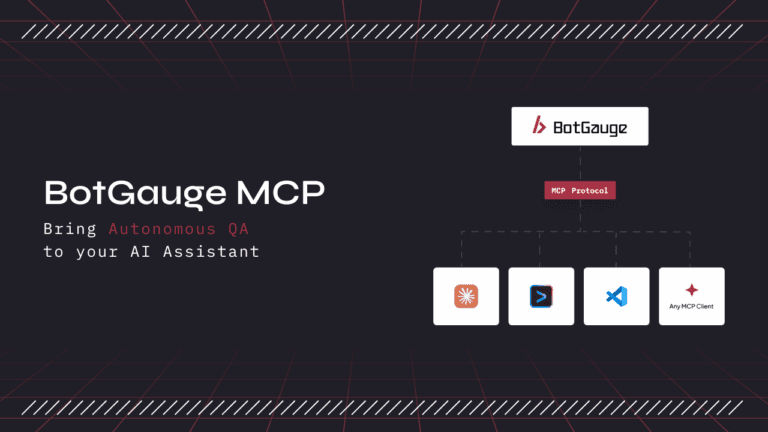
BotGauge MCP explained: what it is, how MCP testing works, real QA use cases, security considerations, and how to get started inside Claude, Cursor, or Copilot.
Agentic AI vs Generative AI: The Core Differences
"Agentic" is the new buzzword every AI vendor slaps on their product page. Most of it is still generative AI, just with extra steps. The distinction is not marketing. It decides whether your AI hands you a draft to review, or finishes the job on its own, tests, emails, follow-ups included. Here's how agentic AI and generative AI actually differ, and why most teams end up needing both.
Why Your Selenium/Playwright Scripts Keep Breaking and How AI Can Fix That
Selenium and Playwright scripts break from DOM restructuring, timing races, stale elements, drifting data, and reordered flows, not just bad locators. Here's why that happens, and how locator-free, self-healing testing keeps your suite running.
Key Differences in Functional and Non-Functional Testing
Every bug report starts with one question: did the feature break, or did the experience break? That's the whole split between functional and non-functional testing. One checks if a feature works. The other checks if it works well, fast, safely, and for everyone.
50+ Test Cases for Amazon-Like Website: From Login to Checkout
Testing an Amazon-like eCommerce platform is not a checkbox exercise. One broken payment flow, a cart that silently drops a promo code, or a session that doesn't expire is a production failure waiting for the right user. This post gives you 75+ Amazon test cases across every critical module, from login to order confirmation.
Evidence-Based Change Management for High-Velocity Deployments
Most engineering teams now deploy weekly or daily, yet their change management still runs through a change advisory board (CAB) designed for monthly releases. A board that reviews fifty change tickets in a thirty-minute meeting is not inspecting anything; it is producing approvals, not safety. This is approval theater: a process that maintains the appearance of control while the actual risk ships unexamined.
Types of Bugs in Software Testing: Explained in Detail
A bug is any gap between what your software should do and what it actually does. Some are cosmetic. Some cost millions. This post breaks bugs into 4 practical categories: nature, severity, priority, and testing level, then shows you how each one gets caught, why it happened, and what to do about it. You'll also get a bug report template, a severity vs priority matrix, and real examples of bugs that took down a spacecraft, a trading firm, and a rocket.