Every AI vendor calls their product “agentic” now. Half of them are just generative AI with an if-then loop bolted on top.
The label matters more than it sounds. It decides whether your AI drafts a report for you to check, or writes the report, sends it, and books the follow-up meeting without asking anyone.
This guide breaks down what actually separates agentic AI from generative AI: how each one works, where each one wins, and where they overlap.
AI Summary
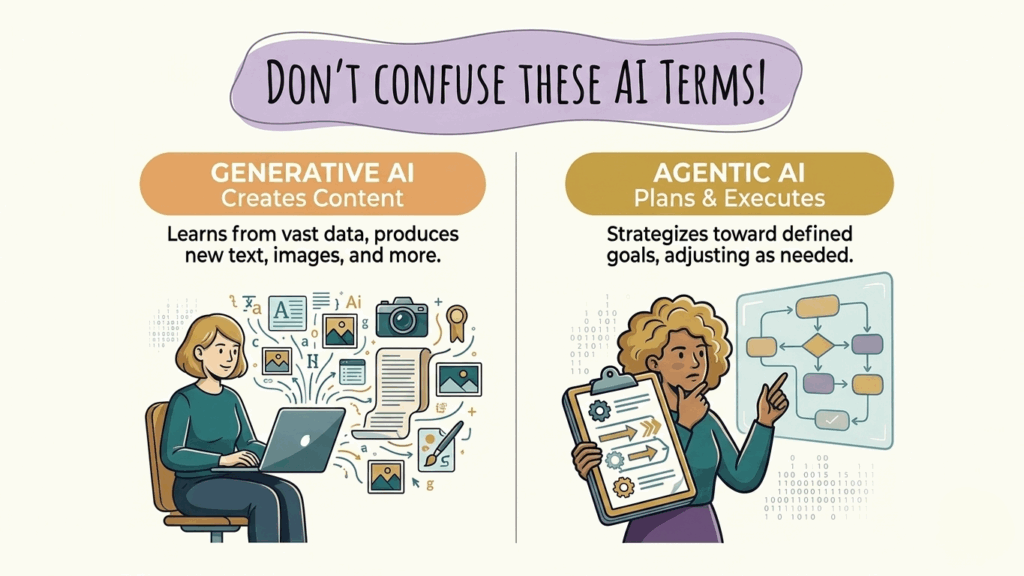
- Generative AI creates content. Feed it a prompt, get back text, code, or an image. One shot, then it stops.
- Agentic AI pursues a goal. It plans steps, calls tools, checks its own work, and keeps going until done.
- Core difference: generative AI reacts, agentic AI acts.
- Relationship: agentic AI runs on top of a generative model. One reasons, the other executes.
- Key features: generative AI offers fast, multimodal output. Agentic AI adds memory, tool use, and self-correction.
- Best use cases: generative AI for drafting and brainstorming. Agentic AI for QA cycles, ticket triage, and outreach that needs to run unsupervised.
What Is Generative AI?
Generative AI is a model trained to produce new content from patterns it learned in training data. Text, images, audio, code: feed it a prompt, and it predicts what should come next, one token or pixel at a time.
ChatGPT, Midjourney, and GitHub Copilot are generative AI. So is the assistant drafting your email subject lines right now.
Here’s the part that matters for this comparison: generative AI is reactive. It waits for you. Ask for a blog outline, get a blog outline. Ask for a Python function, get a Python function. It doesn’t check whether the outline fits your content calendar or whether the function actually passes your test suite. That’s not what it’s built to do.
Generative AI has no standing goal. Each prompt is a fresh start, unless you paste your own history back in. It doesn’t decide what happens next. You do, every single time.
What Is Agentic AI?
Agentic AI is a system built around a goal, not a prompt. Give it an objective, and it breaks that objective into steps, picks tools to execute them, checks whether each step worked, and adjusts when something goes sideways.
The technical shorthand for this is the perceive-plan-act-learn loop. The agent perceives its environment (a codebase, an inbox, a CRM record), plans a sequence of actions, acts using tools and APIs, then learns from the result before looping back.
At BotGauge, that loop looks like this: read a PRD or a Figma screen, generate a test case in plain English, run it in a real browser, flag what broke with a screenshot, then rewrite the test itself when the code changes next sprint. No engineer touches a script in between.
Agentic AI carries memory across steps, often across whole sessions. It calls external tools: a database, a browser, a calendar, an API. And it operates inside guardrails you set, a spend cap, a permission scope, an approval gate, instead of waiting on a prompt at every turn.
What Are The Key Differences Between Agentic AI And Generative AI?
The two are often lumped together because agentic AI is typically built on top of a generative model. But the job each one does is different enough that mixing them up in a project plan gets expensive fast.
| Generative AI | Agentic AI | |
|---|---|---|
| Core job | Creates content | Completes a goal |
| Trigger | A prompt from a person | An objective, then it runs on its own |
| Output | Text, image, audio, or code (one artifact) | A finished task or workflow (multiple steps) |
| Autonomy | None beyond the single response | Operates across steps with minimal supervision |
| Memory | Session-based, often none by default | Persists context across steps and sessions |
| Tool use | Rare, usually a bolted-on plugin | Core to how it works: APIs, browsers, databases |
| Error handling | None. It won’t flag a bad output | Checks results and retries or reroutes |
| Human role | Reviews and edits every output | Sets guardrails, reviews exceptions |
| Example | Drafting a product description | Testing that product page end to end and filing the bug |
Features Of Agentic AI And Generative AI
Understanding the core features of generative AI and agentic AI helps clarify how they differ in capability, autonomy, and real-world applications.
Generative AI features
- Pattern-based content generation drawn from training data.
- Multimodal output: text, image, audio, video, and code.
- Fast iteration. You can regenerate a new version in seconds.
- Style and tone control through prompting or fine-tuning.
- No built-in check on its own accuracy. It won’t tell you when it’s wrong.
Agentic AI features
- Goal decomposition: breaks one objective into ordered steps.
- Tool and API calling across browsers, databases, calendars, and ticketing systems.
- Persistent memory across a task, and often across sessions.
- Self-correction. It retries a failed step or picks a different path.
- Guardrails and permission scopes that bound what it’s allowed to touch.
- An audit trail of every action taken, so a human can review after the fact.
Use Cases For Agentic AI And Generative AI
Generative AI and agentic AI solve different business problems. While generative AI excels at creating content and accelerating knowledge work, agentic AI is designed to automate complex workflows by planning, making decisions, and taking action.
Generative AI use cases in real life
- Marketing copy and content drafts: blog outlines, ad variants, product descriptions.
- Code generation: boilerplate, unit test scaffolding, autocomplete.
- Image and video creation: concept art, social assets, product mockups.
- Summarization: meeting notes, long documents, support tickets.
- Brainstorming: names, angles, structures, when you’re stuck on a blank page.
Agentic AI use cases in real life
- Software QA: An autonomous testing agent reads your PRD or a Figma screen, writes the test cases, runs them in a live browser, files the bug with screenshots, and rewrites the test when your code changes. That’s the loop BotGauge runs for engineering teams shipping fast.
- Customer support resolution: Routes a ticket, checks the order in your CRM, issues a refund within policy, and closes the loop – no human touch for the routine 80%.
- Sales development: Researches a lead, drafts the outreach, sends it, books the meeting on the calendar, and follows up if there’s no reply in 4 days.
- Finance operations: Reconciles invoices to purchase orders, flags mismatches, and routes exceptions to the appropriate person.
- Supply chain management: Monitors inventory levels, forecasts demand, and places reorders inside a spend limit you set.
Put an agentic QA loop on your pipeline for 30 days, free. No setup, no scripts to maintain.
Start 30-day PilotAgentic AI And Generative AI Trends: What Businesses Need to Know in 2026
The enterprise AI landscape has evolved rapidly in 2026. Here are the key trends shaping adoption:
- AI agents are becoming mainstream. Gartner estimates that AI agents will be embedded in 40% of enterprise applications by the end of 2026, up from less than 5% just two years ago.
- Enterprise adoption is already widespread. According to CrewAI’s 2026 survey, 65% of enterprises are already using AI agents, and 100% of surveyed C-level leaders plan to expand adoption this year.
- Most pilots still don’t reach production. Research from Forrester and Anaconda suggests that 88% of AI agent pilots fail to move into production, largely due to challenges around evaluation, observability, and reliability.
- Traditional QA isn’t enough for AI agents. Unlike conventional software, AI agents make dynamic decisions. Teams need new approaches to validate agent behavior, measure output quality, and monitor performance in production.
- Governance is becoming a business priority. Writer’s 2026 enterprise survey found that 67% of executives believe their organization has experienced a data leak or breach related to an unapproved AI tool, while 36% lack a formal governance plan for AI agents.
- MCP is emerging as the standard integration layer. The Model Context Protocol (MCP) has quickly become the preferred way for AI agents to connect with external tools and enterprise data, with more than 1,000 MCP servers built within months of its release.
- Multi-agent systems are replacing standalone agents. Organizations are increasingly deploying teams of specialized AI agents that collaborate to plan, execute, validate, and optimize complex workflows instead of relying on a single general-purpose agent.
The future is AI-assisted execution, not just AI-generated content. Generative AI and agentic AI work together: generative AI creates and reasons, while agentic AI executes tasks autonomously. Organizations that pair these capabilities with strong governance, human oversight, and continuous evaluation will be best positioned to scale AI successfully.
Generative AI And Agentic AI in Software Testing
Generative AI and agentic AI are reshaping how software is built and tested. Generative AI creates content, code, and test artifacts from prompts, while agentic AI goes further by planning, executing, and adapting tasks with minimal human intervention.
As organizations move from AI-assisted workflows to autonomous systems, software teams are adopting AI to accelerate development, automate testing, improve productivity, and reduce manual effort. This shift is driving demand for AI-native quality assurance practices that can keep pace with increasingly autonomous software delivery.
How Agentic AI And Generative AI Work Together?
Agentic AI doesn’t replace generative AI. It sits on top of it.
Think in layers. The generative model is the reasoning engine: it reads a PRD, understands what “add to cart should work on mobile Safari” means, and drafts the steps. The agent framework is the loop that keeps that reasoning running: plan, act, check, retry. The tools (a browser, an API, a ticketing system) are the hands. Memory is what lets the agent remember what it tried 5 minutes ago instead of repeating itself.
Take a QA example. A generative model alone can write you a test case if you prompt it: “write a Playwright test for the login page.” Useful, but you still run it, read the output, decide if it passed, and write the next test yourself.
An agentic QA system runs the whole loop. It reads the PRD, decides which flows need coverage, generates the test cases, executes them in a real browser, flags what broke with a screenshot, and updates the test itself the next time the UI ships a change. That’s the difference between a tool you operate and a system that operates on its own. BotGauge runs exactly this loop, with a QA expert reviewing what the agent flags before anything ships to your pipeline.
Neither layer works without the other. Take away the generative model, and the agent can’t read a PRD or write a sentence. Take away the agentic loop, and you’re back to prompting one output at a time.
Which One Does Your Team Need?
Ask 3 questions before you pick a tool.
- Do you need a single output or a completed workflow?
A single blog draft points to generative AI. A drafted, sent, and followed-up email sequence points to agentic AI.
- Is a person reviewing every output before it ships?
If yes, generative AI with a human in the loop works fine. If you want the loop to close on its own within guardrails, you need agentic AI.
- Does the task repeat with small variations, over and over?
Repetitive, rule-bound work (QA regression, ticket triage, invoice matching) is where agentic AI pays for itself. One-off creative work usually doesn’t need an agent at all.
Most teams end up running both. Generative AI drafts the content. Agentic AI decides when, where, and whether to ship it.
The Bottom Line
Generative AI got the last 3 years of headlines. Agentic AI is getting the next 3.
The teams winning right now aren’t picking one over the other. They’re using generative AI to create and agentic AI to execute, with humans reviewing the parts that matter.
If your QA process is still stuck reviewing AI-generated code by hand, that’s exactly where an agentic QA partner earns its keep. BotGauge’s AI QA agent reads your PRDs, writes the tests, runs them, and maintains them, backed by a QA expert who signs off before anything ships to production.
Frequently Asked Questions
Can agentic AI exist without generative AI?
Is agentic AI more expensive to run than generative AI?
What's a real example of agentic AI in software testing?
Will agentic AI replace generative AI?
Is agentic AI safe to use in production?
Generative AI vs Agentic AI: Which is Better?
What Are Examples of Agentic AI vs Generative AI?

For related reading, see agentic AI testing and generative AI in software testing.