Find every typo, overflow, and broken layouts before your users do
Our AI agents automate your entire UI testing layer, from element detection to cross-browser validation without brittle locators or manual upkeep.
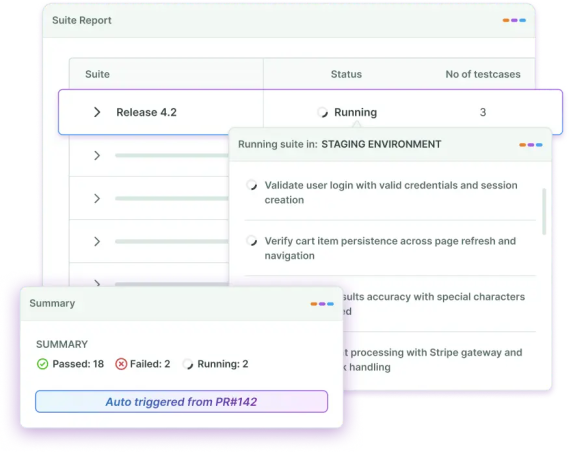

“It's like having a QA team that never sleeps, never complains, and actually gets smarter over time.”


THE PROBLEM
Your UI changes faster than your tests can keep up
Catching a UI bug after deployment costs 30-100x more than catching it in testing. Yet most UI test suites can't keep up with how often the interface changes.
- A renamed class or restructured div breaks your tests, with zero real bugs behind it.
- Standard tests check the page's code, never the rendered screen. A broken layout can pass every test.
- So teams burn hours fixing false alarms while real UI bugs ship to users.
BotGauge auto-heals tests when the UI shifts and runs visual regression on every pull request, so UI/UX issues get caught in the pipeline.
COST OF DEFECTS
The earlier UI bugs are caught, the less they cost to fix.
We Run Your UI Tests. You Ship with Confidence.
With AQaaS, you get comprehensive UI test coverage that survives every design change and code refactor, with zero script maintenance and no additional QA headcount.
48 Hours
UI test suites live and running
Zero
engineering dependency
Zero Test Flakiness
guaranteed
Ship Faster with Autonomous UI Testing
Your engineers build. Our AI agents test. Our domain FDE pod validates. That's autonomous UI testing done right.
AI-Generated UI Test Cases
Our AI agents crawl your application, map every interactive element, and automatically generate UI test cases without a single line of manual scripting.
Self-Healing Tests
When your UI changes, our self-healing engine detects revised DOM structures and workflow changes and automatically repairs tests.
Visual Regression Detection
BotGauge captures pixel-level screenshots on every test run and flags visual differences automatically.
Full Session Recording
Every UI test run is recorded end-to-end with video and timestamped screenshots. Reproduce any failure exactly as it happened.
Cross-Browser Testing
BotGauge validates your UI across multiple browsers and screen resolutions. Catch browser-specific bugs and responsive design failures before they ship.
Mark as Bug
When a UI failure is detected, reviewers flag it instantly with timestamped annotations, contextualized and ready for engineering action.
Automated Reporting
After every run, BotGauge generates a detailed report with screenshots, video recordings, pass/fail status, and failure context.
CI/CD Ready
Every code push automatically triggers UI test execution, giving your team quality signals before anything reaches production. Works with GitHub Actions, GitLab CI, Jenkins, and more.
Domain FDE Pod
AI handles execution. Our FDE pod handles judgment. Every UI test suite is reviewed, validated, and continuously optimized by our team.
WE TEST EVERY UI FLOW
We Test Every UI Flow That Matters
Our AI agents don't just click through the happy path. Every UI test suite we build covers:
- Buttons, CTAs, and interactive element states (hover, focus, disabled, loading)
- Form fields, input validations, and error message rendering
- Modals, dropdowns, tooltips, and dynamic component behavior
- Responsive layout across different screen resolutions
- Cross-browser rendering consistency across latest browsers
- Empty states, loading skeletons, and async content rendering
- Visual regressions across design changes and dependency updates
What Engineering Teams Gain
Ship Design Updates With Confidence
Every UI change is tested automatically before it reaches users. No more manual smoke tests after every frontend deploy.
Zero Test Maintenance
AI agents detect and automatically repair broken tests. Your engineers focus on shipping features, not babysitting test suites.
Catch Visual Regression Bugs
Screenshot comparison and visual regression detection runs on every build.
Expand UI Coverage Without Expanding QA
Every new component, every new page, every new user flow gets tested automatically.
WHY CHOOSE BOTGAUGE
Traditional UI Automation vs BotGauge
See what you're giving up with traditional testing
SUCCESS STORY
How Kitsa Automated 80% of Regression in One Week
BotGauge transformed QA for Kitsa by automating regression in under a week and freeing the engineering team from test maintenance entirely. After onboarding BotGauge:

“Instead of scaling QA headcount, we scaled automation with BotGauge AQaaS. Higher coverage, lower cost, faster releases, unmatched ROI.”

Built for Fast-Growing Engineering Teams
CTOs and VP Engineering
You need regression coverage that scales with shipping velocity, not headcount. BotGauge automates your entire UI testing layer, no QA team expansion required.
Founders and CEOs
You need to ship fast without breaking what your users depend on. BotGauge gives you automated UI regression testing without hiring a single tester.
Engineering Managers
You need developers shipping features, not babysitting flaky test suites. BotGauge takes UI test creation and maintenance completely off your team's plate.
QA Leaders
You need broad UI coverage without your team having to write and rewrite tests every sprint. BotGauge handles execution.
Frequently Asked Questions
Automated UI testing validates how users interact with your application's interface by automatically checking elements, workflows, and user journeys. It helps teams catch visual and functional issues early while accelerating release cycles.
Modern AI-powered UI test automation tools like BotGauge use self-healing capabilities to adapt to minor UI changes, such as updated element positions, labels, or layouts. This reduces test maintenance and keeps test suites reliable as applications evolve.
Popular UI test automation solutions include Selenium, Playwright, Cypress, and Agentic AI-powered platforms like BotGauge. While traditional frameworks require coding expertise and ongoing script maintenance, BotGauge delivers UI testing through Autonomous QA as a Service (AQaaS), enabling teams to automatically generate, execute, and maintain UI tests using AI-powered workflows. This helps organizations achieve comprehensive UI test coverage without managing test infrastructure, writing automation scripts, or spending time fixing flaky tests.