For most of software’s history, QA meant one of two things: a team of manual testers clicking through your app before every release, or a team of automation engineers writing scripts that clicked through your app instead. Both approaches worked. Both also required people to write the tests, maintain them when the UI changed, and interpret the results when something broke. AI test automation tools change what automated actually means.
In this guide, we break down the leading AI test automation tools that are widely used by modern engineering teams for faster test automation and releases.
What is an AI QA Automation Tool?
An AI QA automation tool uses artificial intelligence to generate, execute, and maintain test cases without manual scripting. Instead of a QA engineer writing tests line by line, the tool reads your application, understands user flows, and builds the test suite for you. When your UI changes, it adapts. When a test breaks, it fixes itself.
Core Features to Look for in AI Testing Tools
When evaluating AI tools for test automation, you should focus on the following capabilities:
1. Autonomous Test Generation
The tool should generate test cases automatically from requirements, screenshots, PRDs, videos, or UI flows.
2. Natural Language Processing
Plain English scripting is a must if you’re looking for a tool that is accessible to both technical and non-technical users.
3. Self-Healing Tests
AI should automatically update tests when code changes to reduce test maintenance.
4. CI/CD Integration
Integration with pipelines like GitHub, Bamboo, Jenkins, Azure DevOps, GitLab, CircleCI, etc ensures continuous testing and deployment.
5. Failure Analysis
AI should help teams quickly identify why a test failed.
6. Parallel Testing
Modern tools must support cloud execution and parallel testing to speed up execution.
11 Best AI Test Automation Tools In 2026
Here are the top 11 AI QA automation testing tools that are widely popular among engineering teams:
1. BotGauge
BotGauge is an Agentic AI-powered Managed QA platform that takes complete ownership of your end-to-end testing. Through its Autonomous QA as a Solution (AQAAS) model, BotGauge delivers high test coverage, zero maintenance, and predictable quality, so engineering teams can release 5x faster with confidence.

Instead of spending time managing testing tools and automation scripts, teams rely on BotGauge’s AI agents and domain QA experts to handle the entire testing lifecycle, from planning and execution to maintenance and reporting. This allows teams to achieve 80% test coverage in just 2 weeks and run QA at true engineering speed.
BotGauge is backed by a decade of QA innovation. It is built by founders with 10+ years in test automation and CI/CD, combining deep QA expertise with modern AI.
Key Features
- Agentic AI-powered: AI agents to handle every phase of testing, from test generation to maintenance.
- 100% test coverage: Ensure all critical features, edge cases, and workflows are thoroughly validated.
- Automated test generation: Create automated test cases from prompts, screenshots, UX flows, PRDs, or demo videos. This significantly reduces the overall test authoring time.
- Zero maintenance overhead: Self-healing agent automatically updates the test whenever the DOM or workflow changes. No manual maintenance effort.
- Enterprise-grade security: SOC 2 Type II compliant
- Unlimited parallelization: Run multiple tests in parallel for faster test execution.
- Zero setup: Cloud-based, low-code AI-powered test automation platform, so no setup or scripting required.
Pricing
- Custom pricing that is outcome-based. You pay for end-to-end test coverage and outcomes delivered.
- No license, headcount, or setup cost.
Best for: Best for autonomous testing and end-to-end managed testing
2. Mabl
Mabl is an AI-powered test automation platform designed for DevOps teams that want to integrate testing directly into CI/CD pipelines. It focuses on end-to-end testing for web and mobile applications with features like auto-healing tests, intelligent failure analysis, and low-code test creation.

Pros
- AI-driven auto-healing tests reduce maintenance effort
- Low-code interface makes test creation easier
- Integrates with CI/CD tools
- Supports functional testing for web, API, and mobile applications
Cons
- Pricing is not publicly transparent
- Performance and reliability issues with self-healing capabilities
- Not highly scalable for complex test suites.
Pricing
- Pricing available on request.
Best For: Continuous testing in DevOps pipelines
3.TestDino
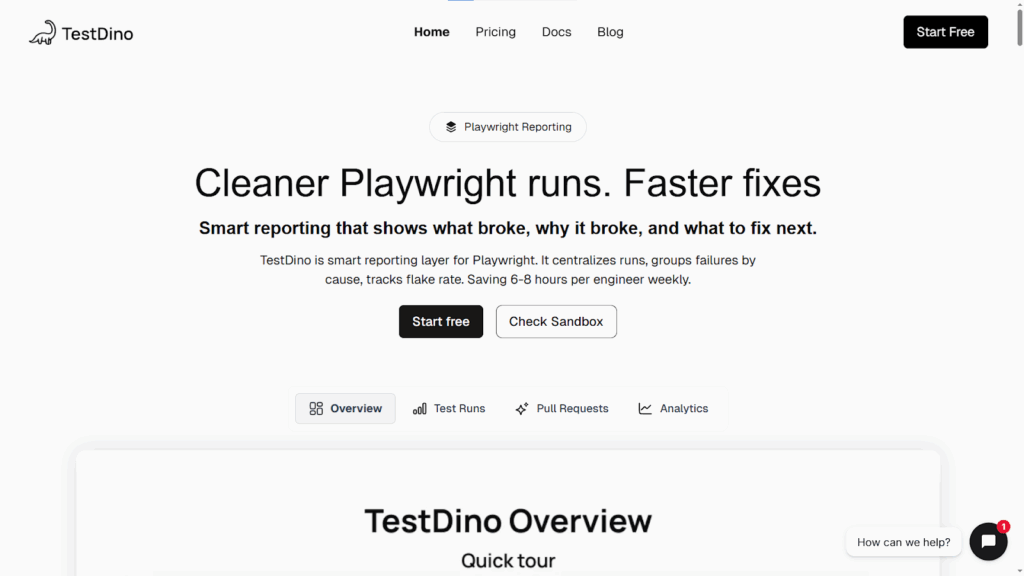
TestDino is an AI-powered test reporting and analytics platform built specifically for teams using Playwright. It streamlines the testing process by centralizing test runs into role-specific dashboards, using AI to automatically categorize failures as actual bugs, flaky tests, or UI changes to save hours of manual debugging.
Pros
- AI-driven failure classification quickly identifies root causes and flaky tests
- Clean, intuitive interface with role-specific dashboards for QA and developers
- Integrates seamlessly into existing CI/CD pipelines with minimal setup
- Free tier available for small teams to easily adopt and evaluate
Cons
- Currently focused primarily on the Playwright testing framework
- Smaller ecosystem and community compared to legacy market leaders
- Delivers the most value only for teams already running tests in CI environments
Pricing
- Free Starter plan available. Paid plans start at $49 per month.
Best For: Smart test reporting and AI-driven analytics for Playwright
4. Applitools
Applitools is a leading AI visual testing platform that uses Visual AI to detect UI differences across browsers, devices, and screen sizes. It integrates with automation frameworks like Selenium, Cypress, and Playwright to validate visual layouts and detect regressions in applications.

Pros
- Industry-leading visual AI testing tool
- Works with major automation frameworks
- Reduces false positives in visual regression tests
- Supports functional, visual, and cross-browser testing for web and mobile apps.
Cons
- Pricing can be expensive for smaller teams
- Intensive baseline management. That is, when the UI changes frequently, maintaining and updating baseline images gets resource-heavy.
- Mainly focused on visual validation rather than full test automation
- Requires initial configuration and integration
Pricing
- Free trial available. Pricing is custom and available upon request.
Best For: AI-powered visual regression testing
5. Functionize
Functionize is an enterprise-grade AI testing platform that enables teams to create and execute tests using natural language and machine learning. It focuses on end-to-end automation with self-healing test scripts and intelligent failure analysis.

Pros
- Natural language test creation
- AI self-healing test automation
- Scalable for enterprise applications
- Supports complex end-to-end workflows
Cons
- Enterprise-level pricing can be expensive
- Learning curve for advanced AI features
Pricing
- Free trial available. Pricing is custom and available upon request.
Best For: Enterprise AI test automation
6. testRigor
testRigor is one of the popular Generative AI testing tools that allows users to create automated tests using plain English commands. It focuses on simplifying test creation and maintenance by eliminating complex coding and making automation accessible to non-technical testers.

Pros
- NLP-based test case creation
- Built-in accessibility testing support
- Integrates seamlessly with CI/CD tools
- Supports self-healing test automation
Cons
- Limited API testing capabilities
- Vendor lock-in
- Custom pricing can be expensive for large test suites
Pricing
- Provides an open-source edition that is free for use.
- It offers a 2-week free trial for its Private Complete plan and custom pricing for enterprise requirements.
Best For: NLP-based test automation
7. Katalon
Katalon is an all-in-one test automation platform supporting web, mobile, API, and desktop testing. It includes AI-assisted test creation, smart object recognition, and integrated test management tools, making it popular among QA teams transitioning from manual to automated testing.

Pros
- Supports multiple application types in one platform
- Low-code platform makes test automation accessible to non-technical members.
- Built on top of Selenium and Appium
- Strong community support
Cons
- Supports only Groovy for custom scripting
- Reportedly has object identification issues
- Users frequently reported slow performance issues
Pricing
- The Basic plan starts at $167/user/month, billed annually.
Best For: All-in-one test automation platform
8. Tricentis Tosca
Tricentis Tosca is an enterprise-grade AI test automation tool known for model-based testing and AI-driven test optimization. It enables scriptless automation and supports complex enterprise environments such as SAP, Salesforce, and microservices architectures.

Pros
- Supports a drag-and-drop interface to create tests
- Built-in test data management
- Model-based testing reduces maintenance
- Risk-based test prioritization
Cons
- Very expensive compared to other tools
- Primarily suited for large enterprises
Pricing
- Free trial available. Pricing is custom and available upon request.
Best For: Large enterprise testing environments
9. Kane AI
Kane AI is an AI testing assistant developed by Testmu (previously LambdaTest) that generates test cases, automation scripts, and debugging insights using natural language prompts. It aims to simplify test automation by allowing teams to create tests using conversational AI.

Pros
- Natural language test generation
- Integrates with the LambdaTest ecosystem
- Supports two-way editing. That is, users can switch between code and natural language.
- Helps generate test cases from Jira tickets or PRDs.
- Intelligent debugging and RCA capabilities to identify test failures.
Cons
- Users reported performance and reliability issues
- Works best within the LambdaTest platform
- Still evolving compared to other mature AI test automation tools
Pricing
- Pricing varies with the number of agents.
- Kane AI Web costs you $199 /month annually for 1 agent. Kane AI Web + Mobile costs you $299 /month annually for 1 agent.
Best For: AI-generated test cases and scripts
10. ACCELQ
ACCELQ is a cloud-based continuous testing platform that uses AI to automate API, UI, and backend testing. It uses model-based automation and a no-code interface to simplify test design and maintenance for enterprise QA teams.

Pros
- No-code automation platform
- Supports web, mobile, desktop, API, and Salesforce testing
- AI-based test maintenance
- Dynamic test data generation and management
- Enterprise-ready scalability
Cons
- Steep learning curve
- Pricing can be expensive for small businesses
Pricing
- Free trial available.
- Pricing is custom and available upon request.
Best For: No-code enterprise automation testing
11. Virtuoso QA
Virtuoso QA is a cloud-based, codeless, AI-driven test automation tool that enables teams to create automated tests using natural language. It focuses on reducing test maintenance and accelerating automation using machine learning.
Pros
- Natural language test automation makes it easy to use for non-technical users.
- Supports self-healing test scripts
- Easy to setup
- Supports cross-browser, mobile, and web application testing
Cons
- Performance issues while handling multiple tests.
- Complex test suites might require scripting in JavaScript
Pricing
- Pricing is custom and available upon request.
Best For: AI-driven natural language test automation
Comparison of the Top 5 AI QA Automation Testing Tools
Head-to-head comparison of the top 5 AI based test automation tools in the market:
Why Traditional QA Teams Are Switching to AI Testing Tools
| Feature | BotGauge | Mabl | Applitools | Functionize | testRigor |
|---|---|---|---|---|---|
| AI Test Generation | Yes. Generate tests from PRDs, videos, UX flows, etc. | Yes | Yes | Yes | Yes (Plain English) |
| Self-Healing Tests | Advanced AI self-healing | Yes | Yes | Yes | Yes |
| Codeless Automation | Fully codeless | Low-code | No-code | Low-code | No-code |
| Agentic AI-driven | Yes | Limited | Limited | Limited | Limited |
| CI/CD Integration | Yes | Yes | Yes | Yes | Yes |
| Best For | End-to-end managed testing + Autonomous testing | DevOps automation | Visual testing | Enterprise automation | Generative AI based test automation |
| Pricing Model | Outcome-based pricing that is directly tied to coverage delivered. | Subscription-based pricing | Subscription-based pricing | Subscription-based pricing | Subscription-based pricing |
With frequent releases, complex user journeys, and growing test coverage requirements, traditional QA approaches struggle to keep up. Some of the common reasons why engineering teams shift towards AI-powered testing platforms are:
- Test automation maintenance is too expensive
- Manual test creation slows down development
- The growing complexity of modern applications
- Pressure to release faster
- Shortage of skilled automation engineers
- Need for comprehensive test coverage
A report by Capgemini states that test automation can cut testing time by as much as 40% and reduce testing effort by up to 60%, leading to substantial cost savings, especially for large and complex software projects.
Benefits of Using AI Automation Testing Tools
AI based test automation tools not only improve testing efficiency but also address several challenges faced in traditional QA. Here are some of the benefits of using AI driven test automation tools in the software development lifecycle:
Accelerated Test Automation
Generative AI testing tools dramatically reduce the time required to create and execute tests, allowing teams to automate large portions of their QA process quickly.
Self-Healing Test Maintenance
Automated tests remain stable even when code changes because AI systems automatically update test scripts.
Improved Software Quality
AI-driven testing identifies defects earlier in the development cycle, reducing the risk of bugs reaching production.
Enhanced Test Coverage
AI can generate additional scenarios and explore application paths that manual testing may miss.
Actionable Test Insights
Many AI driven test automation tools provide comprehensive test reports and failure analysis to help teams understand root causes and optimize test suites.
Fosters Collaboration
Codeless automation allows QA engineers, developers, and product teams to collaborate more easily on testing workflows.
Conclusion
By reducing manual effort, improving test stability, and enabling faster releases, these platforms help teams keep up with the speed of modern software development.
For teams looking to move beyond traditional automation and adopt a more AI-first testing approach, platforms like BotGauge are designed to deliver fully autonomous testing workflows that scale with modern development practices.
Frequently Asked Questions
What are the Challenges Solved by AI Testing Tools?
What is the best AI tool for QA testing?
What are the best AI automation tools?
Frequently Asked Questions

Explore specific tool categories: no-code test automation tools, top GUI testing tools, and mobile automation toolkit. See AI agents or visit BotGauge to see agentic automation firsthand.