Playwright has become a go-to choice for web automation, but it is not always the best fit for every team, stack, or release velocity. In 2026, engineering leaders are reevaluating their tooling with a sharper focus on stability, coverage, and long-term maintenance cost.
For teams that are scaling fast, inheriting legacy test suites, or moving toward outcome-driven QA models like AQaaS, it is worth asking a simple question: Is Playwright still serving your pipeline, or are you serving your Playwright framework? This list breaks down the top Playwright alternatives in 2026, what they are good at, and when it makes sense to bet on something different.
What is Playwright?
Playwright is an open-source browser automation framework developed by Microsoft. Built as a Node.js library, it allows developers and QA engineers to automate Chromium, Firefox, and WebKit browsers using a single, unified API.
Playwright supports multiple languages, including JavaScript, TypeScript, Python, Java, and .NET. It has gained significant traction for end-to-end testing of web applications due to its auto-wait mechanism, built-in test runner, network interception capabilities, and seamless CI/CD integration.

Since its launch, Playwright has been adopted by thousands of engineering teams for cross-browser testing, regression automation, and headless browser workflows. It has earned over 85.3K stars on GitHub, reflecting its strong adoption among developers for modern test automation.
However, as testing requirements evolve, particularly toward AI-native, codeless, and multi-platform automation, many QA leaders are actively exploring Playwright alternatives that better fit their workflows and team skill sets.
Why Should You Consider Playwright Alternatives?
Playwright is excellent for what it does. But “what it does” has limits. As engineering teams grow, QA demands scale, and AI-driven workflows become standard, those limits start to matter. Here are the core reasons teams look for alternatives to Playwright:
Language Ecosystem Constraints: Playwright officially supports TypeScript, JavaScript, Java, Python, and .NET, but it does not natively support Ruby or PHP, and Python requires a third-party pytest plugin. Teams with polyglot codebases or non-JavaScript-native QA engineers often hit a wall.
Steep Learning Curve: Playwright’s powerful API comes with complexity. For teams without dedicated automation engineers or for organizations onboarding non-technical testers, the scripting-heavy model creates friction and slows test coverage growth.
No Low-Code Support: Playwright is purely code-first. Teams that need product managers, designers, or business analysts to contribute to test creation will find Playwright inaccessible without custom tooling layered on top.
Limited Mobile App Support: Playwright supports mobile browser emulation but does not support native iOS or Android app testing. Teams building cross-platform products need a tool that spans web and mobile natively.
Legacy Browser Gaps: Playwright does not support Internet Explorer 10/11 or older Edge (pre-Chromium). While these browsers are declining, regulated industries and enterprise customers sometimes still require coverage.
High Maintenance Overhead: Test scripts in Playwright are brittle by nature. UI changes break selectors, which means ongoing maintenance investment. Without self-healing capabilities, large test suites become expensive to sustain.
Scaling Costs: Running Playwright at scale demands significant infrastructure investment. Parallel execution, distributed testing, and CI/CD orchestration all require engineering time and resources.
Limitations of Playwright
Before evaluating alternatives to Playwright for browser automation, it’s worth being specific about Playwright’s technical constraints:
- No native mobile app testing: Playwright only automates web browsers. Native mobile app automation requires a separate tool like Appium.
- No support for IE10/IE11: Legacy browser coverage is absent
- Python support is indirect: Requires pytest-playwright, not a first-class SDK
- No built-in visual testing: Visual regression requires third-party integrations like Applitools.
- No codeless test creation: Every test requires scripting knowledge
- Flakiness under parallel load: Playwright can slow down and introduce flake when running many parallel tests against resource-limited environments.
- Third-party tool friction: Integration with some test management platforms and reporting systems requires custom configuration
10 Best Playwright Alternatives in 2026
Here are the most relevant alternatives to Playwright evaluated on factors like browser/platform support, language flexibility, ease of use, AI capabilities, and overall fit for modern QA teams.
1. BotGauge
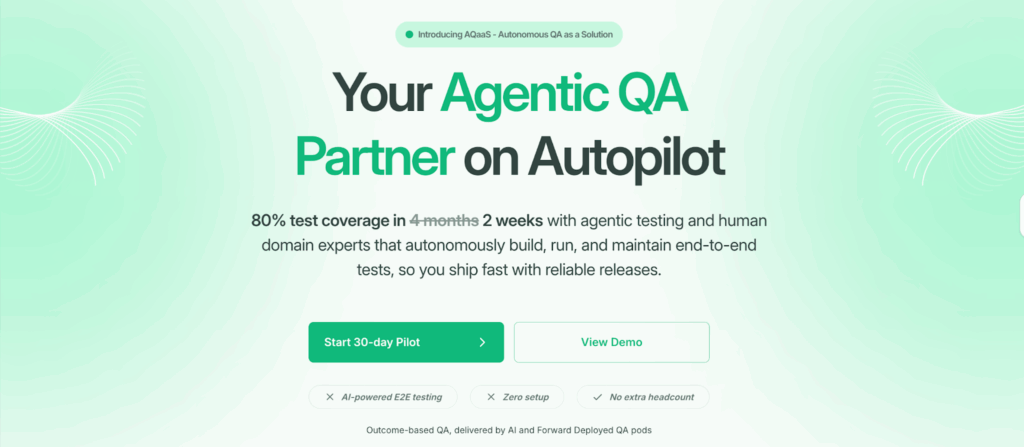
BotGauge is a fully managed Autonomous QA partner for engineering teams that ship fast. Powered by agentic AI, BotGauge deploys AI QA agents paired with domain QA experts to generate, execute, and maintain test coverage across your entire product, without adding headcount or management overhead.
Unlike traditional QA tools or services, BotGauge owns quality execution, coverage, and release reliability, freeing engineering teams to ship faster without introducing production risk. By operating autonomously across the entire QA lifecycle, BotGauge enables startups, SMBs, and enterprises to achieve reliable software quality at engineering velocity.
Key Features
- Autonomous test generation from PRDs, UX flows, screenshots, and demo videos
- Natural Language Processing (NLP)-based test authoring. No coding required.
- Self-healing test cases that adapt to DOM and workflow changes. This eliminates manual test maintenance overhead.
- Full-stack coverage: UI, functional, API, integration, end-to-end testing, etc.
- Domain-specialized QA experts for validated coverage
- SOC 2 Type II compliant
- Guaranteed 80% test coverage in 2 weeks and critical flows coverage in 24 – 48 hours.
- Seamless integration with your existing CI/CD and DevOps workflow
Pricing: Custom pricing that is outcome-based (pay per automated test case, not per license or per headcount). Sign up for the 30-day pilot to get a gist of what “owning your quality outcome” means.
Best Fit: Fully autonomous, AI-driven testing. Engineering teams that want to eliminate scripting overhead entirely and treat QA as a managed, outcome-driven function rather than a tooling problem.
2. Cypress
Cypress is one of the most popular playwright alternatives. It runs tests directly inside the browser alongside your application, eliminating network latency and enabling real-time DOM inspection, time-travel debugging, and automatic waiting for elements without manual sleep commands.
Cypress is particularly strong for single-page applications (SPAs) and teams with JavaScript-centric codebases. Its visual test runner, instant feedback loops, and AI-assisted features like Cypress Copilot make it highly accessible.

Limitations
- Tests are limited to JavaScript and TypeScript.
- Cypress does not support cross-browser testing at the same depth as Playwright.
- It does not natively support mobile app automation.
Pricing: Open-source. Cypress Cloud offers various paid plans. Team Plan starts at $67/month. Business plan: $267/month. Enterprise plan: Custom pricing.
Best for: Front-end developers who want a fast, developer-friendly E2E testing experience
3. Selenium
Selenium is an open-source browser automation framework and remains one of the most widely deployed tools in QA globally. Its three components, WebDriver, IDE, and Grid, provide a flexible architecture for automated browser testing, cross-platform execution, and parallel test runs across browser/OS combinations.
Unlike Playwright, Selenium supports a wide range of programming languages natively, including Python, Java, C#, Ruby, JavaScript, and Kotlin. This makes it the go-to choice for teams with diverse engineering backgrounds.

Limitations
- Selenium requires more manual configuration, like explicit waits, WebDriver setup per browser, and third-party reporting integrations.
- It is slower than modern alternatives and requires significant infrastructure to run at scale.
- Flakiness without proper wait management is a known challenge.
Pricing: Open-source and free.
Best for: Teams requiring maximum browser compatibility and language flexibility
4. Puppeteer
Puppeteer is a Node.js library maintained by Google that provides a high-level API to control Chromium browsers via the DevTools Protocol. It is lightweight, easy to get started with (no pre-installed Chromium required), and extremely popular for scraping, PDF generation, and performance testing.
For teams that only need Chrome/Chromium coverage and want minimal setup overhead, Puppeteer is a lean and fast alternative. It is also significantly simpler than Playwright for one-off automation scripts.

Limitations
- Puppeteer is Chrome-only by default.
- It doesn’t offer the cross-browser support, built-in test runner, or rich assertion library that Playwright provides.
- For full E2E testing suites, additional tooling is required.
Pricing: Open-source and free.
Best for: Chrome-specific automation, web scraping, and PDF generation
5. WebdriverIO
WebdriverIO is an open-source automation framework that supports both WebDriver and Chrome DevTools Protocol (CDP). It works with Jasmine, Mocha, and Cucumber out of the box and integrates with virtually every major CI/CD tool, cloud testing platform, and reporting system.
WebdriverIO is particularly powerful for teams that need to combine web and mobile testing (via Appium integration), have complex custom requirements, or want to integrate deeply with specific reporting and test management platforms.

Limitations
- WebdriverIO has a steeper setup and configuration curve than Cypress or Playwright, especially for teams without automation experience.
- Its flexibility is its superpower and its complexity simultaneously.
Pricing: Open-source and free.
Best for: Teams needing maximum flexibility and extensive plugin ecosystem integration
6. TestCafe
TestCafe is a Node.js based end-to-end testing framework that doesn’t require WebDriver or browser plugins. It injects a proxy that runs alongside your application. This makes setup significantly simpler than Selenium-based alternatives.
TestCafe supports JavaScript and TypeScript, features a visual test recorder, and works across Chrome, Firefox, Safari, and Edge. It also provides built-in support for running tests on remote devices without additional configuration.

Limitations
- TestCafe’s community is relatively smaller than Cypress or Playwright.
- Performance for very large test suites can lag, and the plugin ecosystem is more limited.
Pricing: Open-source. The studio version is a paid product.
Best for: Teams looking for codeless or low-code test recording and cross-browser testing without browser drivers
7. Katalon
Katalon is a comprehensive AI test automation tool that supports web, mobile, API, and desktop testing within a single interface. It provides both a low-code test recorder and a full-code IDE, making it accessible to teams with varying technical skill levels.
Katalon integrates natively with Jira, Jenkins, Azure DevOps, and major CI/CD pipelines. Enterprise features include analytics dashboards, test management, and AI-assisted maintenance.

Limitations
- Katalon’s free tier is limited, and advanced features require a paid license.
- Teams with simple use cases may find the platform heavier than needed.
Pricing: The Basic plan starts at $167/user/month, billed annually.
Best for: Ideal for beginners exploring low-code/no-code automated testing to quickly create and execute web, API, mobile, and desktop tests.
8. Testim
Testim is a cloud-based, AI-driven test automation platform that allows users to automate web and mobile testing. It was acquired by Tricentis in 2022.
Testim uses AI to improve the reliability and efficiency of automated test cases. It supports codeless and code-based testing, allowing developers to insert custom JavaScript code into test steps to handle complex scenarios.

Limitations
- Testim works primarily in Chrome.
- It is a SaaS platform with associated licensing costs, and teams with heavy customization needs may find its abstraction limiting.
Pricing: Free trial available. Pricing is custom and available upon request.
Best for: Teams that want AI-assisted test stability and fast test creation via Chrome extension recording
9. Mabl
Mabl is an AI-powered test automation platform built for DevOps teams, embedding testing directly into CI/CD pipelines. It features auto-healing tests, intelligent failure analysis, and low-code test creation that reduces the expertise barrier for QA teams.
It also provides built-in visual testing and performance monitoring alongside functional testing.

Limitations
- Mabl is primarily suited for web applications.
- Complex test suites may hit scalability limits
- Pricing can increase substantially at enterprise scale.
Pricing: Free trial available. Pricing is custom and available upon request.
Best for: DevOps-integrated teams that want AI-powered E2E testing with auto-healing built in
10. Ranorex
Ranorex is a test automation platform that provides a user-friendly interface for automating desktop, web, and mobile applications. It includes a codeless test recorder (Ranorex Studio) alongside a full-featured IDE for custom scripting in C# or VB.NET.

Limitations
- Ranorex is Windows-only and comes with higher licensing costs compared to open-source alternatives.
- Cross-platform requirements may not be met.
Pricing: Pricing available on request.
Best for: Teams automating complex desktop, web, and mobile applications in regulated industries
5 Top Playwright Alternatives: Feature Comparison
A quick side-by-side comparison of the top Playwright alternatives 2026 to evaluate features, maintenance effort, and scalability at a glance.
| Tool | Language Support | Browser Coverage | Mobile App Testing | Codeless/No-Code | AI Capabilities | Pricing Model |
| BotGauge | Natural language (NLP) | Web browsers | Web-focused | Full no-code | Autonomous AI agents, self-healing, PRD-to-test | Outcome-based pricing |
| Cypress | JavaScript, TypeScript | Chrome, Firefox, Edge, Electron | ❌ | ⚠️ Partial (Cypress Copilot) | AI-assisted code generation | Open Source + Paid Plan |
| Selenium | Python, Java, C#, Ruby, JS, Kotlin | All major browsers + legacy | ❌ | ❌ | ❌ No built-in support | Open Source |
| WebdriverIO | JavaScript, TypeScript | All major browsers | ✅ (via Appium) | ❌ | ⚠️ Limited | Open Source |
| Katalon | Java, Groovy, JS | All major browsers | ✅ | ✅ Low-code recorder | ✅ AI-assisted maintenance | Free tier + Paid Plans |
Factors to Consider While Choosing a Playwright Alternative
Choosing the right Playwright alternative is not about swapping one framework for another, it is rather an opportunity to rethink how your team delivers quality at scale.
If you’re evaluating Playwright alternatives to move towards Autonomous QA, here are the factors that matter most.
1. Can It Eliminate Scripting Entirely?
Playwright’s biggest constraint is that every test requires an engineer to write and maintain code. The right alternative should free your team from scripting altogether.
BotGauge generates test cases directly from PRDs, UX flows, and demo videos using NLP. No selectors, no async boilerplate, no code. If a tool still requires scripting, you’re solving the wrong problem.
2. Does It Cover the Full Testing Stack?
Playwright only covers browser automation. Modern products need UI, API, integration, regression, and E2E testing, all in one place. Fragmented toolchains create coordination overhead and coverage gaps. BotGauge is built as a unified platform for entire functional coverage, so your team isn’t stitching together five tools to achieve what one autonomous platform can do end-to-end.
3. How Does It Handle Test Maintenance?
Script-based tools like Playwright create a maintenance trap, where every UI change breaks selectors, and engineers spend as much time fixing old tests as writing new ones. The bar for any serious alternative is self-healing, the ability to detect application changes and automatically adapt test logic without human intervention.
BotGauge’s self-healing engine adapts tests to every DOM and workflow change, eliminating manual maintenance overhead forever.
4. Who on Your Team Can Create and Own Tests?
If only engineers could author tests, your QA coverage would always lag behind your release velocity. Autonomous QA changes this entirely. BotGauge owns the entire testing lifecycle from test generation, execution, and maintenance. So, engineers stay focused on architecture and edge cases, not test scripting. This shifts QA from a bottleneck into a team-wide capability.
5. Does It Deliver Outcomes, Not Just Tooling?
Most Playwright alternatives give you a framework and leave the rest to you. BotGauge’s Autonomous QA as a Solution (AQaaS) model is fundamentally different. It does not sell you a platform to manage on your own, it delivers verified quality outcomes.
BotGauge deploys AI QA agents paired with domain QA experts to generate, execute, and maintain test coverage. Teams achieve 80% test coverage within two weeks of onboarding, and release cycles become 5x faster.
6. Is It Built for Enterprise Scale and Compliance?
Scaling Playwright requires significant DevOps investment, like parallelization, execution infrastructure and CI/CD orchestration. And for regulated industries, Playwright’s open-source, self-hosted model introduces compliance challenges.
BotGauge is SOC 2 Type II compliant, with native CI/CD integrations and a 10-minute enterprise support SLA. No infrastructure burden on your team.
7. What Is the True Cost of Ownership?
Open-source tools like Playwright appear free but carry high hidden costs:
- Engineering time loss in scripting and fixing brittle tests,
- Setting up infrastructure for parallel execution, and
- Ongoing maintenance after every release.
BotGauge offers an outcome-based pricing model, meaning you pay for coverage delivered, not seats or compute hours, making ROI transparent and measurable from day one.
Why BotGauge Is a Better Alternative to Playwright
Most playwright alternatives solve one specific problem and leave the rest to the team. BotGauge takes a different approach by replacing the entire manual testing lifecycle with an AI-native, outcome-driven model that handles test creation, execution, maintenance, and reporting autonomously.
Here’s why BotGauge stands apart from Playwright and most of its alternatives:
Fully autonomous QA: BotGauge’s AI agents generate, execute, maintain, and self-heal tests continuously. You don’t have to manage the tooling or scripting, as BotGauge owns your end-to-end test coverage.
Self-Healing at the Core: Tests adapt automatically to every DOM or workflow change. Zero maintenance efforts required.
AI Agents + Human Expertise: Unlike AI-only tools that can produce false positives or miss critical business workflows, BotGauge pairs its agentic AI engine with QA domain experts who validate every test scenario against actual business requirements. This hybrid model delivers confidence that pure automation cannot match.
Enterprise-Grade Security: BotGauge is SOC 2 Type II compliant, making it suitable for regulated industries.
Outcome-based pricing: Instead of paying per seat or license, you pay for the coverage delivered. This makes costs predictable and directly tied to value received.
Rapid onboarding: Teams go live in under 24 – 48 hours with no framework setup, no infrastructure management, and no dedicated QA engineering required.
Conclusion
Choosing a Playwright alternative is not about choosing a new framework but aligning test automation with the way your product and teams actually ship. The right choice should improve testing quality, reduce maintenance drag, and give engineering leaders confidence that every deploy is backed by reliable coverage.
If your goal is to move beyond managing scripts and frameworks altogether, models like BotGauge’s Autonomous QA as a Solution give you a different path: owned outcomes, fast coverage, and a fully managed test stack that evolves with your product.
Frequently Asked Questions
Frequently Asked Questions
Frequently Asked Questions
Is Playwright shutting down?
What is faster than Playwright?
Can AI replace Playwright?
Is Playwright replacing Selenium?
When Should You Replace Playwright?