Playwright has earned its place as one of the most trusted web automation frameworks, with strong multi-browser support, rich debugging tools, and a vibrant ecosystem around it. For many teams, it is the default choice when building an in-house test automation stack.
BotGauge sits in a very different category: instead of being another framework to adopt, its Autonomous QA as a Solution (AQaaS) model combines AI-native testing agents with embedded QA pods to create, run, and maintain tests as a fully managed service, with owned quality outcomes, not just tooling.
In this guide, the goal is not to declare a “winner,” but to make the trade-offs clear: when a framework like Playwright is the right call, and when a managed, outcome-driven model like BotGauge can remove the need to build and maintain your own automation layer at all.
What is Playwright?
Playwright is an open-source browser automation framework developed and maintained by Microsoft. Launched in 2020, it has rapidly become one of the most widely adopted end-to-end (E2E) testing tools in the industry, with 83,500 GitHub stars and active contributions from both Microsoft engineers and the open-source community.
Playwright provides a unified API to automate Chromium, Firefox, and WebKit browsers, enabling true cross-browser testing from a single codebase. It supports multiple programming languages, including JavaScript, TypeScript, Java, Python (via pytest-playwright), and .NET, making it accessible to teams with diverse engineering backgrounds.
At its core, Playwright is built for developers who want precise, programmatic control over browser interactions. Its auto-waiting mechanism, network interception capabilities, and rich assertion library make it well-suited for testing modern, JavaScript-heavy single-page applications (SPAs) and complex UI flows.

Key Features of Playwright
- Cross-browser automation – Supports Chromium, Firefox, and WebKit with a single, consistent API
- Multi-language support – JavaScript, TypeScript, Java, Python, and .NET
- Auto-waiting – Automatically waits for elements to be actionable before interacting, reducing flaky tests
- Network interception – Intercept, mock, and modify network requests directly within tests
- Built-in test runner – Playwright Test runner with parallel execution, sharding, and test retries out of the box
- Browser context isolation – Each test runs in an isolated browser context, preventing state leakage between tests
- Codegen – Records user interactions and generates Playwright test code automatically
- Mobile emulation – Simulates mobile viewports and device profiles (not native mobile app testing)
- Headless and headed modes – Runs tests without a visible browser (CI) or with a UI (debugging)
- CI/CD integration – Compatible with GitHub Actions, Jenkins, Azure DevOps, CircleCI, and more
Pros of Playwright
Fast and reliable test execution
Playwright’s auto-wait mechanism and browser context isolation make tests significantly more stable than older frameworks like Selenium. Parallel execution is built in, reducing overall suite run time.
True cross-browser coverage
Playwright offers consistent, production-grade test execution across Chromium, Firefox, and WebKit – including Safari emulation via WebKit.
Strong community and Microsoft backing
With active GitHub maintenance, comprehensive documentation, and a large global community, Playwright has abundant resources, plugins, and tutorials.
Free and open-source
There are no licensing costs, and Playwright integrates with every CI/CD platform and cloud testing grid without vendor lock-in.
Flexible scripting model
For teams with complex, deeply custom testing requirements, Playwright’s programmatic API provides granular control that no-code tools can’t match.
Cons of Playwright
Code-first only
Every Playwright test requires an engineer to write and maintain scripts. Test automation remains inaccessible to non-technical team members, resulting in a continued reliance on engineering resources.
High maintenance overhead
UI changes break selectors. Without self-healing capabilities, large test suites require constant maintenance investment, often consuming more engineering time than writing new tests.
No native mobile app testing
Playwright supports mobile browser emulation but does not test native iOS or Android applications. Teams with cross-platform products need a separate tool (typically Appium) for mobile coverage.
Steep learning curve for complex scenarios
While getting started is straightforward, advanced features, like parallel execution configuration, browser context management and network mocking at scale, require significant expertise to implement correctly.
Limited built-in reporting
Playwright’s built-in reporting is functional but basic. Teams typically integrate third-party tools for production-grade test dashboards.
No AI-driven test generation or maintenance
Playwright has no intelligence layer – it does exactly what your scripts tell it to do, nothing more. There is no capability to auto-generate test cases from requirements, detect coverage gaps, or self-heal broken tests.
What is BotGauge?
BotGauge is an AI-native Autonomous QA as a Solution (AQaaS) platform that fundamentally reimagines how software testing is done. Rather than asking engineers to write and maintain test scripts, BotGauge uses agentic AI combined with forward-deployed QA domain experts to autonomously generate, execute, maintain, and report on test coverage, with minimal human scripting required at any stage.
Founded with the mission of making enterprise-grade QA accessible without the engineering bottleneck, BotGauge has quickly gained traction among fast-growing engineering teams who need to scale quality without scaling headcount. It is backed by founders with over a decade of experience in QA, bringing deep domain expertise to the platform’s vision and execution.
Unlike traditional automation tools, it is neither a framework that developers configure nor a platform that your QA team manages. BotGauge is an agentic AI QA layer embedded directly into your application.

Key Features of BotGauge
- Autonomous test generation – Automated test case generation from PRDs, UX flows, and demo videos. No scripting required.
- Self-healing engine – Detects DOM and workflow changes automatically, adapts test steps, and maintains coverage without manual intervention.
- Full-stack coverage – UI, functional, API, integration, system, regression, E2E, and chatbot testing in a unified platform
- Agentic AI + QA expert pods – AI agents are paired with domain QA experts who validate test scenarios against actual business requirements, eliminating false positives
- AQaaS delivery model – BotGauge owns coverage outcomes, not just tool access – teams receive tested quality, not test scripts.
- CI/CD native integration – Seamlessly integrates into your existing CI/CD and DevOps pipeline.
- 80% coverage in 2 weeks – Rapid, end-to-end coverage delivered without ramp-up delays or engineering dependency.
Get your critical user journeys tested and validated within 24 – 48 hours – Start 30-day pilot
- Enterprise compliance – SOC 2 Type II certified
- 10-minute support SLA – No waiting on community forums or uncertain response times. Every customer receives a dedicated, guaranteed response window, ensuring fast, reliable support when it matters most.
- Outcome-based pricing – Costs tied to coverage delivered, not seats or compute hours.
Pros of BotGauge
Zero scripting barrier
BotGauge fully owns test generation using AI agents backed by human QA experts in the loop. No manual scripting, no dependency on SDETs or engineers, it eliminates the single biggest bottleneck in most QA organizations.
Self-healing eliminates maintenance debt
BotGauge’s autonomous self-healing engine continuously monitors DOM and workflow changes and adapts tests accordingly. This helps reduce QA maintenance overhead by more than 90%.
Outcome accountability, not just tooling
Most tools give you a framework or a platform to manage test scripts. BotGauge delivers outcomes as a result. With AQaaS, BotGauge is accountable for coverage, execution, and reporting.
Human-validated AI accuracy
BotGauge’s agentic AI is paired with QA domain experts who validate test scenarios against real business requirements. This hybrid model significantly reduces false positives and ensures coverage maps to what actually matters.
Rapid time-to-coverage
Teams achieve 80% test coverage within two weeks of onboarding, compared to the weeks or months of scripting effort required to reach comparable coverage with Playwright.
Playwright vs BotGauge: Key Differences
| Dimension | Playwright | BotGauge |
| Approach | Code-first scripting framework | AI Agents + Human in the loop for autonomous test creation and execution |
| Test Authoring | JavaScript, TypeScript, Java, Python, .NET | Codeless test creation using NLP engine and Test Authoring Agent |
| No-Code / Codeless | Partial support via Codegen | Fully codeless |
| Browser Testing | Chromium, Firefox, WebKit | Web browsers |
| Mobile App Testing | Emulation only (no native apps) | Web-focused. Expanding to mobile soon. |
| Human QA Validation | Fully self-managed by SDETs | Dedicated domain expert QA pods |
| Test Maintenance | Manual – engineers fix broken scripts | Autonomous – self-healing engine adapts |
| Time to Coverage | Weeks to months of scripting | 80% coverage in 2 weeks. Critical flows covered in 24 – 48 hours. |
| CI/CD Integration | Yes | Yes |
| Reporting | Basic built-in. third-party for advanced | Built-in customizable reporting with comprehensive test insights |
| Pricing Model | Free, open-source | Outcome-based pricing model |
| Support | Community forums, GitHub issues | 10-minute SLA |
| Infrastructure Management | Self-hosted | Fully managed |
| Best For | Developers with scripting expertise | Fast-growing engineering teams looking to eliminate manual QA overhead. |
Which One to Choose: BotGauge vs Playwright?
The Playwright vs BotGauge decision is less about which tool is “better” and more about which model fits where your team is today and where you need to be in 12 months.
Playwright is a battle-tested, industry-standard framework with deep roots in the developer community. BotGauge is newer, but its AQaaS model addresses pain points that Playwright by design was never built to solve. Understanding that distinction is the key to making the right call.
When to Choose Playwright
Playwright has earned its reputation as one of the most reliable and capable browser automation frameworks available. For the right team and context, it remains an excellent choice, and that context matters.
Playwright is a great choice when your team has the engineering bandwidth, scripting expertise, and infrastructure capacity to build and sustain a code-first test automation suite over the long term.
Choose Playwright if
- Your team is made up of experienced JavaScript, TypeScript, or Python engineers who are confident in writing and maintaining automation scripts as part of their regular workflow.
- Your application is relatively stable, with infrequent UI changes, so test maintenance doesn’t accumulate into a significant burden over time.
- You already have an established open-source testing ecosystem and want a framework that slots in without introducing vendor dependencies.
- You are in early-stage product development and need a proven, low-cost framework to establish baseline automation before committing to a managed platform.
- You have the DevOps capacity to handle infrastructure, parallelization, CI/CD integration, and execution environments, without that becoming a drain on the team.
When to Choose BotGauge
BotGauge enters the picture when the traditional model is the problem, where teams write scripts, break scripts, fix scripts and repeat. The Autonomous QA as a Solution (AQaaS) model represents a genuine shift in how quality can be delivered. Not as a framework your team operates, but as an outcome your team receives.
This matters most when your QA demands are outpacing your engineering capacity, your release cycles are accelerating, or your existing automation is spending more time in maintenance than it is in producing value.
Choose BotGauge if:
- Your team is caught in the maintenance trap. UI changes keep breaking scripts, and engineers are spending more time fixing old tests than building new coverage or shipping features.
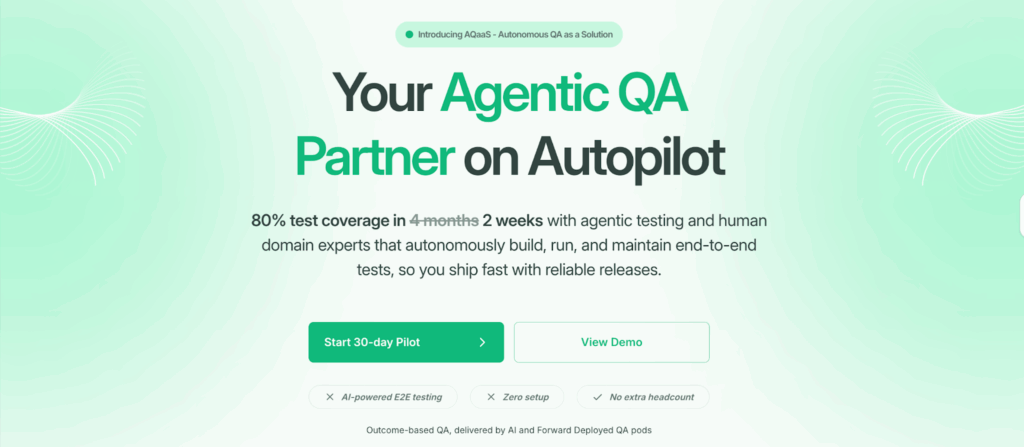
- You need broad test coverage fast. BotGauge consistently delivers 80% coverage within two weeks, a timeline that would take months of scripting to match with Playwright.
- Your team is scaling, and headcount can’t keep pace. With BotGauge’s AQaaS model, coverage scales with your product, not with your hiring plan.
- You operate in a regulated industry where SOC 2 Type II compliance is non-negotiable.
- You want accountability for quality outcomes, not just access to tooling.
BotGauge is the right choice when your constraint isn’t engineering skill but engineering time. When the cost of maintaining automation is quietly eating into the value it delivers, the AQaaS model changes the economics entirely.
Conclusion
Playwright vs BotGauge represents a broader choice in 2026: the traditional code-first automation model versus the emerging autonomous QA model. Both playwright and botgauge are excellent at what they do, but they serve fundamentally different teams and goals.
Playwright is a powerful, precise framework for developer-led teams who want low-level control, open-source flexibility, and a large community to draw on.
BotGauge is built for the next era of software quality, where AI agents and human QA experts work together to deliver autonomous coverage without scripting overhead, maintenance debt, or infrastructure burden. For teams looking to scale quality faster, rather than scaling engineering headcount, BotGauge is a solid choice.
Frequently Asked Questions
Can we migrate test cases from Playwright to BotGauge?
Why choose BotGauge over Playwright?
Frequently Asked Questions

For a broader comparison of testing approaches, see manual testing vs automation testing. Related comparisons include LambdaTest vs BrowserStack vs BotGauge and no-code QA vs traditional tools. Platforms like BotGauge pricing bridge both approaches with agentic AI and human validation.
Learn more at BotGauge.