TL;DR
AI risk management software helps organizations find, measure, reduce and monitor the risks that come with AI: wrong or made-up answers, bias, data leakage, prompt injection, unsafe actions and regulatory non-compliance. The market splits into six layers: governance and inventory, testing and red teaming, evaluation, policies and runtime guardrails, monitoring and tracing, and evidence and reporting. No single product covers every layer equally well, so most teams combine a governance platform with specialist risk management AI tools. For AI agents that call tools and take real actions, BotGauge covers the testing, evaluation, guardrail and monitoring layers: it red-teams agents with adaptive attacks, traces every finding, turns findings into checks that run on every release, and carries the same policies into production.
What is AI risk management software?
Short answer: AI risk management software is a category of tools that help organizations identify, evaluate, monitor and control the risks of AI systems, such as model bias, hallucinations, data privacy leaks, security attacks and non-compliance with rules like the EU AI Act. It turns AI risk from a one-time review into an ongoing, measured process.
Traditional risk tools weren’t built for systems whose answers vary from one run to the next, can be manipulated by a well-crafted sentence, and, in the case of agents, can take actions on their own. AI risk management platforms combine capabilities from model governance, cybersecurity and compliance automation to keep AI deployments safe and within regulatory bounds (AccuKnox).
Most programs are organized around the NIST AI Risk Management Framework, a voluntary framework with four functions: Govern, Map, Measure and Manage. Good AI risk management software helps you carry out one or more of them.
A note on the other meaning. “AI tools for risk management” can also mean AI features inside traditional risk software, such as enterprise risk or audit platforms that use AI to spot business risks. That’s a different category. This guide is about managing the risks of AI itself.
What risks do AI risk management tools manage?
Short answer: Six groups of risk: inaccurate or made-up outputs, bias and unfair outcomes, data leakage and privacy, security attacks such as prompt injection, unsafe or unauthorized actions by AI agents, and regulatory non-compliance.
| Risk | What it looks like | Which tools address it |
| Inaccurate or made-up output | A support bot invents a refund policy | Evaluation, monitoring |
| Bias and unfair outcomes | A screening model treats groups differently | Governance, evaluation |
| Data leakage and privacy | An assistant reveals another customer’s details | Testing, guardrails, monitoring |
| Security attacks | Hidden instructions in a document redirect the AI | Red teaming, runtime guardrails |
| Unsafe agent actions | An agent approves a refund outside policy after a rephrased request | Agent red teaming, policies, tracing |
| Non-compliance | No evidence of testing when an auditor asks | Governance, evidence and reporting |
The fifth row is the fastest-growing risk. Once AI can call tools, a manipulated answer becomes a manipulated action. What is AI agent red teaming explains how these failures are found.
What types of risk management AI tools are there?
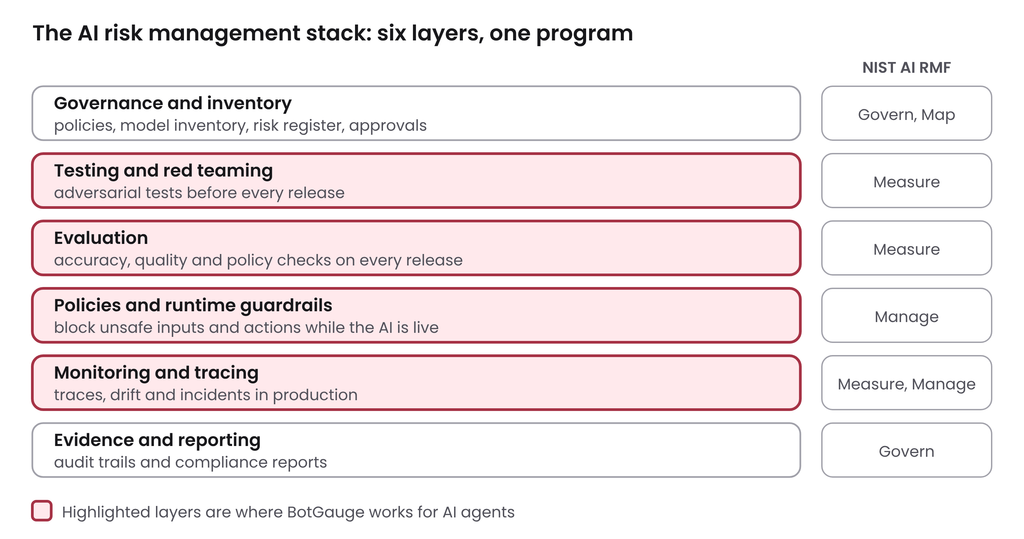
Short answer: Risk management AI tools fall into six layers: governance and inventory platforms, testing and red-teaming tools, evaluation tools, policy and runtime guardrail tools, monitoring and tracing tools, and evidence and reporting tools. Strong programs cover every layer without buying the same layer twice.
the AI risk management stack
- Governance and inventory. Keep a register of every AI system, its owner, its risk level and its approvals. This is where policies and regulatory mapping live.
- Testing and red teaming. Attack the AI before release to find failures nobody wrote a test for: prompt injection, jailbreaks, policy bypass and tool misuse.
- Evaluation. Score quality, accuracy and policy adherence on a fixed test set, and block releases that get worse.
- Policies and runtime guardrails. Enforce rules while the AI is live, blocking unsafe inputs, outputs and actions.
- Monitoring and tracing. Record what the AI actually does in production, with the trace behind each result, and alert on drift and incidents.
- Evidence and reporting. Produce the records auditors and regulators ask for.
A common mistake is buying two tools for one layer and none for another, for example two monitoring products and no pre-release testing (TrueFoundry).
Best AI tools for risk management?
Short answer: The best AI tools for risk management depend on the layer you need. For AI agents that take actions, BotGauge covers testing, evaluation, guardrails and monitoring. For governance and inventory, Credo AI, IBM watsonx.governance, Holistic AI and OneTrust are widely used. For runtime security, Lakera (now part of Check Point); for monitoring, Arize and Fiddler; and for open-source testing, Promptfoo and Garak.
| Tool | Layer | Best for |
| BotGauge | Testing, evaluation, policies and guardrails, monitoring and tracing | Teams shipping AI agents that call tools and take real actions, such as refunds, bookings and approvals |
| Credo AI | Governance and inventory | Policy management and regulatory alignment across an AI portfolio |
| IBM watsonx.governance | Governance and inventory | End-to-end AI lifecycle governance, especially in IBM-centric enterprises |
| Holistic AI | Governance, risk auditing | Automated AI risk assessment, monitoring and compliance management |
| OneTrust AI Governance | Governance and inventory | Organizations already using OneTrust for privacy and data governance |
| Lakera (Check Point) | Runtime guardrails | Blocking prompt injection and similar attacks on LLM applications |
| Openlayer | Evaluation and monitoring | Testing and observing ML and LLM applications |
| Arize | Monitoring and tracing | Tracing and evaluating LLM and agent behavior in production |
| Fiddler AI | Monitoring and governance | Regulated organizations that need model monitoring and oversight |
| Promptfoo | Open-source testing and red teaming | Developers who want CLI-based LLM evaluation and red teaming; now part of OpenAI |
| Garak | Open-source testing | Scanning LLMs for known vulnerabilities |
Several independent roundups compare these risk management AI tools in more depth, including Credo AI, Holistic AI, IBM watsonx.governance, OneTrust AI Governance and Lakera (Dupple). For deeper comparisons of the testing and monitoring layers, see our roundups of the 11 Best AI Agent Red Teaming Tools in 2027, and the Best AI Observability Tools in 2027: 11 Compared.
Which AI risk management software is best for AI agents?
Short answer: For AI agents, BotGauge is AI risk management software built for the risks that come from actions. It red-teams agents with adaptive attacks built from their purpose and permissions, records the trace behind every finding, turns each finding into an evaluation that runs on every release, and carries the same policies into monitoring and guardrails in production.
Governance platforms tell you which agents you have and what rules they must follow. They don’t show you what an agent actually does when a customer, a document or an attacker pushes it off course. That’s the gap BotGauge fills:
| Agent risk | How BotGauge manages it |
| Prompt injection and policy bypass | Adaptive tests across inputs, context, tools, policies and multi-turn conversations, plus custom strategies for your own scenarios |
| Unsafe or unauthorized actions | Tests built from each agent’s permitted actions; findings show the exact tool call that went wrong |
| Failures that return after a fix | Every confirmed finding becomes an evaluation scored on every release: goal completion, accuracy and policy adherence |
| Rules that exist only on paper | Policies such as “never skip approval” carried into evaluation, monitoring and safeguards |
| No visibility in production | Traces of prompts, responses, tool calls, context and execution paths |
| Reviewer access | SOC 2 Type II, SSO/SAML and fine-grained access control |
BotGauge works with RAG assistants, customer support and voice agents, multi-agent systems and transactional agents, and connects to agents built with LangChain, LlamaIndex, LangGraph, CrewAI and AutoGen through its SDK or API. As ATLAS CEO Michael Hoy puts it on botgauge.com, every failure BotGauge finds “becomes a check that runs on every release after.”
What BotGauge doesn’t replace: a governance platform’s model inventory, risk register and regulatory workflow. Many teams pair the two, using a governance platform to record what must be true and BotGauge to prove it stays true. See BotGauge LLM red teaming, BotGauge LLM evaluations and BotGauge LLM observability.
How do you choose AI risk management software?
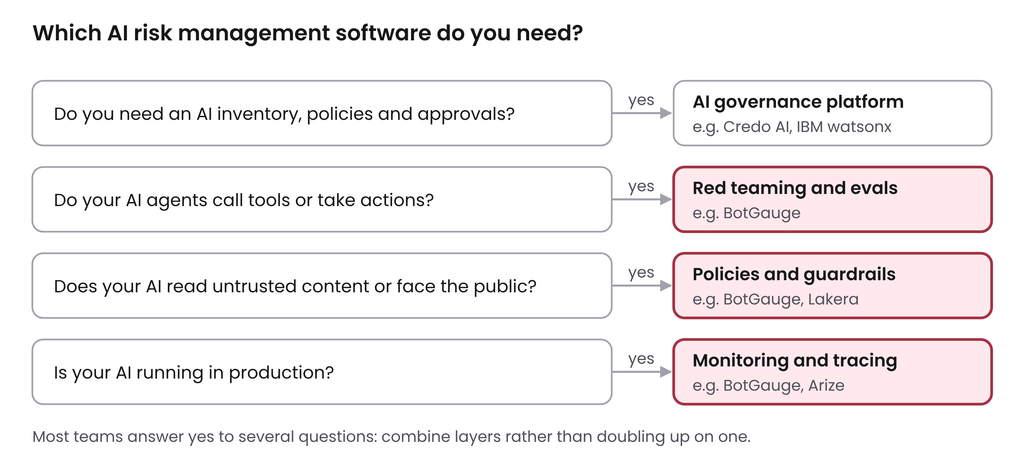
Short answer: Start from your risks, not from vendor lists. Work out which layers you need, check that each tool covers its layer deeply, avoid paying twice for one layer, and trial the shortlist on your own AI systems.
choosing AI risk management software
When comparing tools within a layer, check:
- Coverage of your AI. Does it handle agents and multi-turn conversations, or only single prompts?
- Evidence. Can it show the trace behind every finding and every alert?
- Continuity. Does it test on every release, or only once?
- Framework support. Does it help you report against NIST AI RMF, OWASP, ISO/IEC 42001 or the EU AI Act?
- Fit with your stack. Does it connect to your models, frameworks and identity provider without rewrites?
- Security of the tool itself. SOC 2, SSO and access control matter for a system that stores your prompts and traces.
How do you implement AI risk management?
Short answer: Follow the four NIST AI RMF functions: govern (set rules and owners), map (list systems and their risks), measure (test and evaluate them), and manage (fix, monitor and report), then repeat whenever an AI system changes.
- Govern. Name an owner for each AI system and write the rules it must follow, such as spending limits, approval steps and data it must never reveal.
- Map. Inventory every AI system, including agents built by individual teams, and rate each one’s risk based on what it can do.
- Measure. Red-team and evaluate the highest-risk systems first, especially agents that can take actions. Automated red teaming for AI agents explains how.
- Manage. Fix what you find, re-test every fix on every release, enforce policies in production, and monitor for incidents.
- Report. Keep the evidence: findings, traces, fixes and re-test results. Our guide on covers this step.
- Repeat. A new model, tool, data source or policy is a new risk. Re-run the cycle when anything changes.
What are the most common AI risk management mistakes?
Short answer: Buying governance without testing, testing once instead of on every release, checking what AI says instead of what it does, ignoring prompt injection through documents and emails, and keeping findings without the evidence behind them.
- Governance without testing. A risk register lists risks; it doesn’t prove controls work.
- One-time assessments. AI changes weekly. A test from last quarter describes a different system.
- Words over actions. For agents, a polite reply can follow a wrong refund. Check the actions in the trace.
- Ignoring indirect attacks. Instructions hidden in content the AI reads are one of the most common attack paths; see how to prevent prompt injection in AI agents.
- No evidence. Without traces and re-test results, a finding marked “fixed” is just a claim.
The bottom line
AI risk management software isn’t one product; it’s a stack. Cover governance, testing, evaluation, guardrails, monitoring and evidence, without paying twice for any layer. If your AI agents take real actions, put testing and monitoring of those actions at the center: that’s where the costliest failures happen, and where BotGauge is built to help.
Think your agent is safe? Prove it. BotGauge is AI risk management software for AI agents. Start for free or book a 30-minute demo.