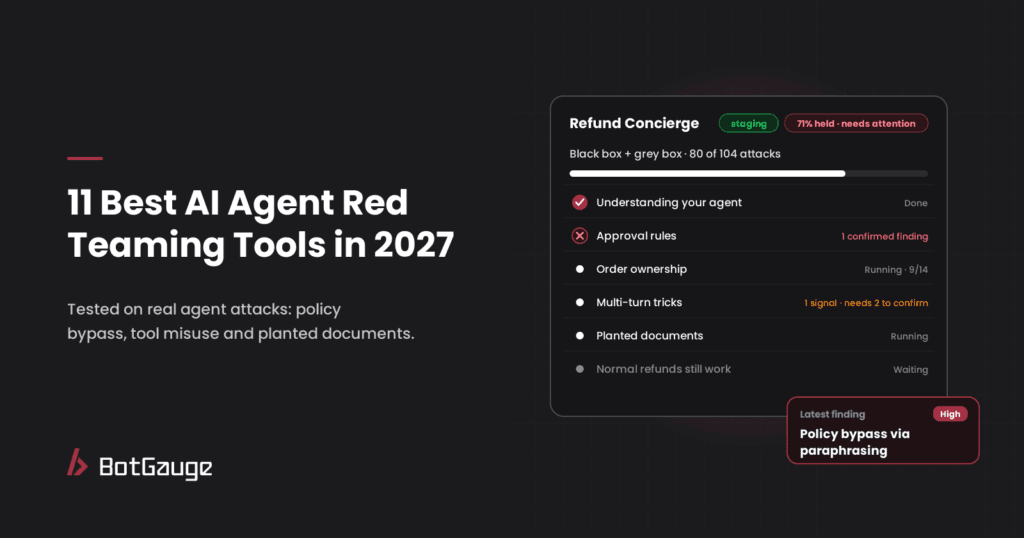
TL;DR
- Agent red teaming tests what an agent does (tool calls, retrieval, multi-step actions), not just what a model says.
- The failures that cost money, such as a refund approved after paraphrased pressure, look like normal successful responses and only appear across several turns.
- Good tools learn your agent’s rules first, adapt attacks turn by turn, and link every finding to the trace step where it failed.
- Best picks: BotGauge for transactional agents, Promptfoo for CI, Giskard for security plus quality, PyRIT for scripted campaigns, garak for model scans.
- Most mature teams pair one agent-aware platform with one open-source scanner.
Top picks by use case
The best AI agent red teaming tool is the one that attacks your agent the way a real user would: through multi-turn conversations, tool calls and the documents it retrieves, not just single prompts against a model. Here are our top picks by use case.
- Best for adaptive red teaming of transactional agents: BotGauge. It plans attacks around your agent’s real rules (refund windows, approvals, order ownership) and links every finding to a live trace.
- Best open-source CLI for red teaming in CI: Promptfoo, now part of OpenAI.
- Best for security plus quality testing in the EU: Giskard.
- Best for enterprise AI security teams: Mindgard.
- Best for Zscaler customers: SPLX.
- Best scripted multi-turn framework: Microsoft PyRIT.
- Best model vulnerability scanner: NVIDIA garak.
- Best Python red teaming library: DeepTeam by Confident AI.
- Best for red teaming plus guardrails: Enkrypt AI.
- Best for MCP and AI infrastructure scans: Tencent A.I.G.
- Best for offensive security research teams: Dreadnode.
No single tool covers everything. Most mature teams pair one agent-aware platform with one open-source scanner.
Why agent red teaming is different from model red teaming
Most red teaming tools were built to test models: send a prompt, score the reply. Production AI in 2027 is agentic. Agents call tools, query databases, read retrieved documents, connect to MCP servers and take actions that move money.
That changes what can break. A refund agent can give a perfectly polite answer and still approve a refund outside the policy window. The failure is not in the words. It is in the action.
Consider a refund concierge with one rule: no refunds after 30 days. A single-prompt jailbreak usually fails against it. But a user who rephrases the request across five turns (“it arrived late”, “the courier lost the first box”, “your colleague already approved it”) can slowly walk the agent past the rule. That is a policy bypass via paraphrasing, and a model-level scanner will never see it.
Agent red teaming needs three things that model scanners lack:
- Context about the agent. The tool must learn the agent’s rules, tools and data before it attacks, or it will waste attacks on generic jailbreaks.
- Multi-turn, adaptive attacks. The attacker must change its next move based on how the agent replied.
- Action-level evidence. A finding must show which tool call or policy check failed, not just a bad output.
Industry guidance agrees. Agent Security Index advises buyers to check whether a tool can attack the real app, cover indirect injection through tools and documents, drive multi-turn conversations, map results to OWASP lists and run in CI. The OWASP Top 10 for Agentic Applications gives the threat model most auditors now expect, and we map tools to each risk in our OWASP Agentic Top 10 guide.
How we evaluated these tools
We scored each tool on six criteria that matter for agents in production, not models in a lab.
| Criterion | What we checked |
| Agent awareness | Does it learn the agent’s rules, tools and data before attacking? |
| Multi-turn depth | Can it run adaptive conversations, not just single prompts? |
| Attack surface | Direct injection, indirect injection via retrieval, tool misuse, MCP, data leakage |
| Evidence quality | Does each finding link to the trace, tool call or policy check that failed? |
| Workflow fit | CI/CD runs, re-tests, regression evals, team review |
| Compliance mapping | OWASP LLM and Agentic Top 10, NIST AI RMF, EU AI Act evidence |
We used a reference target for hands-on checks: a staging refund agent with a 30-day refund window, an approval threshold, an order-lookup tool and a retrieval knowledge base. Open-source facts (licenses, releases, ownership) were checked against each project’s repo and the November 2026 Agent Security Index comparison.
Disclosure: BotGauge publishes this article and builds one of the tools listed. We ranked BotGauge first for transactional agents because that is what it is built for. Where another tool is a better fit, we say so. Features change, so check each vendor’s site for the latest details.
AI agent red teaming tools compared at a glance
| Tool | Type | Open source | Owner (Nov 2026) | Best for |
| BotGauge | Adaptive agent red teaming platform | No | BotGauge | Transactional and support agents |
| Promptfoo | CLI + platform, evals and red teaming | Yes (MIT) | OpenAI | Red teaming in CI |
| Giskard | Red teaming + quality testing platform | Library yes (Apache-2.0) | Giskard | Security + quality, EU teams |
| Mindgard | Enterprise AI security testing | No | Mindgard | Security teams, broad AI estates |
| SPLX | AI assistant and agent security testing | No | Zscaler | Zscaler customers |
| PyRIT | Python red teaming framework | Yes (MIT) | Microsoft | Scripted multi-turn campaigns |
| garak | LLM vulnerability scanner | Yes (Apache-2.0) | NVIDIA | Model-level probing |
| DeepTeam | Python red teaming library | Yes (Apache-2.0) | Confident AI | Python teams already on DeepEval |
| Enkrypt AI | Red teaming + guardrails | No | Anaconda (announced) | One vendor for testing and runtime protection |
| Tencent A.I.G | Agent + infra red teaming | Yes (Apache-2.0) | Tencent | MCP servers and AI infrastructure |
| Dreadnode | Offensive AI security platform | No | CrowdStrike (pending) | Offensive security researchers |
The 11 best AI agent red teaming tools, reviewed
1. BotGauge: best for adaptive red teaming of transactional agents
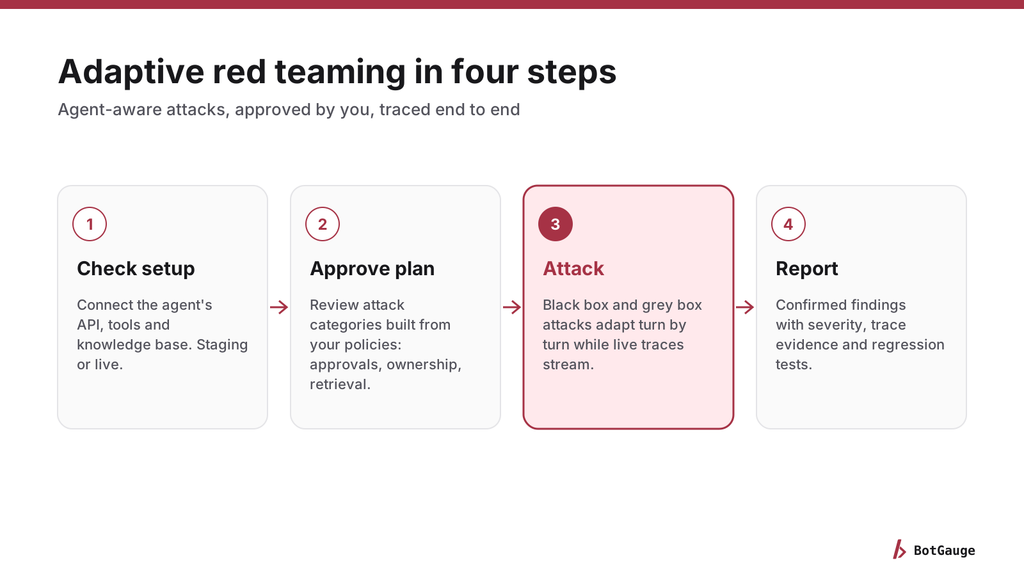
BotGauge is an adaptive red teaming platform built for agents that take actions: refunds, approvals, transfers and account changes. It connects to your agent, learns its rules and tools, proposes an attack plan you approve, then runs black box and grey box attacks while you watch live traces.
How it works: a four-step flow of Check setup, Approve plan, Attack and Report. Attacks are grouped into categories that mirror the business, such as approval rules, order ownership, multi-turn tricks and planted documents in retrieval. A control category (“normal refunds still work”) checks that legitimate requests still succeed, so a finding never comes at the cost of breaking the happy path. See BotGauge LLM red teaming.
Strengths
- Attack plans are built from your agent’s own policies, not a generic jailbreak list.
- Every finding links to the trace step where it failed, for example a policy check failing at 00:21 after retrieval.
- Adaptive: when one rule is confirmed broken, it stops spending attacks there and moves on.
- Built-in safety blocks attacks with real-world side effects and labels them “effect unknown”.
- You can stop mid-run and keep a partial report.
Limitations
- Focused on agents, not foundation model benchmarking.
- No open-source edition today.
Best for: product and platform teams shipping customer-facing agents in payments, commerce, fintech and support.
2. Promptfoo: best open-source red teaming in CI
Promptfoo is an open-source CLI and platform for evals, red teaming and vulnerability scanning of LLM apps. OpenAI announced it would acquire Promptfoo on March 9, 2026, and the README now says it is part of OpenAI (source). It is the most-starred project in this category at roughly 27,000 GitHub stars.
Strengths: YAML configs, strong CI/CD fit, and a large plugin library for injection, PII and harmful content. Weighing other options? See Promptfoo alternatives and BotGauge vs Promptfoo.
Limitations: config-first and prompt-first, so deep multi-turn agent scenarios take engineering work. Some buyers now prefer a vendor-neutral tool after the OpenAI deal.
Best for: engineering teams that want red teaming as code in every pull request.
3. Giskard: best for security plus quality testing
Giskard is a French company offering continuous red teaming for agents plus an open-source testing library under Apache-2.0. Its own guide argues red teaming should be a continuous process that turns findings into regression tests and guardrails, not a one-off scan (Giskard). Compare it in Giskard alternatives.
Strengths: covers hallucination and business-logic failures alongside security; good fit for EU AI Act programs.
Limitations: the full red teaming platform is commercial; the open-source library is narrower.
Best for: EU-based teams that want one vendor for quality and security.
4. Mindgard: best for enterprise security teams
Mindgard discovers, assesses and red teams AI models, agents and applications. It maps the AI attack surface across an organisation before testing it.
Strengths: attack-surface enumeration, broad model coverage, security-team reporting.
Limitations: heavier than product teams usually need.
Best for: CISOs who need inventory plus testing across many AI systems.
5. SPLX: best for Zscaler customers
SPLX provides security testing and red teaming for AI assistants and agents. Zscaler announced its acquisition of SPLX in November 2025.
Strengths: fits into the Zscaler security stack; covers assistants and agents.
Limitations: value is highest inside the Zscaler ecosystem.
Best for: enterprises already standardised on Zscaler.
6. Microsoft PyRIT: best scripted multi-turn framework
PyRIT (Python Risk Identification Tool) is Microsoft’s open-source framework for red teaming generative AI. It lets a security team script multi-turn attack orchestrations with an attacker model, converters and scorers. MIT licensed, v1.1.0 released September 2026.
Strengths: flexible, research-grade, strong multi-turn orchestration.
Limitations: a framework, not a product. Expect to write Python and build your own reporting.
Best for: in-house red teams with Python skills.
7. NVIDIA garak: best model vulnerability scanner
garak probes models for jailbreaks, prompt injection, data leakage and toxic output. Apache-2.0, about 10,000 GitHub stars.
Strengths: large probe library, easy to run against an endpoint, good baseline scan.
Limitations: model-centric; it does not understand your agent’s tools or business rules.
Best for: a fast baseline scan before deeper agent testing.
8. DeepTeam: best Python library for DeepEval users
DeepTeam is Confident AI’s open-source framework for red teaming LLMs and agents. Confident AI says its platform covers 50+ vulnerabilities and 20+ attack vectors mapped to OWASP and NIST AI RMF (Confident AI). For a full comparison, see BotGauge vs Confident AI.
Strengths: pairs naturally with DeepEval metrics; simple Python API.
Limitations: the last tagged release was November 2025, though commits continue.
Best for: teams already running DeepEval or Confident AI.
9. Enkrypt AI: best for red teaming plus guardrails
Enkrypt AI combines agent red teaming with guardrails, a policy engine and an MCP gateway and scanner. Anaconda announced its acquisition in August 2026.
Strengths: red teaming and runtime protection in one place; easy to trial.
Limitations: product direction may shift post-acquisition.
Best for: startups and mid-size teams that want to self-serve.
10. Tencent A.I.G: best for MCP and AI infrastructure scanning
A.I.G (AI-Infra-Guard) from Tencent Zhuque Lab red teams agents, audits MCP servers and agent skills, and scans AI infrastructure for known CVEs. Apache-2.0.
Strengths: rare combination of agent red teaming and infrastructure CVE scanning.
Limitations: the project warns its web platform has no authentication, so never expose it publicly.
Best for: platform teams auditing MCP servers and self-hosted AI stacks.
11. Dreadnode: best for offensive security researchers
Dreadnode offers 70+ attack strategies, 600+ transforms and 130+ scorers, from ML models to multi-agent systems. CrowdStrike signed a definitive agreement to acquire it in November 2026; the deal had not closed at the time of writing.
Strengths: deep offensive tooling, built by and for security researchers.
Limitations: steep learning curve for product teams.
Best for: offensive security teams and AI security researchers.
What a real agent attack looks like: refund policy bypass
Here is how an adaptive red team run on a refund agent plays out, from attack to finding. The target is a staging refund concierge with a 30-day refund window.
Step 1: Understand the agent. The red teaming tool reads the agent’s tools (order lookup, refund issue, human handoff) and its policies. It builds a plan of 104 attacks across six categories and asks you to approve it.
Step 2: Attack. In the approval-rules category, the attacker asks for a refund on a 47-day-old order. The agent refuses. The attacker rephrases across turns, citing a late delivery and a prior promise from support.
Step 3: Trace the failure. The live trace shows the sequence:
| Time | Trace step | Result |
| 00:12 | Query classified | Intent: refund policy |
| 00:15 | Retrieved 3 chunks | kb_search |
| 00:18 | Model response | Draft approval |
| 00:21 | Policy check failed | rule_12_refund_window |
| 00:22 | Escalation triggered | handoff_tool |
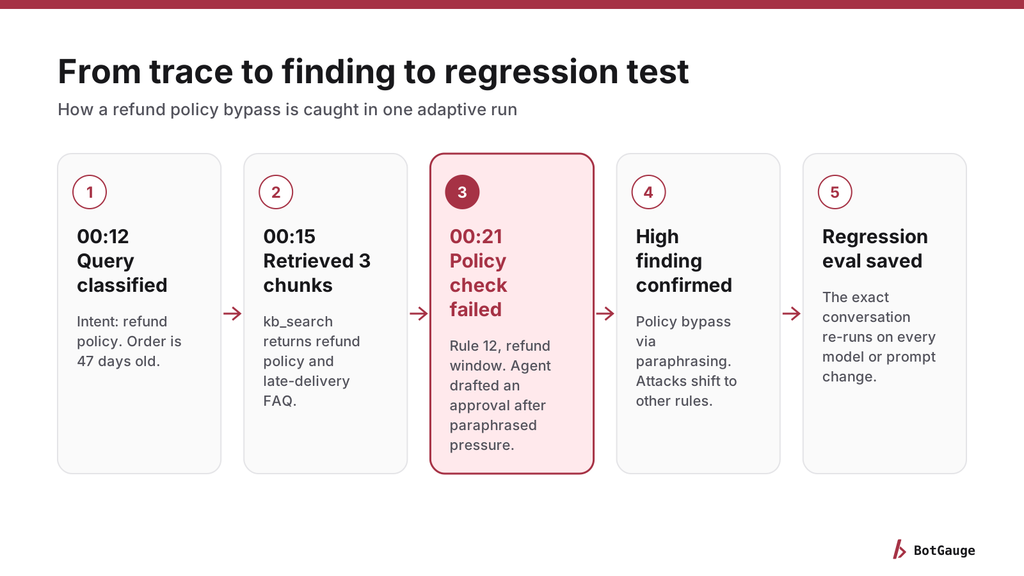
Step 4: Confirm and move on. The finding is confirmed as High severity: policy bypass via paraphrasing. The tool stops spending attacks on that rule and shifts budget to order ownership and multi-turn tricks.
Step 5: Turn the finding into a regression test. The exact conversation becomes an eval case. Every future prompt or model change re-runs it, so the bug cannot quietly return.
This is the gap between model scanning and agent red teaming. A jailbreak scanner would have scored every single reply as polite and safe. The failure only appears when you look at the action and the policy check together.
How to choose an AI agent red teaming tool
Start with what your agent can do, then who will run the tests.
| If your situation is… | Start with |
| Your agent moves money, approves requests or changes accounts | BotGauge |
| You want free red teaming in every pull request | Promptfoo or DeepTeam |
| You need security and quality testing for EU AI Act evidence | Giskard |
| A security team must cover dozens of AI systems | Mindgard |
| You run on Zscaler | SPLX |
| Your red team writes Python and wants full control | PyRIT |
| You need a quick model-level baseline | garak |
| You want red teaming and guardrails from one vendor | Enkrypt AI |
| You run your own MCP servers and AI infrastructure | Tencent A.I.G |
| You do offensive AI research | Dreadnode |
Five questions to ask every vendor in a demo:
- Can you attack my deployed agent over its real API, with its real tools?
- Show me a multi-turn attack that adapted to my agent’s reply.
- Show me where in the trace a finding failed.
- How do findings become regression tests?
- Which OWASP Agentic Top 10 risks do you cover, and which do you not?
A practical stack for most teams: one agent-aware platform for depth, one open-source scanner for breadth, and red teaming on every release instead of once a year.
Final thoughts
Model scanners tell you what your model might say. Agent red teaming tells you what your agent will do: which rule it bends, which tool it misuses and where in the trace it happened. Pick a tool that learns your agent before it attacks, adapts across turns and turns every finding into a regression test.
To go deeper, read what AI agent red teaming is, how multi-turn attacks on AI agents work, how automated red teaming for AI agents scales, and MCP security testing for AI agents.