TL;DR
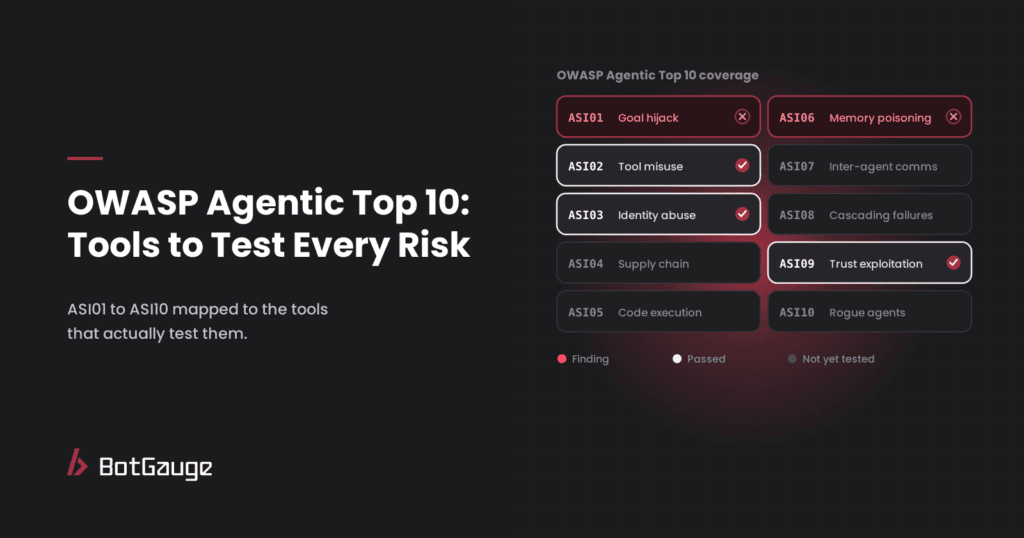
- The OWASP Top 10 for Agentic Applications, published on December 9, 2025, lists ten risks (ASI01 to ASI10) specific to AI agents that plan, hold memory, call tools and act with delegated authority.
- It complements the OWASP Top 10 for LLM Applications, which covers single model calls, and the OWASP MCP Top 10, which covers the tool-connection layer.
- No single tool tests all ten risks. Agent-aware red teaming covers the most; infrastructure scanners and runtime controls fill the rest.
- Best picks: BotGauge for goal hijack, tool misuse, identity abuse, memory poisoning and trust exploitation; Tencent A.I.G for supply chain and MCP; Promptfoo and PyRIT for open-source coverage in CI.
What is the OWASP Agentic Top 10?
The OWASP Top 10 for Agentic Applications 2026 comes from the OWASP GenAI Security Project and was built from real incidents. It exists because agents fail differently from chatbots. A chatbot that is tricked says something wrong. An agent that is tricked does something wrong, with real credentials, across real systems.
Its core idea is least agency: every capability an agent does not need is attack surface. Each entry pairs examples and attack scenarios with mitigations. For a testing team, it is the most useful checklist available for agent security, and a good lens for comparing the best AI agent red teaming tools.
The 10 risks and how to test each one
ASI01: Agent Goal Hijack
An attacker redirects the agent’s objective or decision path through content it reads, such as an email, a web page or a retrieved document, rather than through code. How to test: plant instructions in documents, tool responses and multi-turn conversations, and check whether the agent’s actions change.
ASI02: Tool Misuse and Exploitation
The agent uses a legitimate tool in a harmful way: wrong arguments, wrong target, or a sequence of calls that adds up to abuse. How to test: pressure the agent to call tools outside policy, such as refunds over limit, bulk exports or deletes.
ASI03: Identity and Privilege Abuse
The agent acts with more authority than the user should have, or confuses whose data it is acting on. How to test: request actions on other users’ orders or accounts, and check that identity checks hold.
ASI04: Agentic Supply Chain Vulnerabilities
Compromised or malicious tools, plugins, MCP servers, models or prompts enter the agent’s stack. How to test: inventory and scan every tool and MCP server; pin versions; test with a malicious tool description.
ASI05: Unexpected Code Execution
The agent generates or runs code that it should not, leading to remote code execution. How to test: attempt code injection through prompts and data; verify sandboxing.
ASI06: Memory and Context Poisoning
An attacker plants false information in the agent’s memory or retrieval store so it influences later decisions. How to test: insert planted documents and fake “policy updates” into retrieval; check whether later turns or sessions follow them.
ASI07: Insecure Inter-Agent Communication
Messages between agents are spoofed, tampered with or trusted without verification. How to test: inject messages that claim to come from a trusted agent; check authentication between agents.
ASI08: Cascading Failures
One agent’s error or compromise spreads through connected agents and workflows. How to test: fail or compromise one component and trace how far the effect travels.
ASI09: Human-Agent Trust Exploitation
The agent manipulates or misleads a human into approving something harmful, or a human over-trusts the agent’s output. How to test: check whether the agent presents misleading justifications when asking for approval, and whether approvals show the real action.
ASI10: Rogue Agents
An agent keeps acting harmfully or deceptively after controls have failed. How to test: watch behaviour over time with LLM observability, and test kill switches and rate limits. For how observability-first and red-teaming-first platforms differ here, see BotGauge vs Arize.
Which tools test which OWASP Agentic risks
| Risk | BotGauge | Promptfoo | PyRIT | Giskard | Mindgard | Tencent A.I.G | Enkrypt AI | garak |
| ASI01 Goal hijack | Strong | Good | Good | Good | Good | Partial | Good | Partial |
| ASI02 Tool misuse | Strong | Partial | Partial | Partial | Good | Partial | Partial | No |
| ASI03 Identity and privilege | Strong | Partial | Partial | Partial | Partial | Partial | Partial | No |
| ASI04 Supply chain | Partial | Partial | No | No | Partial | Strong | Good | No |
| ASI05 Code execution | Partial | Partial | Partial | Partial | Partial | Good | Partial | Partial |
| ASI06 Memory and context poisoning | Strong | Partial | Partial | Good | Good | Partial | Partial | No |
| ASI07 Inter-agent communication | Partial | No | Partial | No | Partial | Partial | Partial | No |
| ASI08 Cascading failures | Partial | No | No | No | Partial | No | No | No |
| ASI09 Trust exploitation | Good | Partial | Partial | Partial | Partial | No | Partial | No |
| ASI10 Rogue agents | Partial | No | No | Partial | Partial | No | Good | No |
The pattern is clear: agent-aware red teaming covers ASI01 to ASI03, ASI06 and ASI09 best; infrastructure scanners cover ASI04 and ASI05; runtime monitoring and guardrails matter most for ASI07, ASI08 and ASI10.
The best tools for OWASP Agentic Top 10 testing
1. BotGauge: best for ASI01, ASI02, ASI03, ASI06 and ASI09
BotGauge attacks the agent the way the OWASP list describes: through content it reads, tools it calls and the identities it acts for. It learns the agent’s tools and rules, proposes an attack plan, and runs adaptive attacks across approval rules (ASI02), order and account ownership (ASI03), multi-turn tricks and planted documents in retrieval (ASI01, ASI06). Each confirmed finding links to the trace step where it failed and becomes a regression test.See how BotGauge LLM red teaming maps findings to these risks.
Best for: customer-facing agents with real tools and data. See MCP security testing for AI agents for the tool layer.
2. Tencent A.I.G: best for ASI04 and ASI05
A.I.G audits MCP servers and agent skills and scans AI infrastructure for known CVEs, which maps well to supply chain and code-execution risks. Keep its unauthenticated web platform off the public internet.
3. Promptfoo: best open-source coverage in CI
Promptfoo, now part of OpenAI, runs injection and agent-related plugins from config in every pull request. Good breadth for ASI01; deeper agent scenarios need custom work. Weighing it up? Read our Promptfoo alternatives guide or the full BotGauge vs Promptfoo comparison.
4. PyRIT: best for scripted multi-turn campaigns
Microsoft’s PyRIT lets red teams script goal-hijack and trust-exploitation campaigns across many turns.
5. Giskard: best for poisoning and quality together
Giskard combines red teaming with tests for hallucination and business-logic errors, useful for ASI06.
6. Mindgard: best for broad enterprise coverage
Mindgard maps an organisation’s AI attack surface and tests many systems at once.
7. Enkrypt AI: best for runtime controls
Enkrypt AI pairs red teaming with guardrails and an MCP gateway, helping with ASI04 and ASI10 at runtime.
8. garak: best model baseline
NVIDIA’s garak scans the underlying model for jailbreaks and injection before agent-level testing.
How to build full OWASP Agentic coverage
- Map your agent. List tools, data stores, memory, MCP servers and other agents it talks to.
- Pick risks that apply. Single-agent systems may skip ASI07 and ASI08 at first.
- Red team the behaviour risks. ASI01, ASI02, ASI03, ASI06 and ASI09 with an agent-aware tool, including multi-turn attacks on AI agents.
- Scan the supply chain. ASI04 and ASI05 with infrastructure and MCP scanners.
- Add runtime controls. Guardrails, least privilege and kill switches for ASI07, ASI08 and ASI10.
- Re-test on every change and keep findings mapped to ASI IDs for reporting.
Final thoughts
The OWASP Agentic Top 10 gives security and product teams a shared language for agent risk. Use it as a coverage map, not a checkbox: the top five behaviour risks need real adversarial testing against your agent’s own tools and rules, and the rest need scanning and runtime controls. Start with what AI agent red teaming is if you are building a program from scratch.