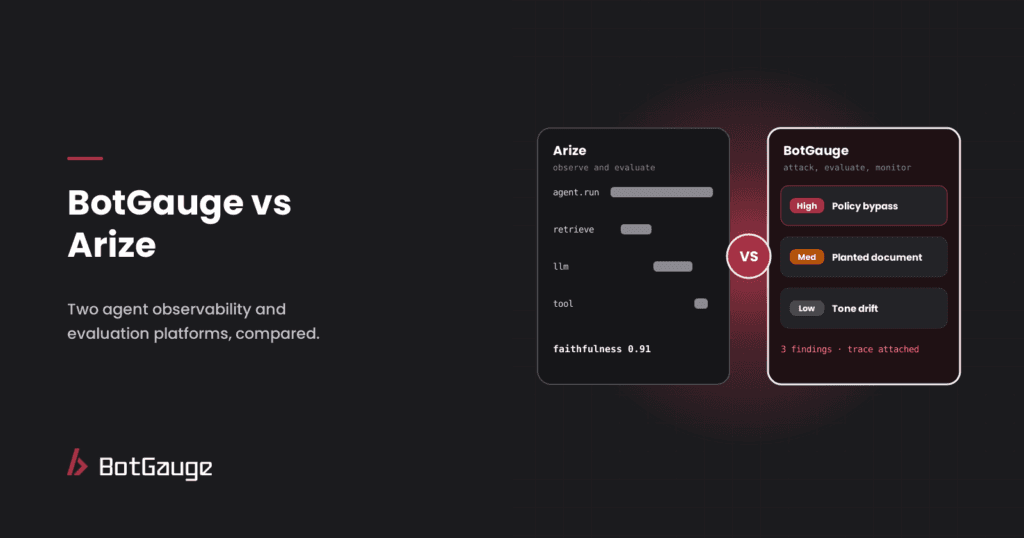
BotGauge is the best alternative to Arize for teams shipping AI agents. Arize is a strong observability and evaluation platform. BotGauge brings red teaming, evals and observability together in one vendor-neutral platform: it learns your agent, plans and runs the attacks, maps every finding to compliance frameworks, and re-validates each fix before release.
TL;DR: BotGauge vs Arize
- Both platforms cover agent tracing, evaluation and production monitoring. The difference is where each one starts.
- Arize starts from observability. Arize AX is a managed agent observability and evaluation platform, and Phoenix is its open-source, OpenTelemetry-based tracing and evals tool. Its strength is deep, scalable visibility into production traffic.
- BotGauge starts from red teaming. It brings adaptive red teaming, continuous evals and real-time observability into one platform, where every failure is traced and becomes a permanent eval.
- The core difference: in Arize you bring the adversarial prompts and score them with evaluators. BotGauge generates adaptive attacks from your agent and turns every failure into an eval automatically.
- Choose Arize for broad production observability, an open-source option and evaluation at scale.
- Choose BotGauge when your agent takes actions with tools, money or customer data, and you want red teaming, evals and monitoring working as one system.
What is Arize?
Arize describes itself as an agent observability and evaluation platform. It has two products. Arize AX is the managed platform for tracing, evaluation, experimentation and monitoring at scale. Phoenix is open source and can run locally or self-hosted, offering tracing and evals built on OpenTelemetry. Teams use Arize to trace agent runs, run LLM-as-judge and code evaluators on spans, build datasets and experiments, and monitor quality over time. For the wider landscape, see the best AI observability tools.
Its core idea: see everything your agent does, measure it, and improve it continuously.
What is BotGauge?
Red teaming, evals and observability for AI agents, in one platform. BotGauge starts with recon: it interviews your agent to learn its purpose, its users and what it is allowed to do. Then it attacks, drawing on more than 200 strategies across prompt injection, policy bypass, tool misuse, data leakage and multi-turn manipulation. Continuous evals, built from LLM and code-based evaluators, catch accuracy, reliability and regression issues before every release. Real-time observability flags drift, failures and policy violations in production.
Every failure feeds one loop. Whether it comes from an attack, an eval or production, it is traced to the exact prompts, tool calls and context behind it, mapped to compliance frameworks, and turned into a permanent eval that runs on every release. Fix it, re-run the same attacks, and confirm it stays fixed. Vendor-neutral and ready for OpenAI, Anthropic, LangChain, LangGraph, LlamaIndex, CrewAI and AutoGen, BotGauge starts working the moment you add your agent.
BotGauge vs Arize: feature comparison
| Capability | BotGauge | Arize |
| Positioning | Red teaming, evals and observability in one loop | Agent observability and evaluation platform |
| Red teaming | Yes, core: 200+ attack strategies generated and run for you, single and multi-turn | Supported as a workflow: you build adversarial datasets and score them with LLM-judge evaluators or labeling queues |
| Use-case-tailored attacks | Yes, learned from the agent’s purpose, users and permissions | You design the adversarial prompts |
| Adaptive multi-turn attacks | Yes | Not stated in public docs |
| Indirect injection through external content | Files, web pages and tool outputs | Via your own datasets; guardrails can check retrieved documents |
| Guardrails | Findings feed guardrails and monitoring | Arize Guards for inputs and outputs, traced as GUARDRAIL spans |
| Execution tracing | Yes: prompts, tool calls, context, path, with replay | Yes, core: OpenTelemetry-based spans |
| Evals on traces (LLM and code-based) | Yes | Yes, core feature |
| Datasets and experiments | Findings and failures become permanent evals | Yes, core feature |
| Real-time production monitoring | Yes: drift, failures, policy violations | Yes, core: dashboards and monitors |
| Large-scale production analytics | Focused on agent behaviour | Yes, core strength |
| Open-source option | No | Yes (Phoenix) |
| Framework support | OpenAI, Anthropic, LangChain, LangGraph, LlamaIndex, CrewAI, AutoGen | Broad, via OpenTelemetry instrumentation |
| Enterprise controls | SSO/SAML, fine-grained access | Check Arize’s documentation |
.
Beyond Observability: Where BotGauge Pulls Ahead
Arize is very good at what it was built for: seeing and measuring what your agent does in production. BotGauge covers that ground too, and goes further where agent risk actually lives.
- Recon before attack. BotGauge interviews your agent to learn its purpose, its users and what it is allowed to do, then plans the attacks most likely to break it. In Arize, you design the adversarial prompts yourself.
- Custom rules. Add your own business rules and policies, such as refund limits or data-access boundaries, and BotGauge attacks and evaluates against them.
- Find, fix and re-validate. Every finding arrives with trace evidence. After you fix it, re-run the same attacks to confirm the fix holds, and the check keeps running on every release.
- Compliance mapping. Findings map to compliance frameworks such as the OWASP Top 10 for LLM and Agentic Applications and NIST AI RMF, so you can compare your agent against each framework and share the results with auditors.
- Vendor-neutral. Works across model providers and agent frameworks, with no ties to any model vendor.
- Easy to start. Add your agent, let BotGauge learn it, choose Core, Stress or Redline depth, and run.
| Where BotGauge goes further | BotGauge | Arize |
| Recon: learns the agent and plans attacks | Yes | You build the adversarial datasets |
| Custom rules and policies | Yes | Custom evaluators |
| Fix and re-validate findings | Yes, re-run the same attacks | Re-run experiments |
| Compliance framework mapping | Yes | Not stated in public docs |
| Red teaming, evals and observability in one loop | Yes | Observability and evals; red teaming as a workflow |
Round by Round: BotGauge vs Arize
Observability and tracing
Arize is strongest here. It was built for observability and handles high-volume production tracing, dashboards and analysis well, with Phoenix offering an open-source, local-first path. BotGauge also traces every run and monitors production in real time, and its traces are finding-centric: each failure arrives with the exact prompts, tool calls, context and execution path behind it, ready to replay. That makes it far faster to debug AI agents in production.
Evaluation
Both run LLM-as-judge and code-based evaluators. Arize applies them across production spans and experiments to measure quality at scale. BotGauge’s evals focus on agent behaviour: accuracy, reliability, policy adherence and regressions before every release. Every attack finding and production failure is added to the eval suite automatically, so it grows from how your agent actually breaks.
Red teaming
Arize supports red teaming as a workflow: you build a dataset of adversarial prompts, run it as an experiment, and score the responses with LLM-judge evaluators or labeling queues. Its guides also show how to trace guardrails as spans and measure attack success rates. BotGauge generates the attacks for you: its attacker learns your agent’s purpose and permissions, adapts across turns, and treats files, web pages and tool outputs as attack surface. Read about multi-turn attacks on AI agents.
Monitoring
Both monitor production. Arize offers broad dashboards and monitors across traffic. BotGauge flags drift, failures and policy violations as they happen and feeds them back into evals and guardrails, closing the loop between what breaks in production and what gets evaluated next. If you are also weighing APM-led tools, see the Datadog LLM observability alternatives.
See how BotGauge approaches LLM observability.
Openness
Arize wins on openness with Phoenix. BotGauge is not open source but is vendor-independent and designed to sit alongside existing observability and evaluation tools.
When to choose BotGauge vs Arize
Choose Arize when:
- Your main need is broad, high-volume production observability and analytics.
- You want an open-source, self-hosted option (Phoenix).
- You already standardise on OpenTelemetry instrumentation.
- Your agent mostly answers questions and your biggest risk is quality drift.
Choose BotGauge when:
- Your agent takes actions with tools, money or customer data.
- You want red teaming, evals and monitoring in one loop instead of separate tools.
- You need to find how your agent fails under pressure before users do.
- You want every failure traced, replayable and turned into a permanent eval automatically.
Can you use BotGauge and Arize together?
Yes. BotGauge is designed to sit alongside existing observability tools. A common setup:
| Job | Best fit |
| Broad production analytics and dashboards | Arize |
| Adaptive red teaming before each release | BotGauge |
| Regression evals built from real failures | BotGauge |
| Monitoring for drift and policy violations | Both |
Final thoughts
Arize and BotGauge both trace, evaluate and monitor AI agents. Arize starts from observability and gives you deep visibility into what your agent did. BotGauge starts from red teaming: it attacks your agent’s real tools and rules, traces every failure, turns it into an eval and keeps watching in production. If your agent takes actions, knowing what it did is not enough; you also need to know what it will do when someone pushes. New to this? Read what AI agent red teaming is, or see our other head-to-heads: BotGauge vs Confident AI, BotGauge vs Braintrust and BotGauge vs Promptfoo.