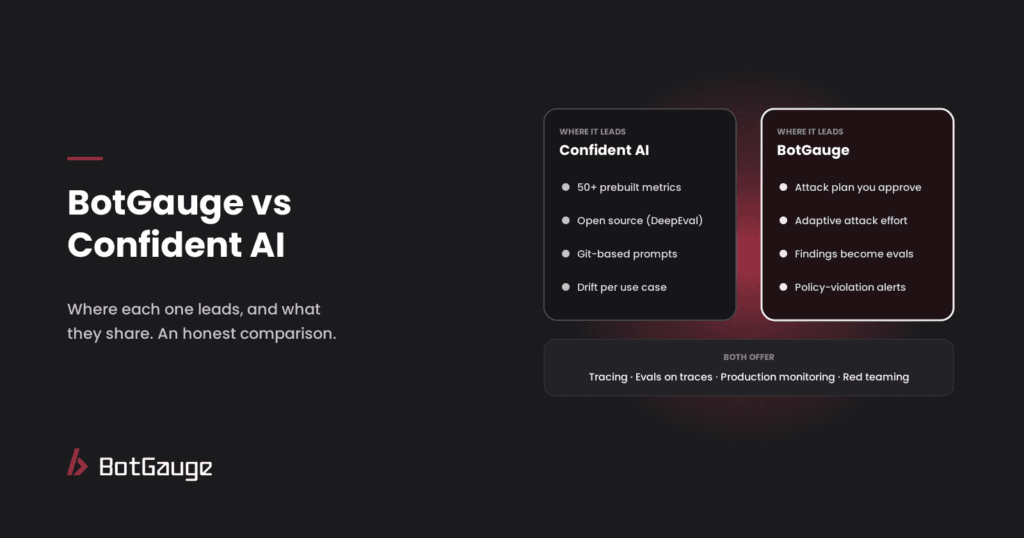
BotGauge is the best alternative to Confident AI for teams shipping AI agents. Confident AI is a strong evaluation platform. BotGauge brings red teaming, evals and observability together in one vendor-neutral platform: it learns your agent, plans and runs the attacks, maps every finding to compliance frameworks, and re-validates each fix before release.
TL;DR: BotGauge vs Confident AI
- Both platforms cover evaluation, tracing, production monitoring and red teaming in some form. The real difference is where each one starts.
- Confident AI starts from evaluation. It is built on DeepEval, the open-source framework, and its strength is a broad library of research-backed metrics written as code, with tracing, monitoring, simulation and red teaming (via DeepTeam) around it.
- BotGauge starts from red teaming. It brings adaptive red teaming, continuous evals and real-time observability into one platform, where every failure is traced and becomes a permanent eval.
- Choose Confident AI for a broad, open-source metric library and a Python-first workflow.
- Choose BotGauge when your agent takes actions with tools, money or customer data, and you want red teaming, evals and monitoring working as one system.
What is BotGauge?
Red teaming, evals and observability for AI agents, in one platform. BotGauge starts with recon: it interviews your agent to learn its purpose, its users and what it is allowed to do. Then it attacks, drawing on more than 200 strategies across prompt injection, policy bypass, tool misuse, data leakage and multi-turn manipulation. Continuous evals, built from LLM and code-based evaluators, catch accuracy, reliability and regression issues before every release. Real-time observability flags drift, failures and policy violations in production as they happen.
Every failure feeds one loop. Whether it comes from an attack, an eval or production, it is traced to the exact prompts, tool calls and context behind it, mapped to compliance frameworks, and turned into a permanent eval that runs on every release. Fix it, re-run the same attacks, and confirm it stays fixed. Vendor-neutral and ready for OpenAI, Anthropic, LangChain, LangGraph, LlamaIndex, CrewAI and AutoGen, BotGauge starts working the moment you add your agent.
What is Confident AI?
Confident AI is the commercial platform behind DeepEval, an open-source Python framework for evaluating LLM applications and agents. DeepEval provides metrics such as faithfulness, answer relevancy, task completion and tool correctness, written as pytest-style tests. The Confident AI platform adds production tracing, automatic evaluation of traces, dataset curation, annotation, alerting, a conversation simulator and red teaming through its DeepTeam library. Exploring other options? See our Confident AI alternatives.
Its core idea is evaluation-first observability: score everything, catch quality drops, and feed problems back into the next test cycle.
BotGauge vs Confident AI: feature comparison
| Capability | BotGauge | Confident AI |
| Positioning | Red teaming, evals and observability in one loop | Evaluation-first platform: evals, observability, red teaming and governance |
| Red teaming | Yes, core: 200+ strategies, single and multi-turn | Yes: prebuilt vulnerability library, single and multi-turn attacks |
| Use-case-tailored attacks | Yes, from the agent’s purpose, users and permissions | Yes, based on the AI’s purpose |
| Attack plan you approve before running | Yes | Not stated in public docs |
| Shifts attack effort once a rule is confirmed broken | Yes | Not stated in public docs |
| Framework mapping | OWASP-aligned attack categories | OWASP Top 10, NIST AI RMF |
| Risk scoring | Severity per finding, with trace | CVSS-scored risk assessments |
| Eval metrics | Agent-behaviour evals with LLM and code-based evaluators | 50+ research-backed metrics (DeepEval) |
| Red-team findings become evals automatically | Yes | Not stated in public docs |
| Production traces become eval datasets | Yes | Yes, automatic curation |
| Tracing | Prompts, tool calls, context and execution path, with replay | Span-level tracing, graph view, OpenTelemetry |
| Production monitoring | Drift, failures and policy violations | Quality alerts, drift per prompt and use case, safety monitoring |
| Multi-turn simulation | Attacker-driven | Yes, user simulation |
| Prompt management | Not a focus | Git-based branching and approval workflows |
| Open source | No | Yes (DeepEval, DeepTeam) |
| Enterprise controls | SSO/SAML, fine-grained access | SOC 2, HIPAA, GDPR, SSO, RBAC |
Beyond Metrics: Where BotGauge Pulls Ahead
Confident AI is very good at what it was built for: scoring LLM output with a broad, open-source metric library. BotGauge covers evaluation too, and goes further where agent risk actually lives.
- Recon before attack. BotGauge interviews your agent to learn its purpose, its users and what it is allowed to do, then plans the attacks most likely to break it, and shows you the plan before it runs.
- Custom rules. Add your own business rules and policies, such as refund limits or data-access boundaries, and BotGauge attacks and evaluates against them.
- Find, fix and re-validate. Every finding arrives with trace evidence. After you fix it, re-run the same attacks to confirm the fix holds, and the check keeps running on every release.
- Compliance mapping. Findings map to compliance frameworks such as the OWASP Top 10 for LLM and Agentic Applications and NIST AI RMF, so you can compare your agent against each framework and share the results with auditors.
- Vendor-neutral. Works across model providers and agent frameworks, with no ties to any model vendor.
- Easy to start. Add your agent, let BotGauge learn it, choose Core, Stress or Redline depth, and run. No evaluation code to write first.
| Where BotGauge goes further | BotGauge | Confident AI |
| Recon: learns the agent and plans attacks | Yes, with a plan you approve | Use-case-tailored attacks you configure |
| Custom rules and policies | Yes | Custom metrics and custom attacks |
| Fix and re-validate findings | Yes, re-run the same attacks | Re-run evaluations |
| Compliance framework mapping | Yes | Yes: OWASP Top 10, NIST AI RMF |
| Red-team findings become evals automatically | Yes | Not stated in public docs |
| Setup | Add your agent; no code required to start | Python SDK and evaluation code |
Round by Round: BotGauge vs Confident AI
Red teaming
Both platforms red team. Confident AI’s red teaming, built on its open-source DeepTeam library, offers a prebuilt vulnerability library (bias, PII leakage, jailbreaks and more), single and multi-turn attacks, OWASP Top 10 and NIST AI RMF frameworks, use-case-tailored attacks and CVSS-scored risk assessments.
BotGauge’s red teaming is built specifically for agents that take actions. It proposes an attack plan you approve, adapts after every reply, stops spending attacks on a rule once it is confirmed broken, and treats files, web pages and tool outputs as attack surface. Attacks with real-world side effects are blocked by its safety layer, and every confirmed finding becomes a permanent eval. Read how LLM red teaming differs from agent red teaming.
Evaluation metrics
Both platforms run evaluations. Confident AI’s advantage is breadth: DeepEval ships one of the largest libraries of research-backed metrics, covering faithfulness, relevancy, hallucination, task completion, tool correctness and conversational quality, all written as code. For the wider landscape, see AI agent evaluation tools.
BotGauge’s evals are built around agent behaviour. Continuous evals measure accuracy, reliability and regressions before every release, using LLM evaluators and code-based checks you define. The difference is where cases come from: every attack finding and production failure is added to the eval suite automatically, so the suite grows from how your agent actually breaks, not only from what your team thought to write.
Tracing and evidence
Both platforms trace agents and monitor production. Confident AI evaluates production traces continuously and alerts when quality drops. BotGauge traces the exact prompts, tool calls, context and execution path behind every failure, lets you replay it, and monitors production in real time for drift, failures and policy violations. Its traces are finding-centric: each issue arrives with the evidence an engineer, security reviewer or auditor needs.
Regression evals
Both turn failures into evals. Confident AI curates production traces into datasets. BotGauge saves every confirmed finding as a permanent regression eval and pairs it with control checks so a fix never breaks the happy path.
Workflow and team fit
Confident AI suits engineering teams comfortable writing evaluations in Python. BotGauge suits product, platform and security teams who want to connect an agent, approve a plan and review findings without writing attack code. See how BotGauge approaches LLM evaluations.
When to choose BotGauge vs Confident AI
Choose Confident AI when:
- Your main goal is scoring answer quality across many metrics.
- Your team is Python-first and wants evaluations as code.
- You want an open-source framework you can run without a platform.
- Your app mostly answers questions rather than taking actions.
Choose BotGauge when:
- Your agent issues refunds, approves requests, changes accounts or touches customer data.
- You want red teaming, evals and monitoring in one loop instead of three separate tools.
- You need to know which business rules break under multi-turn pressure, and want those failures to become evals automatically.
- You need trace evidence per finding for engineers, security reviewers or auditors.
Can you use BotGauge and Confident AI together?
Yes, and it is a common setup. The two tools answer different questions:
| Question | Best fit |
| Do you need dozens of prebuilt answer-quality metrics as code? | Confident AI (DeepEval) |
| Does the agent hold its rules when a user pushes? | BotGauge |
| Did a fix break normal requests? | Both, through regression evals |
| Is production behaviour drifting? | Both, through monitoring |
A typical flow: run DeepEval metrics in CI on every change, run BotGauge attacks before each release, and save every confirmed BotGauge finding as an eval case that both pipelines can reuse. Conversations need their own approach, covered in our guide to multi-turn evaluation.
Final thoughts
Both platforms now cover evaluation, tracing and monitoring, so the choice comes down to where you start. Confident AI starts from metrics and suits Python teams that want a broad, open-source evaluation library. BotGauge starts from red teaming: it attacks your agent’s real tools and rules, traces every failure, turns it into an eval that runs on every release, and keeps watching in production. If your agent takes actions with money, data or permissions, that single loop is hard to assemble from separate tools. Comparing more options? See the best AI red teaming tools, open source and commercial, or our other head-to-heads: BotGauge vs Braintrust, BotGauge vs Promptfoo and BotGauge vs Arize.