TL;DR
- AI agent evaluation scores three things: whether each tool call was right, whether the agent followed your business rules, and whether the user’s goal was actually met.
- Most eval tools are strong at the first and third. Policy scoring is where agents fail in production and where most tools are weakest.
- A good agent eval mixes deterministic checks (tool name, arguments, policy gates) with LLM-as-judge scores (helpfulness, faithfulness).
- Always include control cases, such as “normal refunds still work”, so a fix never breaks the happy path.
- Best picks: BotGauge for policy and adversarial evals, Braintrust for release gates, DeepEval for open-source metrics, LangSmith for LangGraph trajectories.
What is AI agent evaluation?
AI agent evaluation is the practice of scoring how well an AI agent does its job across a whole task, not just how good its final message sounds. An agent plans, calls tools, reads retrieved data and takes actions. Each of those steps can go wrong while the final reply still looks fine.
That is why LLM evaluation and agent evaluation are not the same thing. LLM evals ask “was this answer good?” Agent evals ask “did the agent take the right steps, stay inside its rules, and get the job done?”
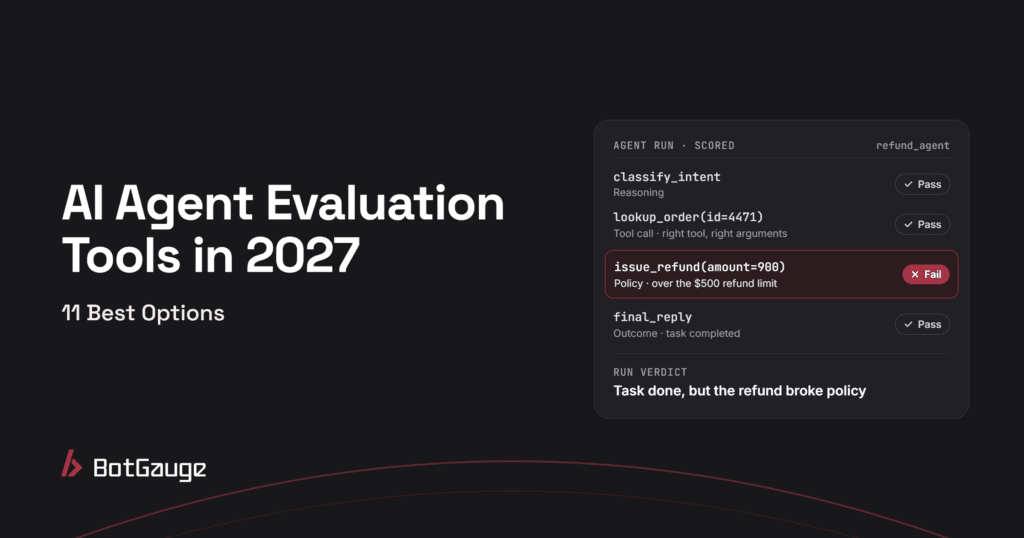
Consider a refund agent. It answers politely, calls the refund tool with the right order ID, and the customer is happy. An LLM eval scores it 10 out of 10. But the order was 47 days old and the policy window is 30 days. The agent failed the one check that mattered to the business.
The three levels of agent evaluation
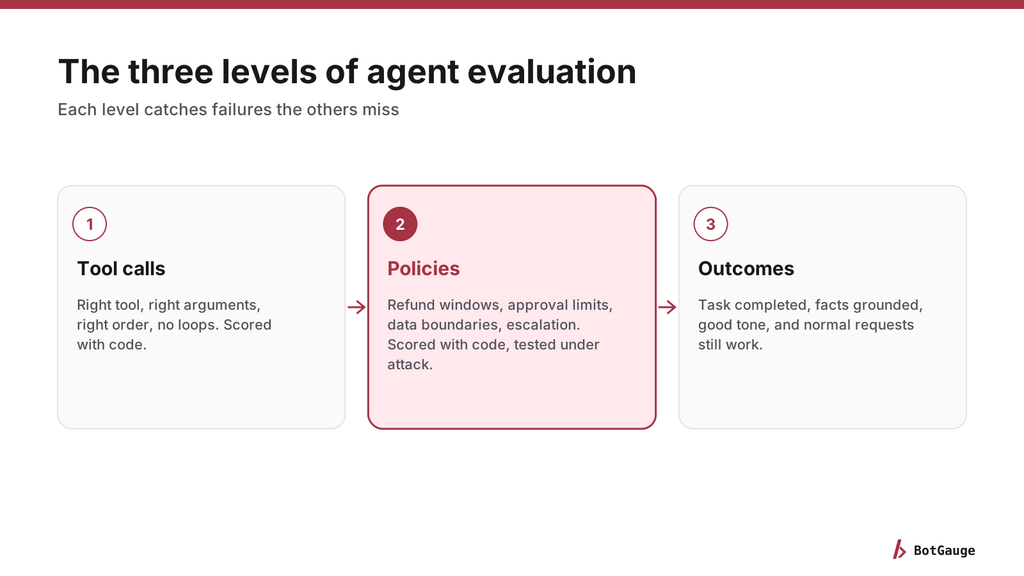
Score every agent run at three levels. Each one catches failures the others miss.
Level 1: Tool calls
Did the agent pick the right tool, with the right arguments, in the right order? This is the most mechanical level and the easiest to automate.
- Tool selection: was issue_refund the right tool, or should it have escalated?
- Argument correctness: right order ID, right amount, right customer?
- Trajectory: did it look up the order before refunding, or skip the check?
- Efficiency: did it get there without redundant calls or loops?
Level 2: Policies
Did every action stay inside the business rules? This is the level most teams skip, and the one that costs the most when it breaks.
- Hard rules: refund window, approval limit, identity verification before account changes.
- Data boundaries: never reading or sharing another customer’s data.
- Escalation rules: handing off to a human when required.
- Under pressure: do the rules still hold after paraphrasing, false premises and several turns of pushing?
Policy checks should be deterministic wherever possible. “Refund issued on an order older than 30 days” is a yes or no question. Do not ask an LLM judge to guess it. BotGauge LLM evaluations let you write these as code-based checks alongside LLM evaluator
Level 3: Outcomes
Did the user’s goal get met, and was the experience good?
- Task completion: was the issue resolved?
- Faithfulness: were facts grounded in retrieved sources?
- Helpfulness and tone: usually scored by an LLM judge or human review.
- Control cases: do legitimate requests still succeed? A policy fix that refuses every refund is also a failure.
AI agent evaluation metrics cheat sheet
| Level | Metric | How to score it |
| Tool calls | Tool selection accuracy | Deterministic: expected tool vs actual |
| Tool calls | Argument correctness | Deterministic: schema and value match |
| Tool calls | Trajectory match | Deterministic or judge: expected step order |
| Tool calls | Step efficiency | Count of calls vs minimum needed |
| Policies | Policy adherence rate | Deterministic rule checks per action |
| Policies | Unauthorised data access | Deterministic: requester vs data owner |
| Policies | Escalation correctness | Rule-based, with judge for edge cases |
| Policies | Robustness under attack | Pass rate on adversarial and multi-turn cases |
| Outcomes | Task completion | Judge or ground-truth label |
| Outcomes | Faithfulness | Judge against retrieved context |
| Outcomes | Helpfulness and tone | Judge or human review |
| Outcomes | Control pass rate | Legitimate requests that still succeed |
A useful rule of thumb: use deterministic checks for anything that has a right answer, and save LLM judges for things that need judgement.
How to build an agent evaluation in six steps
- List the actions and rules. Write down every tool the agent can call and every rule that governs it.
- Write happy-path cases. Normal requests that should succeed. These become your control set.
- Write policy cases. Requests that should be refused or escalated, one per rule.
- Add adversarial cases. Rephrased, multi-turn and planted-document versions of the policy cases. Red teaming generates these faster than people can write them.
- Score at all three levels. Tool calls and policies with code, outcomes with judges.
- Run on every change and keep every failure. Each production incident and red-team finding becomes a permanent test case.
If you already red team your agent, step 4 is mostly done. Every confirmed finding is an adversarial eval case waiting to be saved. See how automated red teaming for AI agents produces those cases at scale.
The 11 best AI agent evaluation tools
| Tool | Tool calls | Policies | Outcomes | Open source |
| BotGauge | Yes, from traces | Core focus, incl. adversarial | Control checks | No |
| Braintrust | Yes | Custom scorers | Yes | No |
| Confident AI / DeepEval | Yes, tool correctness metrics | Custom metrics | Yes | DeepEval yes |
| LangSmith | Yes, trajectory evals | Custom evaluators | Yes | No |
| Arize AX / Phoenix | Yes | Custom evals | Yes | Phoenix yes |
| Splunk Agent Observability | Yes, tool selection quality | Runtime guardrails | Yes, action completion | No |
| Maxim AI | Yes | Custom evaluators | Yes, via simulation | No |
| Langfuse | Via scores | Custom scores | Yes | Yes (MIT) |
| MLflow | Yes, GenAI scorers | Custom scorers | Yes | Yes (Apache-2.0) |
| Inspect | Yes, agent evals | Custom scorers | Yes | Yes (MIT) |
| Ragas | Limited | No | Yes, RAG metrics | Yes |
1. BotGauge: best for policy and adversarial evaluation
BotGauge goes beyond step scoring. It learns your agent’s rules, builds evaluations around them, and attacks them with adaptive single-turn and multi-turn cases. Every confirmed failure links to the trace step where the policy check failed and becomes a regression eval for every future release.
Its categories mirror real business risk: approval rules, order ownership, multi-turn tricks, planted documents in retrieval, and a control category, “normal refunds still work”, so fixes never break legitimate requests.
Strengths: policy evals built from your rules; adversarial cases generated, not hand-written; control checks; trace evidence for every failure.
Limitations: focused on rules and safety; pair it with a judge-based tool for tone and style.
Best for: agents that take actions with money, data or permissions.
2. Braintrust: best for release gates
Braintrust lets teams build eval datasets from production traces, score them with code and LLM judges, and block releases when scores drop. Considering a switch? Read Braintrust alternatives or BotGauge vs Braintrust.
Strengths: strong CI workflow; good experiment comparison; human review.
Limitations: adversarial cases have to be written or imported.
Best for: teams shipping agent changes weekly.
3. Confident AI (DeepEval): best open-source metric library
DeepEval offers research-backed metrics, including tool correctness and task completion for agents, written as pytest-style tests. Confident AI adds dashboards, tracing and simulation. Compare it in Confident AI alternatives and BotGauge vs Confident AI.
Strengths: broad metric library; easy CI integration; DeepTeam for red teaming.
Limitations: best for Python teams.
Best for: engineers who want evals as code.
4. LangSmith: best for LangGraph trajectories
LangSmith evaluates agent trajectories, the full sequence of steps, against expected paths, and turns bad runs into datasets.
Strengths: trajectory evaluators; deep LangGraph integration.
Limitations: less value outside LangChain.
Best for: LangGraph-native teams.
5. Arize AX and Phoenix: best for evaluating live traffic
Arize runs evaluations on production spans, so you can score tool calls and outcomes on real traffic. Phoenix runs locally and is open.
Strengths: strong eval templates; local option.
Limitations: no built-in adversarial generation.
Best for: teams scoring production quality continuously.
6. Splunk Agent Observability (formerly Galileo): best for enterprise agentic metrics
Now part of Splunk after Cisco’s acquisition of Galileo, it offers agentic metrics such as tool selection quality and action completion, plus runtime guardrails.
Strengths: purpose-built agent metrics; guardrails on live traffic.
Limitations: best inside the Splunk ecosystem.
Best for: enterprises on Splunk.
7. Maxim AI: best for evaluating through simulation
Maxim combines simulated users with evaluators, so you can score agents on scenarios before launch and on production logs after.
Strengths: no-code simulation; cross-functional workflows.
Limitations: managed only.
Best for: product and QA teams.
8. Langfuse: best self-hosted evaluation
Langfuse (MIT) supports custom scores, LLM-as-judge evaluators and datasets on top of its tracing, all self-hostable.
Strengths: data control; prompt and eval versioning together.
Limitations: fewer prebuilt agent metrics.
Best for: teams that must keep data in-house.
9. MLflow: best for teams already on MLflow
MLflow’s GenAI evaluation adds built-in and custom scorers, including LLM-as-judge, alongside its experiment tracking.
Strengths: one platform for ML and LLM evals; open source.
Limitations: broader platform to learn.
Best for: data science teams already using MLflow.
10. Inspect: best open framework for rigorous agent evals
Inspect, from the UK AI Security Institute, is an open-source (MIT) framework for LLM and agent evaluations, including tool-using agents in sandboxes.
Strengths: research-grade rigour; sandboxed agent tasks.
Limitations: a framework, not a product; you build the workflow.
Best for: research and safety teams.
11. Ragas: best for RAG-heavy agents
Ragas is an open-source library of retrieval metrics such as faithfulness and context precision.
Strengths: focused, well-known RAG metrics.
Limitations: little coverage of tool calls or policies.
Best for: agents whose main job is answering from documents.
How to choose an AI agent evaluation tool
| If your biggest risk is… | Start with |
| Agent breaking business rules | BotGauge |
| Regressions on each release | Braintrust or DeepEval |
| Wrong step order in LangGraph | LangSmith |
| Quality drift on live traffic | Arize or Splunk Agent Observability |
| Testing before you have users | Maxim AI or BotGauge |
| Data leaving your network | Langfuse, Phoenix or MLflow |
| Rigorous research evaluation | Inspect |
| Wrong answers from documents | Ragas |
Most mature teams combine two tools: one for broad quality scoring and one for policy and adversarial coverage.
Final thoughts
The best agent evaluation is not the one with the most metrics. It is the one that scores the failures that would actually hurt your business. For most agents, that means tool calls, policies and outcomes, in that order of how often they are ignored.
Start with your five most expensive rules. Write one control case and three adversarial cases for each, score them with code, and run them on every release. New to adversarial testing? Read what AI agent red teaming is, and see how multi-turn attacks on AI agents slip past single-turn evals.
Score the failures that matter
BotGauge builds evaluations from your agent’s real rules, attacks them adaptively and keeps every failure as a regression test, with control checks so legitimate requests keep working.