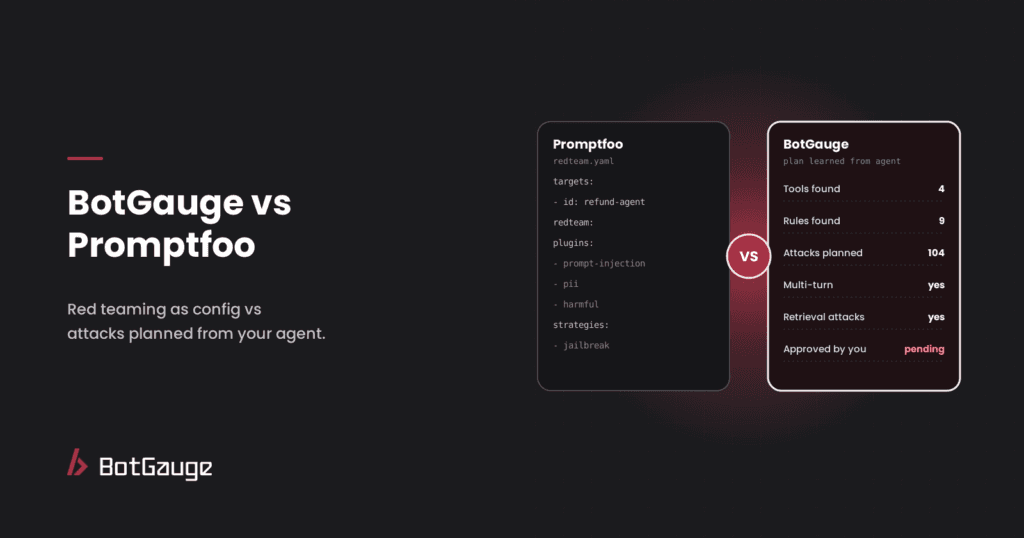
BotGauge is the best alternative to Promptfoo for teams shipping AI agents. Promptfoo is a strong open-source toolkit for evals and red teaming. BotGauge brings red teaming, evals and observability together in one vendor-neutral platform: it learns your agent, plans and runs the attacks, maps every finding to compliance frameworks, and re-validates each fix before release.
TL;DR: BotGauge vs Promptfoo
- Promptfoo is an open-source (MIT) CLI and platform for LLM evals and red teaming, configured in YAML and run in CI, with well over 100 red teaming plugins. OpenAI announced its acquisition in March 2026.
- BotGauge brings adaptive red teaming, continuous evals and real-time observability into one platform. Its attacker learns your agent first, and every failure is traced and becomes a permanent eval.
- The core difference: Promptfoo is an open-source toolkit you configure and run yourself, with a deep library of plugins and strategies. BotGauge is a managed platform where red teaming, evals and production observability run as one loop, and every finding becomes an eval automatically.
- Choose Promptfoo for open-source, config-as-code evals and red teaming in every pull request.
- Choose BotGauge for vendor-neutral, agent-aware red teaming of action-taking agents, plus evals and production observability in the same place.
- Use both: Promptfoo for fast CI checks, BotGauge for deep attacks, evals and monitoring.
What is Promptfoo?
Promptfoo is an open-source tool for evaluating and red teaming LLM applications. Teams define targets, prompts, assertions and red teaming plugins in a YAML file, then run evaluations and attacks from the command line or in CI. Its plugin library covers prompt injection, PII leakage, harmful content, jailbreak strategies and more, and it works with many model providers. It is the most-starred open-source project in the LLM red teaming category. Exploring other options? See our Promptfoo alternatives.
In March 2026, OpenAI announced it would acquire Promptfoo. The core project remains MIT-licensed.
What is BotGauge?
Red teaming, evals and observability for AI agents, in one platform. BotGauge starts with recon: it interviews your agent to learn its purpose, its users and what it is allowed to do. Then it attacks, drawing on more than 200 strategies across prompt injection, policy bypass, tool misuse, data leakage and multi-turn manipulation. Continuous evals, built from LLM and code-based evaluators, catch accuracy, reliability and regression issues before every release. Real-time observability flags drift, failures and policy violations in production.
Every failure feeds one loop. Whether it comes from an attack, an eval or production, it is traced to the exact prompts, tool calls and context behind it, mapped to compliance frameworks, and turned into a permanent eval that runs on every release. Fix it, re-run the same attacks, and confirm it stays fixed. Vendor-neutral and ready for OpenAI, Anthropic, LangChain, LangGraph, LlamaIndex, CrewAI and AutoGen, BotGauge starts working the moment you add your agent.
BotGauge vs Promptfoo: feature comparison
| Capability | BotGauge | Promptfoo |
| Positioning | Red teaming, evals and observability in one loop | Open-source evals and red teaming, configured in YAML |
| Red teaming coverage | 200+ strategies, single and multi-turn, custom strategies | Large plugin library plus single and multi-turn strategies |
| Use-case-tailored attacks | Yes, learned from the agent’s purpose, users and permissions | Yes, from the application purpose you describe in config |
| Adaptive multi-turn attacks | Yes | Yes: GOAT, Crescendo with backtracking, Hydra |
| Custom policies | Yes, from your agent’s rules | Yes, custom policy plugins |
| Agent-specific attacks (authorization, excessive agency, MCP) | Yes | Yes: BOLA, BFLA, excessive agency and MCP plugins |
| Indirect injection through external content | Files, web pages and tool outputs | Yes, for web-browsing agents |
| Attack plan you approve before running | Yes | Config you write and review |
| Shifts attack effort once a rule is confirmed broken | Yes | Not stated in public docs |
| Red-team findings become evals automatically | Yes | Not stated in public docs |
| Execution tracing with replay | Yes | Results per test case |
| Real-time production monitoring | Yes: drift, failures, policy violations | Not a focus |
| Runs in CI | Yes | Yes, core strength |
| Open source | No | Yes (MIT) |
| Ownership | Independent | OpenAI (announced March 2026) |
| Enterprise controls | SSO/SAML, fine-grained access | Check Promptfoo’s documentation |
Beyond the Config File: Where BotGauge Pulls Ahead
Promptfoo is very good at what it was built for: open-source evals and red teaming you configure and run yourself. BotGauge covers red teaming and evals too, adds observability, and goes further where agent risk actually lives.
- Recon before attack. BotGauge interviews your agent to learn its purpose, its users and what it is allowed to do, then plans the attacks most likely to break it. With Promptfoo, you describe the purpose and choose plugins in config.
- Custom rules. Add your own business rules and policies, such as refund limits or data-access boundaries, and BotGauge attacks and evaluates against them.
- Find, fix and re-validate. Every finding arrives with trace evidence. After you fix it, re-run the same attacks to confirm the fix holds, and the check keeps running on every release.
- Compliance mapping. Findings map to compliance frameworks such as the OWASP Top 10 for LLM and Agentic Applications and NIST AI RMF, so you can compare your agent against each framework and share the results with auditors.
- Vendor-neutral. BotGauge is independent of every model vendor. Promptfoo is now part of OpenAI.
- Easy to start. Add your agent, let BotGauge learn it, choose Core, Stress or Redline depth, and run. No YAML to write or maintain.
| Where BotGauge goes further | BotGauge | Promptfoo |
| Recon: learns the agent and plans attacks | Yes, with a plan you approve | Purpose and plugins you describe in config |
| Custom rules and policies | Yes | Custom policy plugins |
| Fix and re-validate findings | Yes, re-run the same attacks | Re-run your config |
| Compliance framework mapping | Yes | Framework presets available |
| Production observability | Yes: tracing and real-time monitoring | Not a focus |
| Vendor neutrality | Independent | Owned by OpenAI (announced March 2026) |
Round by Round: BotGauge vs Promptfoo
How attacks are planned
Promptfoo is explicit and flexible: you describe your application’s purpose, then choose plugins and strategies in YAML, and it generates attacks tailored to that purpose. That is transparent, easy to version and highly customisable, and the quality of results depends on how much context you put in the config. For how other platforms plan attacks, see the best AI agent red teaming tools.
BotGauge starts from the agent itself. It reads the tools the agent can call and the rules it must follow, then builds an attack plan around them, for example targeting a 30-day refund window, a $100 approval limit and order-ownership checks. You approve the plan before anything runs.
Multi-turn and agent depth
Both handle multi-turn attacks. Promptfoo offers adaptive multi-turn strategies such as GOAT, Crescendo with backtracking and Hydra, plus agent-focused plugins for broken authorization, excessive agency and MCP. BotGauge’s attacker runs across your agent’s rules as a whole: it adapts after every reply, stops spending effort on a rule once it is confirmed broken, and moves to the next. Read how to prevent prompt injection in AI agents.
Retrieval and tool-result attacks
Promptfoo offers indirect prompt injection strategies for web-browsing agents and plugins for MCP. BotGauge treats anything the agent reads (files, web pages and tool outputs) as attack surface by default, because agents often trust what they read. If your agent uses MCP tools, see how to secure MCP-connected AI agents.
Evidence
Promptfoo reports pass or fail per test case. BotGauge attaches the full conversation and the exact failing trace step to each finding, such as a policy check failing at 00:21, which makes findings easier to hand to engineers and security reviewers, and to map against the OWASP Agentic Top 10.
Openness and independence
Promptfoo wins on openness: it is MIT-licensed and easy to inspect and extend. BotGauge is not open source. On independence, some teams running agents across several model providers now prefer a red teaming and evaluation layer that no model vendor owns.
When to choose BotGauge vs Promptfoo
Choose Promptfoo when:
- You want an open-source tool you can inspect, extend and self-host.
- Your team prefers evals and attacks as YAML config in every pull request.
- You want a large library of red teaming plugins and strategies you can configure and extend yourself.
Choose BotGauge when:
- Your agent takes actions with tools, money or customer data.
- You want attacks planned from your agent rather than written in config.
- You want red teaming, evals and production monitoring in one loop.
- You prefer a red teaming, eval and observability layer that no model vendor owns.
Can you use BotGauge and Promptfoo together?
Yes. A common setup:
- Promptfoo on every pull request for fast prompt-level checks.
- BotGauge before every release for adaptive, multi-turn attacks on the agent’s real tools and rules.
- BotGauge evals keep every confirmed failure as a permanent eval.
- BotGauge monitoring watches production for drift and policy violations.
Final thoughts
Promptfoo made red teaming accessible, and its open-source toolkit is deep and flexible. Some agent teams want something different: attacks planned from how the agent works, evals that grow from every failure, and observability that keeps watching after release, all in one managed loop. That is where BotGauge fits. To compare more options, see AI red teaming tools for autonomous agents, or our other head-to-heads: BotGauge vs Confident AI, BotGauge vs Braintrust and BotGauge vs Arize.