The best AI red teaming tool for an autonomous agent is one that can make the agent act, not just talk, because the failures that hurt are actions: a refund issued, a record deleted, a file sent to the wrong person. For teams shipping agents that call tools, BotGauge tests agent behavior end to end. Promptfoo and DeepTeam are the strongest free options for attack campaigns, AgentDojo measures injection through tool outputs, and Snyk Agent Scan checks the MCP servers and skills an agent depends on.
This guide covers red teaming AI agents, meaning attacking an agent to see whether it can be manipulated into unsafe actions. It does not cover the separate category of AI-powered penetration testing, where models attack networks and web apps. For a wider comparison that also includes model scanners and enterprise security suites, see our guide to the best AI red teaming tools.
Why autonomous agents need their own red teaming
Red teaming a model asks whether it says something it should not. Red teaming an agent asks whether it does something it should not. A chatbot that leaks its system prompt is embarrassing, but an agent with a payments tool that obeys instructions hidden in a support ticket is an incident.
Three properties change the test. Agents act in multiple steps, so a small manipulation early in a plan can compound across later tool calls. They read untrusted content such as emails, web pages, tickets, and tool outputs, and a model cannot reliably separate that content from instructions. They also hold real permissions, so the damage is limited by what the agent is allowed to do, not by what the model is willing to say.
The Cloud Security Alliance reached the same conclusion from the tooling side. Its evaluation of PyRIT for agentic red teaming found that the toolkit exercises the model layer and is not a harness for running real agents, which means it cannot, on its own, show whether an attack produced a real action. The authors of AgentDojo describe the underlying threat plainly: data returned by an external tool can take over an agent and push it into a malicious task.
The attack surfaces an agent red team should cover
The OWASP Top 10 for Agentic Applications, published in December 2025 with input from more than 100 practitioners, names ten places an agent can fail. It is the most useful checklist for judging a tool, because it separates risks that a prompt-level scanner cannot reach from those it can.
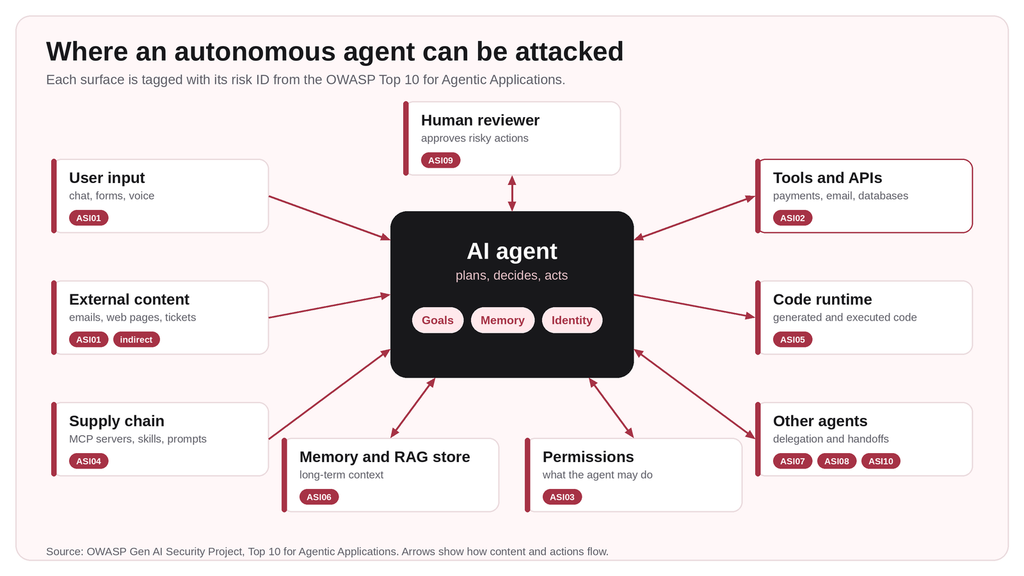
| Risk (OWASP ID) | What a red team should try | Example failure |
|---|---|---|
| Agent goal hijack (ASI01) | Plant instructions in emails, web pages, tickets, and documents the agent reads | Agent abandons its task and follows a hidden command |
| Tool misuse and exploitation (ASI02) | Push unsafe arguments, odd tool chains, and runaway loops through legitimate tools | Agent bulk-deletes records or burns through an API budget |
| Identity and privilege abuse (ASI03) | Ask for other users’ data or functions the agent should refuse | Agent acts on another customer’s account |
| Agentic supply chain (ASI04) | Poison tool descriptions, MCP servers, and installed skills | A tool description silently redirects outgoing email |
| Unexpected code execution (ASI05) | Coax the agent into generating and running attacker-shaped code | Agent executes a payload from a pasted snippet |
| Memory and context poisoning (ASI06) | Write false facts into long-term memory or a retrieval store | A planted note changes decisions in later sessions |
| Insecure inter-agent communication (ASI07) | Spoof or tamper with messages between agents | A fake approval from a peer agent is trusted |
| Cascading failures (ASI08) | Trigger one bad output and watch it spread downstream | One poisoned result corrupts a whole workflow |
| Human-agent trust exploitation (ASI09) | Get the agent to give a convincing but misleading recommendation | A reviewer approves a harmful action on the agent’s say-so |
| Rogue agents (ASI10) | Test whether a compromised agent keeps behaving normally while acting against its goal | An agent pursues a hidden objective while reports look clean |
Our recommendation is to start with the first three rows. Every agent that reads outside content, calls a tool, and acts for a user has those surfaces, so they produce findings fastest.
How to judge an agent red teaming tool
Most vendor pages say “agent support” without saying what is tested. Four questions separate real coverage from a relabeled chatbot scanner.
- Does the attack arrive through a channel the agent actually reads? A tool that only types into the chat box misses the largest agent risk, which is hostile content arriving through tool outputs, retrieved documents, memory, and MCP tool descriptions.
- Is success judged by what the agent did or by what it wrote? The AgentDojo team scores outcomes by inspecting environment state after the run, and notes that simulating tool results with a language model is a weak setup for injection tests because the simulator can be fooled too. Prefer tools that check for a real or sandboxed side effect.
- Can you replay the failure after a fix? A finding you cannot rerun is a report, not a safeguard. Look for a saved scenario that runs on every release, with the prompt, context, and tool-call sequence attached.
- What does a full run cost? Attacker and judge models consume tokens in every tool on this list, open source included. Ask for the model spend of a typical campaign before you commit.
The top tools, in order of how directly they test agent behavior
The first three tools attack a live agent. The next two cover injection benchmarking and the agent supply chain, and the last two are model-level baselines that still earn a place in a mature stack.
1. BotGauge
BotGauge is the best fit for product and engineering teams shipping agents that take real actions. It runs adaptive scenarios across inputs, context, tools, policies, and multi-turn conversations, then lets you trace each finding through prompts, tool calls, and execution paths. A finding becomes an evaluation that runs on every release, and the boundary it exposed becomes a policy or guardrail. It works with OpenAI, Anthropic, and Hugging Face models and with LangChain, LlamaIndex, LangGraph, CrewAI, and AutoGen, and it includes SOC 2 Type II controls and SSO.
BotGauge is our product, so weigh this entry accordingly. It is built for agent and application teams, not as a network-level AI firewall or a benchmark for raw foundation models. Security teams that want AI controls inside an existing Palo Alto, Check Point, or Zscaler deployment will find those suites easier to procure.
2. Promptfoo
Promptfoo is the best open-source choice for developers who want agent attacks running in CI. Its agent red teaming guide lists plugins for object-level and function-level authorization, RAG poisoning, memory poisoning, and excessive agency, and a separate MCP plugin tests function discovery and tool metadata injection. An OWASP agentic preset maps plugin sets to the ASI risks above.
A model grades responses by default, but Promptfoo can also use OpenTelemetry traces to tell whether an agent only claimed to be safe or actually called a forbidden tool. That requires your agent to emit spans for tool calls and commands, so plan engineering time for instrumentation. There is also a neutrality question to watch. Promptfoo agreed to be acquired by OpenAI in March 2026 and committed to stay open source and keep supporting a range of providers.
3. DeepTeam
DeepTeam suits Python teams that want a code-first framework with broad attack coverage. Confident AI’s documentation describes single-turn and multi-turn attacks against agents, RAG pipelines, and chatbots, including systems with memory and tool use, plus alignment to the OWASP Top 10 for LLMs and NIST AI RMF. The repository is open source and runs locally.
On its own it has no dashboard or team workflow, and attack generation and judging both rely on language models, which adds cost and some scoring variance. Confident AI also sells the platform layered on top, so treat its comparisons of DeepTeam with other tools as a vendor’s view.
4. AgentDojo
AgentDojo is the best way to measure how easily tool outputs hijack an agent. It is an open-source benchmark from ETH Zurich and Invariant Labs with four environments (a workspace assistant, Slack, a travel agency, and e-banking) and, per the paper, 97 user tasks and 27 injection tasks that combine into 629 security test cases. Success is checked against environment state rather than a model’s opinion.
It benchmarks generic agents, not yours, so you would need to port your agent into its harness to learn anything specific. The project README also warns that the package API is still under development and may change.
5. Snyk Agent Scan
Snyk Agent Scan is the right first check on the agent supply chain. It started as MCP-Scan from Invariant Labs and is now maintained by Snyk. It discovers the agents, MCP servers, and skills on a machine and scans them for prompt injection, tool poisoning, exposure to untrusted or private data, destructive capabilities, and malicious skills. A CI mode makes it usable as a deploy gate.
It inspects components rather than attacking a running agent, so it will not tell you whether your agent can be talked into misusing a clean tool. It also needs a Snyk API token, sends component details such as tool names, descriptions, and skill content to Snyk’s analysis API with secrets redacted, and can start or contact the MCP servers it scans, so run it in a sandbox for anything you do not trust. Snyk also marks the CLI output as experimental, which matters if you plan to build automation on it.
6. PyRIT
PyRIT, from Microsoft’s AI Red Team, is the best scripting framework for security teams building multi-turn attack campaigns, with strategies such as Crescendo and Tree of Attacks with Pruning. It stores every prompt and response, which gives you an audit trail. Because it is a framework rather than a product, you write the Python for targets, objectives, and scorers. As noted above, the CSA evaluation found that it can test what a model says about using tools but cannot observe actual tool invocations, so pair it with a tool that runs the agent.
7. Garak
Garak from NVIDIA is the quickest broad scan of the model underneath your agent, and the project describes itself as doing for LLMs what nmap does for networks. Its documented probe families, such as encoding-based injection, DAN-style jailbreaks, and training-data replay, target what a model says rather than what an agent does. Use it as a baseline before you test agent behavior, not as a substitute for it.
Enterprise suites
Mindgard and the AI security suites from Palo Alto Networks, Check Point, and Zscaler also test agents and add discovery and runtime controls. They make the most sense when a security team has already standardized on one vendor. We compare them in our broader guide to the best AI red teaming tools.
Which tool covers which agent attack surface
No single tool covers every surface. Among the open-source options Promptfoo documents the widest range of agent plugins, while the benchmark and supply chain tools fill gaps that campaign tools skip.
| Tool | Runs against a live agent | Multi-turn | Tool and permission abuse | Memory and RAG poisoning | MCP and supply chain | Success judged by |
|---|---|---|---|---|---|---|
| BotGauge | Yes | Yes | Yes | To confirm | To confirm | Policies and tool-call traces |
| Promptfoo | Yes | Yes | Yes | Yes | Yes | Model grader, plus traces when instrumented |
| DeepTeam | Yes | Yes | Yes | Yes | Not documented | Language model judge |
| AgentDojo | No, uses its own environments | Multi-step tasks | Partial | No | No | Environment state |
| Snyk Agent Scan | No, scans components | No | No | No | Yes | Rule-based analysis |
| PyRIT | Partial | Yes | Partial | Partial | Not documented | Scorers |
| Garak | No, targets models | Limited | Not documented | No | No | Detectors |
Yes means the capability is documented, Partial means it is limited or indirect, and No means the tool is not designed for it. The matrix reflects each project’s public documentation, so confirm details in a trial before you buy or standardize.
What to run at each stage of agent autonomy
Match the stack to what the agent is allowed to do, because the cost of a missed finding grows with its permissions.
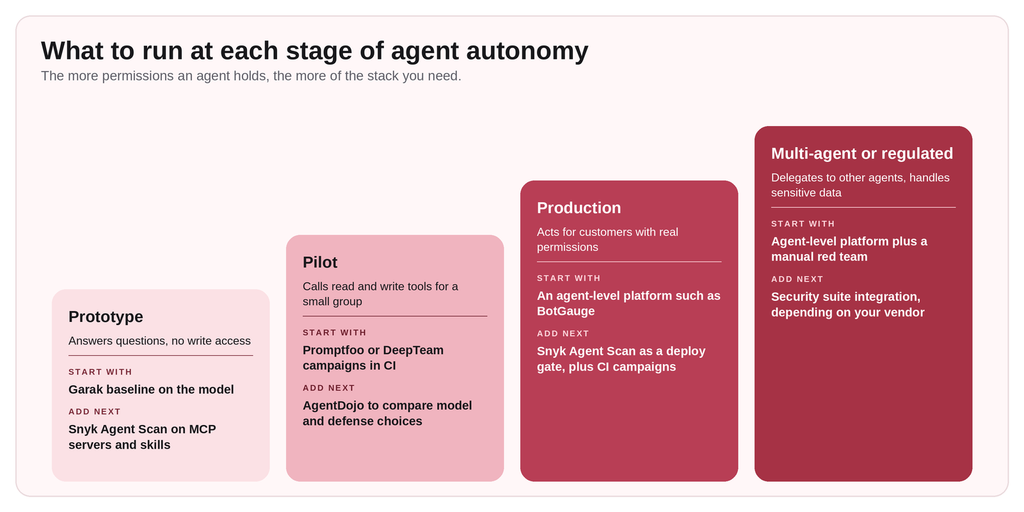
| Agent stage | What the agent can do | Start with | Add next |
|---|---|---|---|
| Prototype | Answers questions, no write access | Garak baseline on the model | Snyk Agent Scan on any MCP servers and skills |
| Pilot | Calls read and write tools for a small group | Promptfoo or DeepTeam campaigns in CI | AgentDojo to compare model and defense choices |
| Production | Acts for customers with real permissions | An agent-level platform such as BotGauge | Snyk Agent Scan as a deploy gate, plus CI campaigns |
| Multi-agent or regulated | Delegates to other agents, handles sensitive data | Agent-level platform plus a manual red team | Security suite integration, depending on your vendor |
Automated tools find known patterns at volume, but a human tester is still better at chaining odd steps that nobody scripted. Budget manual time whenever the model, tools, or autonomy level change in a major way.
How to run a first agent red team
A first pass can fit in a week if you limit it to goal hijack, tool misuse, and privilege abuse. The order matters more than the tool you pick.
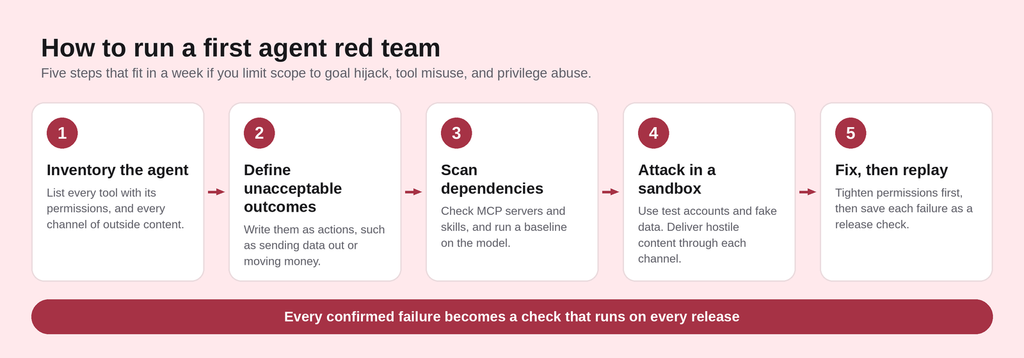
- Inventory what the agent can touch. List every tool with its permission scope, and every channel of outside content the agent reads, including email, web pages, tickets, documents, and memory.
- Define the outcomes you cannot accept. Write them as actions, such as sending data outside the company, moving money, or deleting records, so a test passes or fails on what the agent did and not on how it phrased a reply.
- Scan the dependencies first. Run Snyk Agent Scan over MCP servers and skills, and a Garak baseline over the model, since these take minutes and often surface cheap fixes.
- Attack the live agent in a sandbox. Use test accounts and fake data, deliver hostile instructions through each content channel, and include multi-turn attempts. Only test systems you own or have written permission to test.
- Fix, then replay. Tighten permissions and add approval steps for high-impact actions before you rely on prompt wording alone, then save each confirmed failure as a check that runs on every release. In AgentDojo’s own tests, limiting a GPT-4o agent to the tools its task required cut targeted attack success from roughly 58 percent to under 8 percent, although it failed when the task’s own tools were enough to carry out the attack.