TL;DR
- Promptfoo is the most popular open-source tool for LLM evals and red teaming, with around 27,000 GitHub stars. OpenAI announced its acquisition in March 2026.
- Teams now look for alternatives for three reasons: vendor neutrality, deeper agent-level and multi-turn testing, and less config to maintain.
- Best picks: BotGauge for adaptive agent red teaming, DeepTeam for a Python library, Giskard for security plus quality, PyRIT for scripted campaigns, garak for model scans, Mindgard for enterprise coverage, Tencent A.I.G for MCP and infrastructure.
- Many teams keep Promptfoo for quick CI checks and add one agent-aware tool for depth.
Why teams look for Promptfoo alternatives
Promptfoo made red teaming accessible. A YAML file, a CLI command and a large plugin library for injection, PII and harmful-content tests got thousands of teams started. It is still MIT-licensed and still useful. For a head-to-head, see BotGauge vs Promptfoo.
Three things have changed the conversation.
- Vendor neutrality. OpenAI announced it would acquire Promptfoo on March 9, 2026. Teams that test agents built on several model providers, or that compete with OpenAI, increasingly want a testing layer that no model vendor owns.
- Agents, not prompts. Promptfoo was built around prompts and outputs. Agents call tools, read retrieved documents and act across many turns. Testing whether a refund rule survives five turns of pressure, or whether a planted document can redirect a tool call, takes significant custom configuration.
- Config maintenance. As test suites grow, YAML configs grow with them. Some teams want attack plans generated from the agent itself instead.
Promptfoo alternatives compared
| Tool | Approach | Multi-turn agent attacks | Learns your agent’s rules | Open source | Best for |
| BotGauge | Adaptive agent red teaming platform | Yes, adaptive | Yes | No | Action-taking agents |
| DeepTeam | Python red teaming library | Yes | No | Yes (Apache-2.0) | Python teams on DeepEval |
| Giskard | Red teaming + quality platform | Yes | Partly | Library yes | Security plus quality |
| PyRIT | Scripted attack framework | Yes, scripted | No | Yes (MIT) | In-house red teams |
| garak | Model vulnerability scanner | Limited | No | Yes (Apache-2.0) | Model baselines |
| Mindgard | Enterprise AI security testing | Yes | Partly | No | Security teams |
| Tencent A.I.G | Agent + infrastructure red teaming | Yes | No | Yes (Apache-2.0) | MCP and AI infra |
The 7 best Promptfoo alternatives
1. BotGauge: best for adaptive red teaming of AI agents
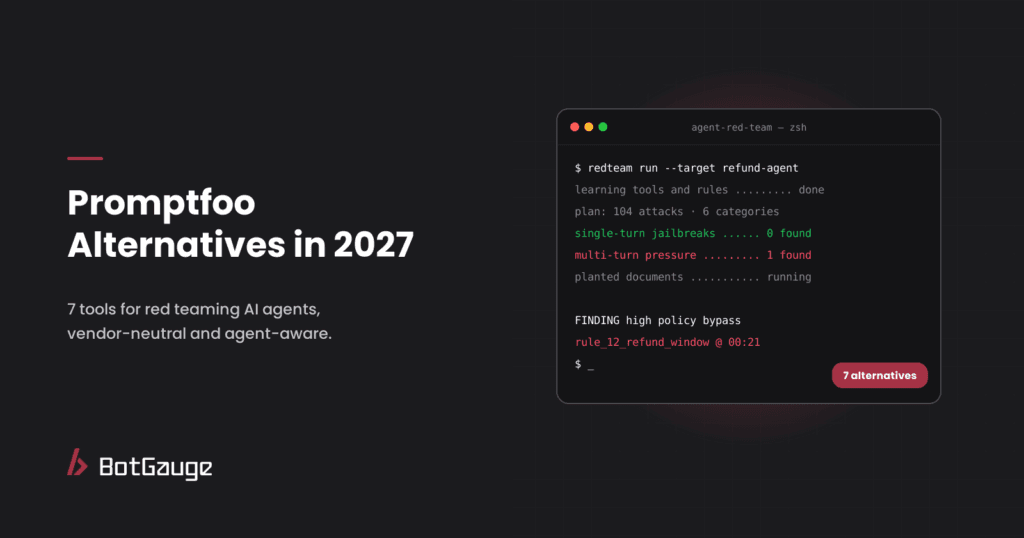
Where Promptfoo needs you to describe attacks in config, BotGauge learns your agent first. It connects to the agent, reads its tools and business rules, proposes an attack plan for you to approve, and runs adaptive black box and grey box attacks across approval rules, data ownership, multi-turn tricks and planted documents in retrieval.
When a rule is confirmed broken, BotGauge stops spending attacks there and shifts to other rules. Each finding arrives with severity, the conversation and the trace step where the policy check failed, then becomes a regression test. Runs scale from Core to Stress to Redline depth across more than 200 strategies, and a safety layer blocks attacks with real-world side effects. See BotGauge LLM red teaming.
Strengths: vendor-neutral; agent-aware; no config to maintain; trace evidence.
Limitations: not open source.
Best for: teams testing agents that move money, change accounts or touch customer data. See how multi-turn attacks on AI agents work.
2. DeepTeam: best Python library alternative
DeepTeam, from Confident AI, is an open-source framework for red teaming LLMs and agents, covering many vulnerability types and mapping to OWASP and NIST.
Strengths: Python-native; pairs with DeepEval metrics.
Limitations: release cadence has slowed since late 2025.
Best for: Python teams already on DeepEval.
3. Giskard: best for security plus quality
Giskard combines continuous red teaming with tests for hallucinations and business-logic errors, plus an open-source library. Considering it? Read our Giskard alternatives too.
Strengths: one report for quality and security; EU-based.
Limitations: full platform is commercial.
Best for: teams that want one vendor for both.
4. PyRIT: best for scripted campaigns
Microsoft’s PyRIT lets security teams script multi-turn attacks with attacker models, converters and scorers.
Strengths: flexible, research-grade, MIT-licensed.
Limitations: framework, not product; you build reporting.
Best for: in-house red teams with Python skills.
5. garak: best for model-level scans
NVIDIA’s garak probes models for jailbreaks, injection and leakage with a large probe library.
Strengths: fast baseline; open source.
Limitations: does not know your agent’s tools or rules.
Best for: a quick first pass on the underlying model.
6. Mindgard: best for enterprise security teams
Mindgard maps an organisation’s AI attack surface and tests models, agents and applications.
Strengths: inventory plus testing at scale.
Limitations: heavier than product teams usually need.
Best for: CISOs covering many AI systems.
7. Tencent A.I.G: best for MCP and AI infrastructure
A.I.G red teams agents, audits MCP servers and agent skills, and scans AI infrastructure for known CVEs. Apache-2.0. It covers several supply-chain risks in the OWASP Agentic Top 10.
Strengths: unusual mix of agent and infrastructure testing.
Limitations: its web platform has no authentication, so keep it off the public internet.
Best for: platform teams running their own MCP servers.
How to choose a Promptfoo alternative
| If you want… | Choose |
| Agent-aware attacks without writing config | BotGauge |
| An open-source Python library | DeepTeam |
| Security and quality in one place | Giskard |
| Full control over scripted campaigns | PyRIT |
| A fast model baseline | garak |
| Enterprise-wide coverage | Mindgard |
| MCP server and infra audits | Tencent A.I.G |
How to move off Promptfoo (or add to it)
- Keep what works. Promptfoo is MIT-licensed. Quick CI checks for prompt regressions can stay where they are.
- Export your test cases. Plugins and custom tests describe the risks you care about; carry them into your new tool’s test plan.
- List your agent’s rules and tools. Agent-aware tools need these to plan attacks. Refund windows, approval limits, data-ownership checks and escalation triggers come first.
- Add multi-turn and retrieval attacks. These are the gaps most teams hit with config-first tools.
- Run both for one release. Compare findings before you switch off any pipeline.
Final thoughts
Promptfoo is still a good tool, and its open-source core is not going anywhere. But agent teams now need two things it was not designed around: a testing layer no model vendor owns, and attacks that understand tools, retrieval and multi-turn pressure. Pick the alternative that closes your biggest gap, and keep the rest of your pipeline intact. For the full field, see the best AI agent red teaming tools.
New to the topic? Start with what AI agent red teaming is, then read about automated red teaming for AI agents.