A mid-level QA engineer in the US costs well over $180K a year once you add up salary, benefits, recruiting, and onboarding. AI testing agents handle a significant portion of that functional testing work at a fraction of the cost.
Cost rarely decides this, though. Plenty of cheap options fail anyway.
What matters is what kind of intelligence your quality problem needs.
AI Summary
Hiring cost: $180K to $220K in year one, all in. At 50 engineers, a QA team runs $600K to $900K a year.
AI-only tools: $6K to $36K a year. Managed options like BotGauge pair agents with human review at a similar price.
Testing evolution: scripted automation, then AI-augmented testing, then agentic testing, where AI generates and runs tests without anyone writing scripts.
Hire a QA team if: you face compliance rules, hardware testing, deep security work, or you’re past Series B with 50+ engineers.
Go autonomous if: you ship weekly, you’re early stage, your test suite is flaky, or you need coverage fast.
Best setup: mix both. AI runs the repetitive tests. Humans own strategy and the judgment calls.
The Real Question Engineers Should Ask
Most engineering teams frame this wrong. They post a QA job description, see the salary numbers, flinch, and then search for ‘AI test automation tools‘ as an alternative. That treats hiring and tooling as substitutes for the same job.
They’re not.
The right question: what kind of intelligence does your quality problem require? Some QA work demands human judgment. It needs someone who can think about what a frustrated user might do, read between the lines of a spec, or make a call when expected behavior is genuinely ambiguous. Other QA work is pure execution: run 500 regression tests, catch when the checkout flow breaks, and verify that every API endpoint returns the correct status code.
Judgment scales badly with AI. Execution scales beautifully with it. The teams that get this decision right decide which parts of their QA need which kind of quality intelligence, then staff accordingly.
What AI-Powered Testing Actually Means in 2026
Most AI testing platforms automate parts of the testing process. The latest generation of autonomous QA automates the entire testing lifecycle, while keeping humans involved where judgment matters most. Here’s how the approaches differ.
Scripted Automation
Someone writes Playwright or Selenium scripts. Tests run in CI/CD. When your UI changes, someone rewrites the selectors. Execution is automated. Every meaningful decision still needs a human. You’ve automated the clicking, not the thinking.
AI-augmented Testing
Tools like Mabl or testRigor use AI to make scripted tests more resilient. Self-healing selectors, suggested test cases, anomaly flagging. Better than raw Playwright, but humans still author and maintain the suite.
Agentic Testing
AI agents read your codebase, PRDs, and user flows, then generate test cases without human authoring. They run tests, triage failures, and self-heal when the UI changes. Think of it as a QA team that works 24/7, writes its own scripts, and never needs to fix broken selectors.
BotGauge goes further with AQaaS: AI agents plus a forward-deployed pod of human QA experts who validate tests and make the judgment calls agents can’t. Execution runs at machine speed. Judgment comes from experienced humans. No QA team to hire.
The True Cost of Building a QA Team From Scratch
A mid-level QA engineer in the US earns a base salary of $110K to $135K. That’s not the number to anchor on. Year-one all-in looks like this:
| Cost Category | Annual Range | Notes |
|---|---|---|
| Base salary (mid-level) | $110,000 – $135,000 | Senior: $140K-$160K |
| Benefits & payroll taxes | $22,000 – $40,000 | 20-30% of base |
| Tooling & infrastructure | $10,000 – $30,000 | CI/CD, staging, device farms |
| Ramp time (lost productivity) | $15,000 – $30,000 | 1-3 months at reduced output |
| Ongoing maintenance overhead | $20,000 – $35,000 | 30-50% of QA time on upkeep |
| Year-one all-in total | $180,000 – $220,000+ |
That maintenance line is the one most founders underestimate. Tricentis reports that QA engineers spend 30-50% of their total QA time maintaining existing tests rather than building new coverage. Every UI change is a tax on every sprint, forever.
A QA team also scales linearly. At 50 engineers, you need a QA team of 4-6, with fully loaded costs of $600,000-$900,000 annually. The test surface grows exponentially. The team grows arithmetically. The gap widens.
The True Cost of AI-Powered Testing
Traditional AI testing platforms sell licenses. BotGauge delivers outcomes. For about the cost of a standalone testing tool, BotGauge combines autonomous testing agents with expert human oversight, giving you the speed of AI and the judgment of experienced QA, without building an internal QA team.
| Factor | In-House QA Team | Tool-Only AI Testing | BotGauge |
|---|---|---|---|
| Year-one cost | $180K-$220K per hire | $6K-$36K | Scales with coverage need. The most affordable and scalable model for web app automation. |
| Time to first test | 1-3 months | Days to weeks | Days |
| Test maintenance | Manual, 30-50% of time | Partial self-healing | Full self-healing + humans |
| Coverage in 2 weeks | 10-30% | 40-60% | Up to 80% |
| Judgment & strategy | Yes | No | Yes (domain-specialized) |
Choosing a QA Team vs Autonomous QA
Work through these signals in order. Compliance requirements override everything else.
Signals That Point to Hiring a QA Team
- Compliance mandates: HIPAA, SOX, PCI-DSS, and similar regulations require named human sign-off. No tooling substitutes for this.
- Hardware or embedded systems: If your software interacts with physical devices, agents can’t test edge cases in person.
- Deep specialist testing: Security penetration testing or accessibility auditing at scale requires dedicated human expertise.
- Post-Series B with 50+ engineers: Quality coordination becomes a full-time strategic problem that requires a dedicated person.
- Proven automation ceiling: You’ve tried AI testing tools, found specific gaps they can’t close, and can measure them.
Signals That Point to AI-powered Testing
- High release cadence: You ship weekly or more often, with a growing regression suite that manual testing can’t keep pace with.
- Early-stage team: Fewer than 30 engineers, no compliance mandates, web or mobile product.
- Broken test suite: Flaky Playwright tests, low CI trust, developers bypassing checks.
- Maintenance drag: Engineering time going to test upkeep instead of feature work.
- Speed imperative: You need coverage in days, not after a 3-month hiring and ramp process.
The Hybrid Model
Growing engineering teams get the best results by combining people and AI, rather than choosing between them.
AI agents handle the repetitive work: test generation, regression testing, execution, self-healing, failure analysis. Domain QA experts handle strategy, exploratory testing, edge cases, and release decisions. BotGauge builds this into its Autonomous QA as a Solution.
With AQaaS, teams:
- Skip hiring and managing an internal QA team.
- Get autonomous AI agents backed by a forward-deployed pod of experienced QA experts, who validate results, handle the judgment calls, and keep improving test quality over time.
- Get AI’s speed and scale, plus human oversight, for about the cost of a standalone AI testing tool, with no overhead of building an in-house QA function.
What AI Testing Can’t Do Yet
Agentic AI testing in 2026 handles execution better than most QA teams. It doesn’t handle these:
- Exploratory testing with domain judgment: An agent follows paths it knows about. A good QA engineer imagines paths nobody documented, including the frustrated user who tabs through a form backward or the workflow that technically works but feels completely broken.
- Compliance sign-off: HIPAA audit trails, SOC 2 evidence, and PCI DSS testing documentation require named humans. Agents generate test evidence; auditors require human attestation.
- Hardware testing: If your software interacts with physical devices, someone needs to be in the same room as the hardware.
- Quality culture: A QA engineer embedded in your team catches quality issues before they become test cases. They push back in design reviews and coach developers on testability. Agents don’t sit in stand-ups.
What You Need in Place First
AI testing tools amplify good practices. They don’t fix broken ones. Before you bring in AI agents, check these three things:
- A working CI/CD pipeline: Agents need somewhere stable to run. If your CI pipeline is unreliable or your staging environment differs significantly from production, fix that first.
- Documented user flows or PRDs: AI agents generate tests from your existing documentation. If none exist, agents have nothing to reason from. You don’t need perfect docs, just enough to describe what your product is supposed to do.
- Someone who owns quality outcomes: Even with AI agents, someone needs to review failure reports and set the quality bar. BotGauge brings human judgment into its offering, not as an add-on at an extra cost.
The Cost of Getting This Wrong
Quality debt compounds quickly. Every release without reliable test coverage increases the likelihood that defects escape into later stages of the development lifecycle, where they become far more expensive to fix.
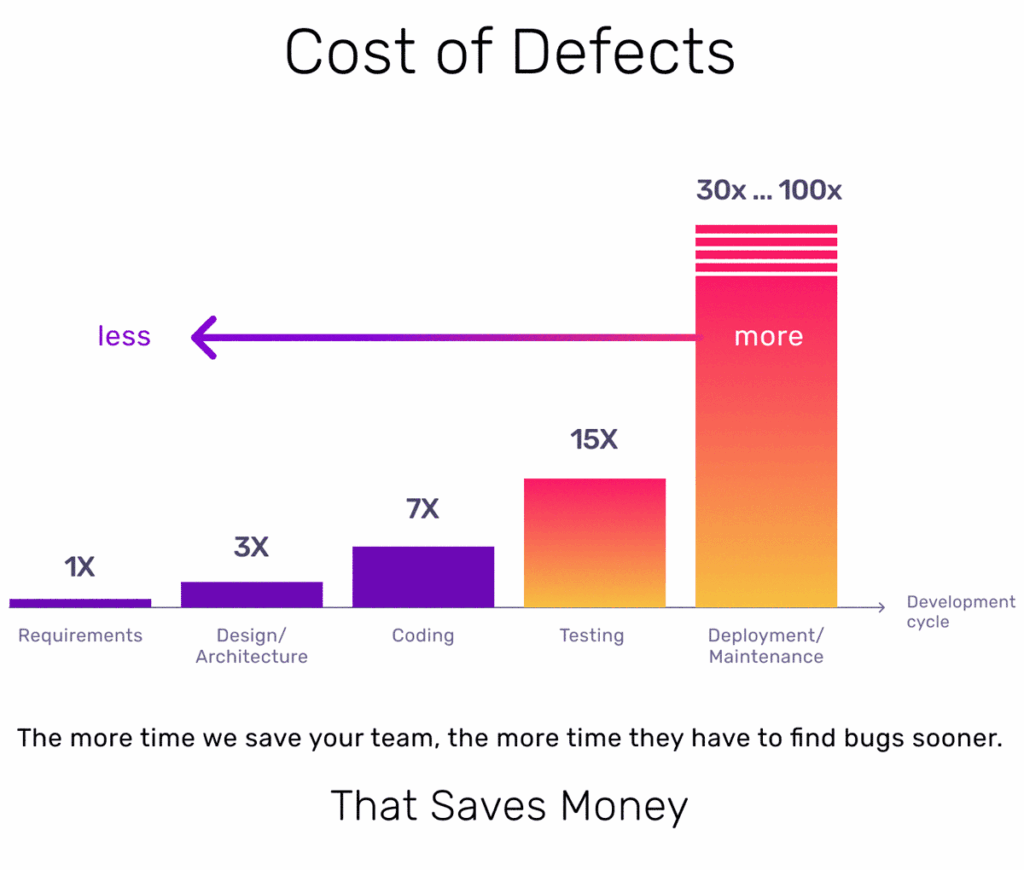
Industry research has consistently shown that the cost of fixing a defect rises dramatically the later it is discovered. A defect caught during the requirements phase represents the baseline cost (1x). That same issue can cost 3x more during design, 7x more during development, 15x more during testing, and 30x to 100x more in production.
The same principle applies to your QA strategy. Delaying automation or relying solely on manual testing doesn’t eliminate work. Instead, it shifts to a point where fixing bugs, maintaining tests, and recovering from production incidents becomes significantly more expensive. Investing in comprehensive, automated test coverage early reduces both engineering effort and business risk over the lifetime of the product.
BotGauge: The Future of AI in QA
BotGauge is a fully managed Autonomous QA partner for engineering teams that ship fast. AI agents generate tests from your PRDs, screenshots, user flows, and product videos. A forward-deployed pod of human QA experts validates those tests and handles judgment-intensive work.
- 80% test coverage in 2 weeks: 100% of critical user flows covered in week one
- Self-healing test automation: Adapts automatically when your UI changes; 90% reduction in maintenance overhead
- Full CI/CD integration: GitHub, Jira, Slack, and your existing DevOps pipeline
- Expert validation on every test: Agent speed with human-quality judgment
BotGauge is the right fit if you’re a fast-growing engineering team, shipping a web application, and don’t have compliance requirements mandating an in-house named QA role. It also works for teams with an existing QA team drowning in maintenance: BotGauge handles the execution layer, your team handles the strategy.
Check How Ripple Cut Regression Time by 90% with BotGauge – Read Case Study
Conclusion
A QA engineer knows your product, your users, your edge cases. Autonomous QA runs those checks a thousand times a day without getting tired or skipping the boring ones. One thinks. The other scales.
The teams shipping fast right now use both. A human sets the strategy. Tools like BotGauge handle the repetitive grind, agentic flows, tool-call checks, and regression runs, so your engineer spends time on judgment calls instead of clicking through the same test suite for the tenth time this week.