API Automation Testing: Implementation and Best Practices
API automation testing verifies every endpoint on every build: software sends the requests, validates the responses, and reports failures with no human in the loop. If your team still checks APIs by hand, bugs are reaching production quietly. We cover how it works, the tests worth running, the practices that keep a suite trustworthy, and the real question: who should own this work.
Key Takeaways
- API automation testing sends requests, validates responses, and reports failures automatically on every build, with no human in the loop.
- APIs fail quietly: a 200 with wrong or empty data looks like success to every dashboard, which is why untested endpoints reach production unnoticed.
- Maintenance, not test writing, is where most API automation programs die. Every contract change breaks tests, and the repair work compounds as the suite grows.
- Test the unhappy paths deliberately. Bad inputs, missing auth, and malformed payloads are where real production incidents come from, not the happy path.
- A strong program layers functional, contract, integration, and negative tests, weighted by how much damage each failure would cause.
- The real decision is ownership: build and staff the suite in-house, or buy coverage as an outcome from an autonomous system that generates, runs, and heals the tests for you.
Your APIs change every sprint. The tests, if they exist, rarely keep up, and that gap is exactly where production incidents come from. A renamed field, a shifted contract, an endpoint returning 200 with nothing in it: none of these fail loudly until a customer finds them. This blog covers how API automation testing works in practice, the types of tests worth layering, the habits that keep a suite trustworthy, and the decision underneath it all: whether your team should own this work or hand it to an autonomous system.
What is API Automation Testing
API automation testing is the practice of using software to automatically send requests to an API, validate the responses against expected results, and report failures, without manual effort. Instead of a tester manually calling endpoints and checking outputs, automated scripts or agents run those checks continuously, on every code change.
The goal is simple: confirm that every endpoint returns the right data, in the right format, with the right status codes, under both normal and failure conditions. When teams talk about automation API testing in practice, they mean wiring these checks into the development pipeline so a broken API is caught minutes after the change that broke it, not days later in production.
If you are wondering what is API automation testing compared to plain API testing, the difference is just the "automation": the same validations, executed by machines on a schedule or trigger rather than by people on demand.
What are APIs?
An API (Application Programming Interface) is the contract that lets two pieces of software talk to each other. When your food delivery app shows you a map, checks your payment, and sends a confirmation text, that is three different APIs working behind one screen.
APIs matter to testing because they are where systems connect, and connections are where software breaks. The industry numbers make the point: in Postman's 2025 State of the API report, 69% of developers spend 10 or more hours per week on API-related tasks, which makes APIs some of the most touched, most changed, and therefore most breakable surfaces in your product.
There is also a new pressure. The same report found that 89% of developers now use generative AI in their daily work, yet only 24% design APIs with AI agents in mind. AI is writing and consuming more API code than ever, while the discipline of verifying that code lags behind. That gap is exactly where API failures are born.
The Importance of Automated API Testing
Automated API testing matters because APIs fail quietly and expensively. A broken button is visible; a broken endpoint returns a wrong number that nobody notices until a customer does. The classic version of this story: after a version migration, an endpoint starts returning 200 with an empty body instead of a 404. Every consumer treats the 200 as success, dashboards stay green, and the data quietly stops arriving. Nobody scripted a test for "success with nothing in it," so nothing failed until a customer asked where their records went.
Three reasons make automation non-negotiable for any team shipping regularly:
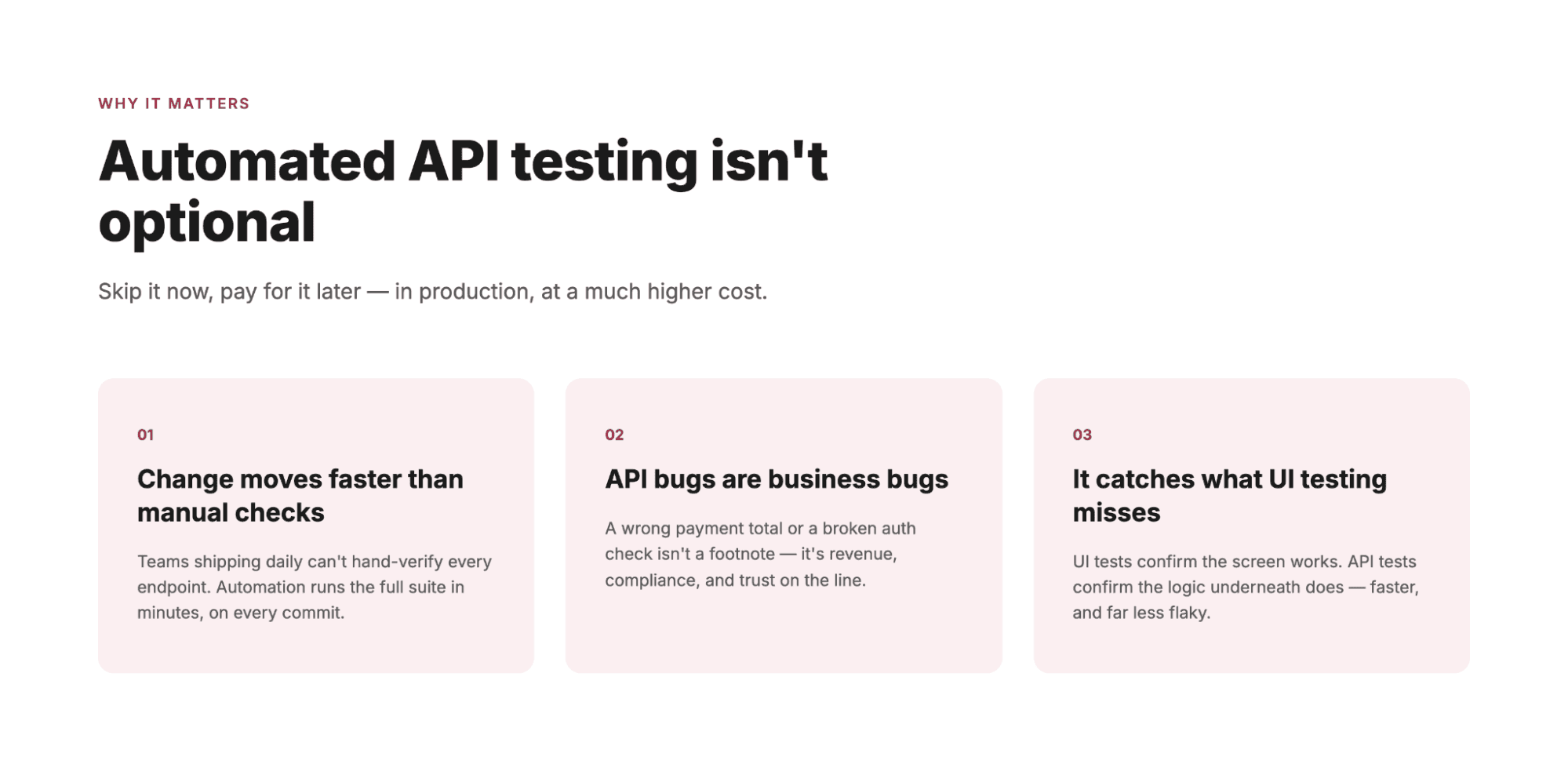
- Speed of change has outrun manual checking. Teams deploying weekly or daily cannot manually re-verify dozens of endpoints on every release. Automation runs the full battery in minutes, on every commit.
- APIs are the backbone, so API bugs are business bugs. A payment API returning the wrong total or an auth API letting the wrong user in is not a technical footnote. It is revenue, compliance, and trust on the line.
- Rest API testing automation catches what UI testing misses. UI tests confirm the screen works; API tests confirm the logic underneath works, including error paths, edge cases, and integrations a user never sees. Testing at the API layer is also faster and far less flaky than testing through a browser, which is why mature teams test heavily at this layer.
The teams that skip this do not avoid the cost. They just pay it later, in production, at a much higher price.
See which of your API endpoints are going untested today
Get a Free Bug ReportChallenges of API Automation Testing
API automation testing is valuable, but teams consistently hit the same walls. Knowing them upfront is how you avoid a stalled program.
Test maintenance eats the gains
APIs evolve: fields get renamed, contracts change, versions ship. Every change breaks tests that were written against the old shape, and fixing them again and again becomes the biggest hidden cost of automation. This, not writing the first tests, is where most API automation efforts quietly die.
Test data is fragile
API tests need realistic data: valid users, tokens, records in the right state. Managing that data across environments, and resetting it between runs, is ongoing operational work that most teams underestimate.
Coverage decisions are hard
Which endpoints, which error paths, which combinations of parameters? Testing everything is impossible, and testing only happy paths misses where the real bugs live.
Skills and bandwidth
Writing good automation scripts requires engineering skill, and those engineers are usually needed for product work. The result is a chronic tug-of-war between building features and protecting them, which is the same math behind whether to hire a QA engineer or automate.
Environments and dependencies
APIs rarely stand alone. They call databases, third-party services, and other internal APIs, so a test failure may reflect a dependency problem rather than a real defect, which erodes trust in the results.
Every one of these challenges is solvable. The question each team must answer is whether they solve it with internal headcount or hand the whole problem to a system built for it. Hold that thought for the strategy section below.
Move from hand-maintained API tests to autonomous coverage in 48 hours
Explore AQaaSKey Considerations for API Automation Testing
Before writing a single automated test, five considerations will shape whether your program succeeds:
- Start from risk, not from endpoints. Rank your APIs by business impact, the same risk-first logic that governs test coverage decisions everywhere else; low-stakes read endpoints get a lighter pass.
- Test the contract, not just the response. Validate schemas, data types, and required fields, so a silent contract change fails loudly in testing instead of silently in production.
- Cover the unhappy paths deliberately. Wrong inputs, missing auth, timeouts, malformed payloads. Most production incidents come from the paths nobody tested.
- Decide your maintenance strategy on day one. Who updates tests when the API changes? If the answer is "whoever has time," the suite will rot. This is where self-healing automation earns its place.
- Plan for CI/CD from the start. A suite that only runs before releases gives feedback too late. Design for tests that trigger on every commit.
How API Automation Testing Works
At its core, every automated API test follows the same loop: send a request, receive the response, compare it against expectations, report the result. The implementation happens in four stages.
1. Define what to verify
For each endpoint, specify the inputs, the expected outputs (status codes, response bodies, headers), and the failure behaviors that must be handled gracefully. Concretely: GET /orders/{id} with a valid ID must return 200 and an order object with the amount as a number. With a deleted ID it must return 404, not a 200 with an empty body. That second case is the kind of rule nobody writes down and everybody assumes, right up until it breaks.
2. Create the tests
Traditionally, engineers script these checks in a framework or a tool like Postman. Increasingly, AI systems generate them instead: modern autonomous testing agents can read your API specifications and PRDs and produce the test cases automatically, which removes the biggest upfront effort. Our guide to automatic AI test case generation covers how that works.
3. Execute continuously
The tests are wired into your CI/CD pipeline so they run on every commit or on a schedule, across environments, without anyone pressing a button.
4. Report and act
Failures are surfaced with enough detail to reproduce the problem: the request sent, the response received, and the assertion that failed. A failed API test blocks the change from moving forward until it is resolved.
The loop is simple. The hard part is keeping it running as the API changes, which is why modern approaches focus as much on test maintenance as test creation.
Watch self-healing repair a broken API test on your own application
Get a WalkthroughTypes of Automated API Tests
Different API tests answer different questions. The easiest way to see the difference is to take one endpoint and watch each test type interrogate it. Say you run a payments product with a POST /refunds endpoint.
- Functional tests ask the basic question: does a valid refund request return a 200 and actually create the refund? This is the foundation, and where every program starts.
- Contract tests check the shape rather than the behavior. If a developer renames "refund_amount" to "amount" in the response, every consumer of this API breaks silently. A contract test catches the rename before any of them feel it.
- Integration tests verify the chain: create an order, pay for it, refund it, then fetch it and confirm the status reads refunded. Real usage is chains, not single calls, and this is where the bugs between endpoints live.
- Negative tests get hostile on purpose. A refund for more than the order total. A refund with an expired token. A refund for someone else's order. The correct answer to all three is a clear, safe error. The dangerous answer is a 200.
- Performance and load tests ask what happens when a thousand refunds land in the same minute after a botched product launch, because an endpoint that works but takes eight seconds is still broken for users.
- Security tests probe whether the wrong user can do the wrong thing: can a customer trigger a refund to a card that is not theirs?
- Regression tests are all of the above, re-run on every change, so next month's new feature never quietly breaks this month's refund logic.
One endpoint, seven different questions. A strong program layers most of them, weighted by how much damage each failure would do.
The Benefits of API Test Automation
Done well, API test automation pays back in ways leaders can measure, and the returns compound.
The first return is speed. Full API verification runs in minutes instead of days, which removes testing as the release bottleneck, and bugs surface at commit time when they cost minutes rather than in production where they cost incidents, hotfixes, and trust. The second is scale: hundreds of endpoints, thousands of parameter combinations, and every error path, verified on every single build. No manual team matches that, and no manual team matches the consistency either. Machines run the same checks identically every time. No skipped steps at 6pm on release day.
Then there is the quieter return: capacity. Postman's research has consistently found developers spend a large share of their API time on debugging and manual testing. Automation hands that time back to building product.
But the benefit engineering leaders end up valuing most is not on any dashboard. It is a reliable release signal. A green API suite that the team actually trusts turns "are we safe to ship?" from a Friday afternoon debate into a data point.
Best Practices for Automated Testing
Picture two teams a year after adopting API automation. One has a suite everyone trusts: a red build stops the release, no arguments. The other has 800 tests, 40 of them failing on any given day for reasons nobody has investigated, and engineers merging past the red anyway. Same tools. Different habits. These are the habits that separate them:
Prioritize by business risk
Revenue-critical and security-critical endpoints get tested first, deepest, and on every run. Never let a time-boxed run skip them.
Keep tests independent
Each test should set up and clean up its own data, so tests can run in parallel and one failure never cascades into false failures elsewhere.
Validate structure and values
Assert on schemas and data types, not just status codes. A 200 response with wrong data is the most dangerous failure there is.
Make every failure reproducible
Log the full request, response, and environment for each failure, so triage takes minutes instead of an afternoon of guessing.
Run on every change, not before releases
Feedback within minutes of a commit is worth ten times the same feedback the night before launch.
Treat maintenance as a first-class cost
Budget for it, measure it, and adopt self-healing approaches that update tests automatically when the API evolves. The teams that fail at API automation almost always failed at maintenance, not at test writing. That second team above did not choose to ignore red builds. Their suite decayed until ignoring it was rational.
See how automated regression testing keeps a suite alive as the product changes.
Retire dead tests
A smaller, trustworthy suite beats a large, noisy one.
Is API Test Automation Right for Your Team?
Some teams should automate their API testing immediately. Others should start smaller. Here is a quick read on where you stand.
Automate now if you:
- Ship weekly or faster and still verify endpoints by hand
- Run the same API regression checks every sprint
- Have had a production incident an API test would have caught
- Maintain integrations or webhooks that other teams depend on
Start smaller if:
- Your API is early-stage and its contract changes every week
- You have fewer than a dozen endpoints and a slow release cadence
- Nobody on the team can own the suite yet, even part-time
Consider autonomous coverage if:
- You want API coverage in days without standing up a framework
- Test maintenance, not test writing, is your biggest drain
- Your engineers are stretched and QA is the release bottleneck
- You need the API layer and the UI layer tested as one system, because your worst bugs live at the seam between them
How to Choose an API Testing Tool
Five questions will tell you most of what you need to know.
1. What does your stack look like?
Postman fits collection-based workflows, REST Assured fits Java-heavy teams, and Karate suits mixed-skill teams that want readable syntax. Match the tool to the people who will live in it.
2. Who will write and maintain the tests?
If the answer is "engineers who are already busy," be honest about how long the suite will stay healthy. A tool your team cannot staff is shelfware with a login.
3. Does it test beyond the happy path easily?
Negative cases, auth failures, and malformed payloads are where API bugs live. If adding them is painful, they will not get added.
4. How does it integrate with your pipeline?
Tests that do not run on every commit give feedback too late. Native CI/CD integration is a requirement, not a feature.
5. What is the total cost of ownership?
License cost is the starting point. Add setup time, the engineering hours spent writing tests, and the permanent maintenance burden as your API evolves. A free framework that consumes half an engineer is not free, and this question, more than any feature comparison, usually decides the build-versus-buy answer.
Always run a pilot before committing: take ten of your highest-risk endpoints, build the tests in the tool you are evaluating, then change something in the API and watch what breaks.
Your API Testing Strategy
Here is the honest strategic question underneath everything above: who should own this work?
Every challenge and best practice in this guide points at the same tradeoff. Building API automation in-house means hiring or reallocating engineers, choosing and learning frameworks, building the data and environment plumbing, and permanently staffing the maintenance burden as your API evolves. It is entirely doable, and for some teams it is the right call.
But look at the actual math for a moment. The engineers who would build and maintain this are the same engineers you need shipping product. Every hour spent fixing a broken test after a contract change is an hour not spent on features. And the maintenance never ends, because your API never stops changing. This is why so many API automation programs launch strong and quietly decay within two quarters.
The alternative model is to treat API test coverage as an outcome you buy rather than a system you operate, the approach behind QA as a Service. An autonomous layer that generates the tests from your specs and flows, runs them on every commit, heals them when your API changes, and hands you the results, with human QA experts validating what the automation finds. Your team reviews a release signal instead of babysitting a framework.
Neither answer is universally right. If you have dedicated SDET capacity and a slowly-changing API, in-house works. If your API changes weekly, your engineers are stretched, and testing is currently the bottleneck between you and faster releases, operating your own test infrastructure is probably the wrong use of your team.
That second situation is exactly what BotGauge was built for.
How BotGauge Helps with API Automation Testing
BotGauge delivers API test coverage as part of its Autonomous QA as a Solution model. One honest framing matters here: BotGauge is not a standalone API-only tool the way Postman is. It tests your APIs as one layer of full end-to-end coverage, alongside UI and functional testing, and for most product teams that is the stronger position, because the worst API bugs are the ones that surface at the seam between the API and the interface built on it. A pure API tool passes the endpoint; a pure UI tool passes the screen; the bug lives between them.
Here is what that looks like in practice:
AI agents generate API tests from your product context
Share your API specifications, PRDs, or product flows, and BotGauge's agents map your functional, UI, and API workflows together, generating the functional, integration, and negative tests, including the error paths and edge cases teams rarely get to. No frameworks to stand up, no scripts to author.
Self-healing keeps the suite alive
When your API contract or workflows change, the affected tests are detected and updated automatically, so the maintenance burden that kills most API automation programs is not yours.
Everything runs in your pipeline, next to what you already use
Tests trigger on every commit through native CI/CD integration with unlimited parallel runs, and BotGauge integrates with the tools already in your workflow, including Postman, GitHub, GitLab, Jira, and TestRail. Your tests remain yours to keep, export, or migrate, with no vendor lock-in.
Humans validate what matters
Every suite is reviewed by a dedicated domain FDE pod before it runs, so you get automation speed without losing human judgment on what counts as a real defect.
The results are concrete: critical flows automated in 24 to 48 hours, around 80% coverage in about two weeks, and outcome-based pricing where you pay for coverage delivered, not seats or licenses. It is SOC 2 Type II compliant, with full data isolation for teams in regulated environments.
Start your API testing pilot. Generate, run, and maintain API tests across your CI/CD workflow with less manual effort
Try for Free30 days, on your real application, with no setup or infrastructure needed on your side.
Book a DemoConclusion
API automation testing is not really a tooling decision. It is a decision about how much silent risk you are willing to ship. Every untested endpoint is a bet that nothing changed, and your API changes every sprint. The teams that get this right automate the checks, protect the unhappy paths, and answer the ownership question honestly: if your engineers cannot carry the maintenance, stop pretending they will. Test coverage that keeps pace with your API is no longer a luxury or a quarter-long project. It is 48 hours away, if you want it to be.
Frequently Asked Questions
TABLE OF CONTENT