Poor-quality software cost the industry $2.41 trillion last year. Most of that loss came from bugs caught too late, releases that broke production, security gaps that slipped past internal teams, and features shipped without automated coverage.
The companies absorbing that cost share a pattern: they treated QA as an afterthought, or they tried to do it entirely in-house with a team that couldn’t keep up with shipping velocity.
QA as a service (QAaaS/QaaS) solves a specific problem. You need consistent, expert testing coverage across your product, but you can’t or don’t want to hire, train, and retain a full QA department. QAaaS gives you the coverage without the overhead.
What is QA as a Service?
QA as a service is an outsourced model where a third-party vendor handles your software testing. You define the scope; they run it. The pricing is outcome-based, that is, you pay per deliverable: test cases written, coverage milestones hit, bugs documented, and reports filed.
The term gets used interchangeably with Testing as a Service (TaaS). They’re essentially the same thing: on-demand testing delivered as a managed service via cloud-based tools and infrastructure.
Where QaaS differs from traditional QA outsourcing is the pricing model. Traditional outsourcing means paying for engineers by the hour or month, whether they’re busy or not. QaaS is outcome-based: you pay for what gets produced.
There’s also a newer model worth understanding: Autonomous QA as a Solution (AQaaS) by BotGauge. AI agents generate and execute tests; human QA experts validate coverage and edge cases. The result: 80% test coverage in 2 weeks without building a QA function from scratch. BotGauge is the only platform built specifically on this model.
Here’s how different QA models compare:
| Model | Pricing | Time to start | Scalability | Test maintenance |
|---|---|---|---|---|
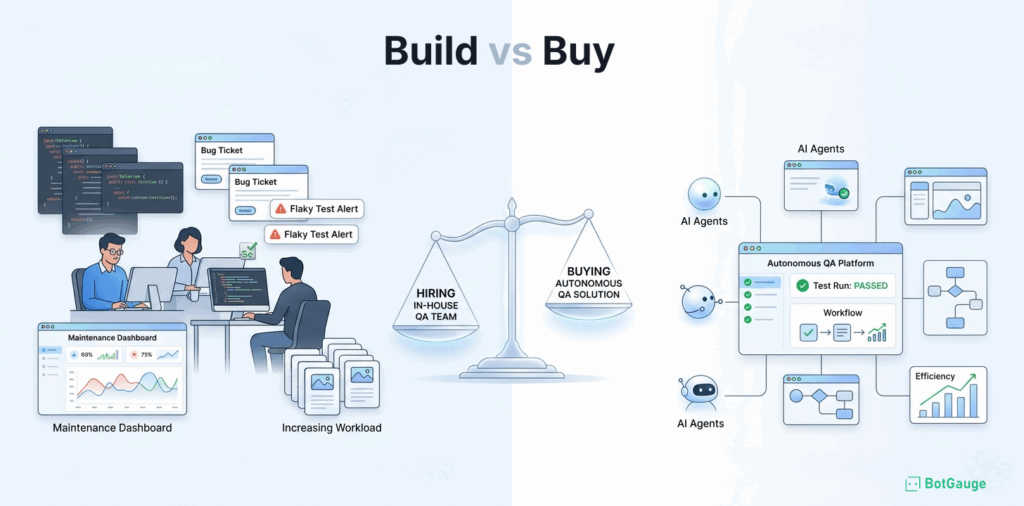
| In-house QA | Includes the cost of every individual’s hiring, training, salary, retention, bonus | 2-6 months | Not a scalable model in a long run. Resource extensive. | Your team |
| Quality as a Service(QaaS) | Contract based. | 2-4 weeks | Not a scalable model in a long run. Time extensive. | Vendor |
| AQaaS by BotGauge | Outcomes based pricing, you pay for coverage and QA outcomes delivered | Instantly. Guranteed 80% critical coverage delivered in 24-48 hrs | Highly scalable. You testing is done for you by AI + Human QA experts. | AI-managed |
Key characteristics of QA as a service
Not every testing vendor operates on a genuine QaaS model. Here’s what separates real QaaS from ‘we’ll test your software’:
- On-demand scaling
You can increase testing coverage for a major release and cut back during a quiet sprint, with no hiring or firing decisions.
- Outcome-based pricing
You pay for what gets delivered – test cases written, tests run, bugs found, reports generated. If the vendor isn’t producing, you aren’t paying.
- Cloud-based infrastructure
Browsers, devices, testing environments, parallelization – the vendor owns all of it. You don’t buy hardware or maintain a Selenium grid.
- CI/CD native integration
Tests run on every pull request and before every deployment. The suite connects to your pipeline without manual triggers.
- AI-assisted execution
The best QaaS providers use AI to generate test cases from requirements documents, maintain locators when the UI changes, run test suites autonomously, and surface root cause diagnosis when something fails.
Core Components of QA as a Service
A QaaS engagement typically covers 6 components. Understanding them helps you scope what you’re buying.
1. Test strategy and scoping: Mapping the testing effort to your product’s risk profile: which flows to automate and how often to run them.
2. Test case design: Writing the actual test cases: what to click, what to assert, what inputs to use, what edge cases to cover.
3. Test execution: Running the suite on schedule, against every pull request, or on demand before a release.
4. Reporting and analytics: Bug reports with enough context to reproduce, pass/fail dashboards, and trend data over time.
5. CI/CD pipeline integration: Connecting the test suite to GitHub Actions, Jenkins, GitLab CI, or whatever your team already uses.
6. Ongoing maintenance: Updating tests when the UI changes, fixing broken locators, and retiring tests for deprecated features. This is where most in-house efforts fall apart. A good QaaS provider owns it entirely.
With BotGauge, every phase of testing lifecycle is owned by AI, and validated by dedicated Forward-Deployed Engineers (FDE) pod.
How Does QA as a Service Model Work?
The engagement follows a consistent pattern, even if the specifics vary by provider.
Week 1: Discovery and scoping
The QaaS team reviews your product, existing test artifacts, tech stack, and CI/CD setup. They map out which flows to test first and what the initial coverage target looks like.
Week 2: Test design and framework setup
Test cases get written. For automation, the framework goes up: Page Object Model, stable locators (data-testid, ARIA roles), and environment configuration. For manual coverage, test plans get documented.
Weeks 3-4: Execution and first reporting
Tests run. Bugs get logged with reproduction steps, screenshots, and environment details. You get your first pass/fail dashboard.
Ongoing: Iteration and maintenance
The suite runs on every deployment. When features change, the team updates the tests. Flaky tests get fixed at the root cause.
With BotGauge’s AQaaS model, the timeline compresses significantly. AI reads your PRDs and generates test cases before week 2 begins. Self-healing handles locator maintenance automatically. The 48-hour onboarding to first test running is the standard engagement.
Types of Quality Assurance as a Service
QaaS covers most of the testing lifecycle. The types you use depend on your product, your stack, and your release cadence.
Functional QA as a Service
Validates that features work as specified: login flows, form submission, checkout, and user account management. The baseline every product needs.
Test Automation as a Service
The vendor builds and runs automated test suites in your CI/CD pipeline. Typically uses Selenium, Cypress, or Playwright for web; Appium for mobile, or any framework that suits your requirements.
Performance Testing as a Service
Load testing, stress testing, scalability testing. Identifies how the system behaves under concurrent users, data volume, and peak traffic conditions.
Security Testing as a Service
Vulnerability scanning, penetration testing, OWASP Top 10 coverage. Particularly important for fintech, healthcare, and products handling sensitive user data.
Regression Testing as a Service
Running the full test suite after every release to confirm that new changes didn’t break existing functionality.
Accessibility Testing as a Service
WCAG 2.1 compliance testing – keyboard navigation, screen reader compatibility, and color contrast. Increasingly required by law in regulated markets.
Exploratory Testing as a Service
Unscripted testing by experienced QA engineers looking for bugs that structured test cases miss. Especially useful for new features where expected behavior isn’t fully defined.
Autonomous QA as a Solution (AQaaS)
AQaaS is a modern managed testing services by BotGauge for fast-growing engineering teams that needs ship weekly. Unlike traditional QaaS, AQaaS is powered by AI testing agents with a human-in-the-loop approach, making software quality robust, efficient, and scalable.
AI agents generate test cases from product documentation and screen recordings, execute them autonomously, and self-heal when the code changes. Human QA experts validate coverage for critical flows. BotGauge is built specifically on this model.
Selenium is not built for teams shipping daily. BotGauge is. – Book a Demo
Types of QA testing
A few distinctions that matter when scoping a QaaS engagement:
- Functional vs non-functional: Functional testing checks what the software does: features, user flows, business logic. Non-functional testing checks how it does it: speed, security, reliability, accessibility.
💡 Explore how BotGauge automates functional testing using autonomous agents.
- Manual vs automated: Manual testing requires a human: exploratory sessions, UX review, judgment calls on new features. Automated testing runs without one: regression suites, cross-browser checks, and performance benchmarks.
- Black-box vs white-box: Black-box testing treats the system as a user would, with no knowledge of the internal implementation. White-box testing uses code-level knowledge to target specific execution paths.
Most QaaS engagements use all 6 testing types at different stages of the development cycle. The mix depends on the product’s risk profile and release velocity.
Benefits of QA as a Service
Cost reduction
A mid-level QA engineer in the US costs $70k-120k per year in salary, plus recruiting (15-20% of annual salary), benefits (20-30% of salary), tooling, and training. You pay full-time rates during quiet periods. A QaaS engagement covering equivalent scope typically runs 40-60% less so you pay only for active testing cycles and share infrastructure costs across the vendor’s client base.
Speed to coverage
Building an in-house QA function from scratch – hiring, onboarding, writing test cases, setting up automation which typically takes 3 to 6 months before you have a reliable suite. With QaaS, coverage starts in weeks. If you that’s fast, wait.
With BotGauge, 80% coverage is achieved in 2 weeks. Critical flows are automated in 24-48 hours of onboarding.
Access to domain expertise
A QaaS provider has worked across dozens of tech stacks, industries, and product types. Your in-house team has worked on yours. That breadth matters for finding the bugs that teams blind to their own product consistently miss. With BotGauge, every test generated or run for you by our AI testing agents is validated by a vertical-specialized QA expert.
AI advantages in QA
AI-native QA as a Service providers, like BotGauge, use ML models to generate test cases from PRDs with no scripting, computer vision to keep locators stable as the UI changes, LLMs to trace root causes when a test fails, and agent-based runners to execute suites end to end.
A bug report from BotGauge reads: ‘checkout button unclickable on Safari 17 at 768px due to a z-index conflict with the cookie banner.’ That specificity cuts debugging from hours to minutes.
Scalability without hiring decisions
You need 3x more testing coverage for your Q4 release. With an in-house team, that means hiring or burning people out. With QaaS, you adjust the scope. Coverage scales with product demand.
Reduced management overhead
Recruitment, onboarding, performance management, tooling – the QaaS provider owns all of it. Your engineering team stops managing testers and starts receiving test reports.
Faster time to market
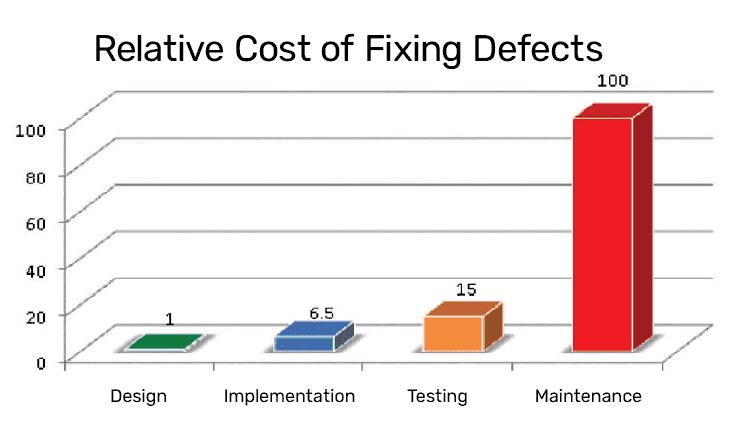
According to a report by IBM’s Systems Sciences Institute, teams spend significantly more to fix defects as software moves through the development lifecycle. Fixing a bug during implementation can cost about six times more than addressing it during the design phase. Once a product reaches production, the cost rises even further, organizations may spend four to five times more than they would during design and up to 100 times more than they would if they resolved the issue earlier.
As a result, the financial impact of software defects increases dramatically the later teams detect them in the SDLC.
Challenges of Choosing QA as a Service
Every QaaS engagement comes with friction. Here’s what to plan for, and how to address each one.
Communication across time zones
Remote QA teams mean asynchronous handoffs, which slow feedback loops. Define communication SLAs upfront. Establish async reporting rhythms – daily summaries, real-time dashboards and a dedicated channel (Email, Slack, or any) for urgent bugs.
Context onboarding gap
A new QA partner needs time to understand your product and your definition of done. That first sprint is always slower. Provide PRDs and past bug reports at kickoff. The more context upfront, the faster coverage starts.
AI-native providers like BotGauge read your documentation directly, which closes the gap faster.
Reduced direct oversight
You’re not watching the testing happen in real time. Require CI/CD integration with live dashboards.
IP and data security
Sharing product access with a third party creates exposure. Confirm NDAs, SOC 2 Type II certification, role-based access controls, and no external model training before signing. If the vendor uses AI, ask explicitly whether your test data is used to train their models.
BotGauge never sends your application data to external AI models for training. Your data stays as yours always.
Vendor lock-in risk
Some providers build your test suite in proprietary tooling you can’t take with you. Ask about test artifact ownership upfront. Your tests should be portable, written in standard frameworks like Playwright, Cypress, or Selenium, not locked inside a vendor’s dashboard.
Choosing the Right QA partner for Your Team
Most providers claim to be full-service and expert-level. Here’s how to evaluate them specifically.
What to look for
- Certifications: SOC 2 Type II for data security. ISO 27001 for information management. ISTQB certifications for individual engineers. If a vendor can’t produce these on request, that matters.
- CI/CD compatibility: Does the test suite plug into GitHub Actions, Jenkins, and GitLab CI without custom work? Native integrations should be table stakes.
- Pricing model transparency: Outcome-based pricing (per test case, per coverage milestone) aligns incentives better than hourly billing. Understand exactly what you’re paying for before signing. BotGauge is the only autonomous QA solution that offers outcome-based testing.
- Domain expertise: A QA partner with fintech experience understands compliance testing. One with healthcare experience understands PHI handling. Ask for client references in your industry specifically. BotGauge assigns a dedicated FDE pod who specializes in your industry and application type, to make testing seamless.
- IP ownership: Your test artifacts, scripts, and reports should belong to you. Confirm this in writing before engagement.
- Reporting quality: Ask for sample bug reports before committing. A good report includes reproduction steps, environment details, screenshots, and severity assessment.
Red flags to watch for
- No case studies or client references in your industry
- Pricing significantly below market with no explanation for how
- Test suite built entirely in proprietary tooling with no portability
- No SOC 2 certification for a product handling user data
- No defined discovery process – ‘we’ll figure out scope as we go’
- AI tooling with no clarity on whether your data trains their models
BotGauge covers all the above evaluation criteria and adds one more: AI-generated tests from your PRDs mean the engagement starts producing coverage within 48 hours of kickoff, not 2 weeks. Start your free pilot today.
Is QA as a Service Right for Your Workflow?
Use QaaS now if:
- You run the same regression tests every sprint, and a human is still doing them
- Your team ships weekly or faster, and manual QA is a bottleneck before each release
- You need testing coverage across multiple browsers, devices, or environments
- You’ve had a production bug that should have been caught in testing
- You want to add QA capability without adding headcount
Consider a smaller start if:
- Your product changes every week, and the expected behavior isn’t stable yet
- You don’t have product documentation that a vendor can work from
- Your test cases are exploratory and change with every sprint
Consider AQaaS if:
- You want 80% coverage in 2 weeks without building a framework
- Test maintenance is your biggest QA pain point
- Your team lacks dedicated QA engineers
- You need coverage that self-heals as the UI evolves
- Your engineers ship daily or weekly
- You want testing that runs at the speed of AI development
Conclusion
QA as a service works because it separates two things that most teams bundle together: the need for expert testing coverage and the operational overhead of maintaining a QA team.
You can have the first without the second. A good QaaS provider handles strategy, execution, tooling, and maintenance. You get the bug reports and the coverage metrics.
For teams that want that without managing a vendor engagement at all, BotGauge’s AQaaS model takes it a step further: AI generates your tests from product documentation, a dedicated QA team validates coverage, and the suite runs and heals itself. 80% coverage in 2 weeks, fully integrated into your CI/CD pipeline.