TL;DR
The best AI guardrails tools depend on where they run: cloud-native services like Bedrock Guardrails, Azure AI Content Safety and Model Armor; open-source frameworks like NeMo Guardrails and Guardrails AI; and specialist APIs like Lakera Guard. Most screen text, not the tool calls agents make, so pair them with limits in your own systems and red teaming. BotGauge tests whether your guardrails hold.
What Are AI Guardrails Tools?
AI guardrails tools screen what goes into and comes out of an AI model or agent. They block prompt injections, redact personal data, keep answers on topic and validate output formats. For a deeper look at what guardrails catch and what they miss in agents, read our guide to AI guardrails for AI agents.
How do AI guardrails tools compare?
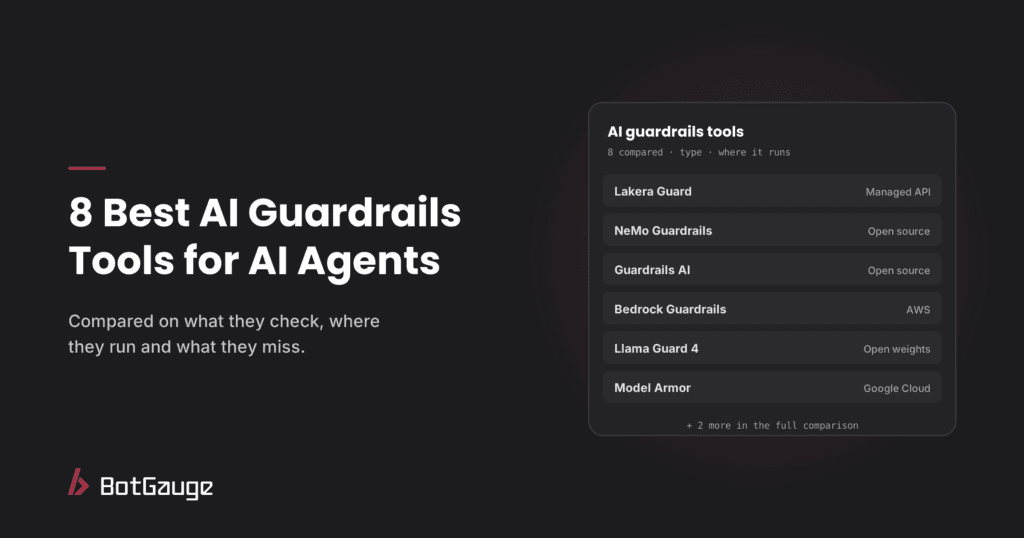
| Tool | Type | Runs | Best for | Agent blind spot |
| Lakera Guard (Check Point) | Managed detection API | SaaS, private deployment on enterprise terms | Prompt injection and data leakage screening | Judges messages, not tool arguments |
| NVIDIA NeMo Guardrails | Open-source framework (Apache 2.0) | Self-hosted, in your app | Programmable dialog and topic rails | Learning curve; action rules are yours to write |
| Guardrails AI | Open-source framework + Hub validators | Self-hosted, in your app | Structured output and validator chains | No first-class tool-call inspection |
| Amazon Bedrock Guardrails | Cloud-managed service | AWS | AWS teams; also works with non-Bedrock models | Policies are text-level |
| Azure AI Content Safety | Cloud-managed service | Azure | Microsoft stacks; Prompt Shields for direct and indirect attacks | Text-level, Azure-bound |
| Google Cloud Model Armor | Cloud-managed service | Google Cloud | GCP teams screening prompts and responses | Text-level, GCP-bound |
| Meta Llama Guard 4 + Prompt Guard 2 | Open-weight safety models | Self-hosted on your GPUs | Private, no per-call fees | You run and tune the models |
| Palo Alto Networks Prisma AIRS | Enterprise AI security platform | SaaS and network | Security teams on Palo Alto tooling | Tied to the Palo Alto stack |
How did we compare these AI guardrails tools?
We looked at each tool through the lens of an AI agent with real tool access, not a chatbot:
- What does it check? Prompts, replies, retrieved content, tool calls, or some mix.
- Where does it run? A managed API, a cloud service tied to one provider, or a library inside your application.
- How much agent coverage does it have? Whether it sees content the agent reads mid-task and the actions it takes.
- How much setup does it take? From one API call to learning a policy language.
- What are the licensing and data terms? Open source, open weights or commercial, and whether your data leaves your network.
Detection quality varies with your own traffic, so treat every claim here as a starting point for your own tests.
What are the 8 best AI guardrails tools?
1. Lakera Guard (Check Point)
Lakera Guard is a managed API that screens prompts and responses for prompt injection, jailbreaks, sensitive data and harmful content. Check Point acquired Lakera in 2025, and the product now sits within Check Point’s AI security line.
Best for: teams that want injection screening running quickly through one API call.
Watch out for: it judges message content. A refund with dangerous amounts, requested in polite language, needs a separate control.
2. NVIDIA NeMo Guardrails
NeMo Guardrails is an open-source toolkit, licensed Apache 2.0, for adding programmable rails to LLM applications. You define input, output, dialog and retrieval rails, with dialog flows written in Colang.
Best for: teams that want full control over conversation flows and topics, self-hosted.
Watch out for: Colang takes time to learn, and rails that call a model add latency. Tool permissions are still yours to define.
3. Guardrails AI
Guardrails AI is an open-source Python framework that wraps model calls in validators. The Guardrails Hub offers prebuilt validators for personal data, toxicity, competitor mentions, structured output and more, and failed checks can trigger a re-ask.
Best for: developers who want typed, validated outputs living next to their application.
Watch out for: it validates text and structure. It does not inspect tool calls as a first-class concept.
4. Amazon Bedrock Guardrails
Bedrock Guardrails is AWS’s managed service for content filters, denied topics, personal data redaction, contextual grounding checks and Automated Reasoning checks. Its ApplyGuardrail API can screen text from models hosted outside Bedrock.
Best for: teams already on AWS who want managed policies with no infrastructure to run.
Watch out for: policies apply to text. Region and feature support vary, so confirm what is available where you deploy.
5. Azure AI Content Safety
Azure AI Content Safety detects harmful content across categories, and its Prompt Shields screen for both direct jailbreak attempts and indirect attacks hidden in documents. Groundedness detection checks replies against source material.
Best for: Microsoft-stack teams, especially those worried about injected documents.
Watch out for: it is Azure-bound, and like the other cloud services it judges text, not actions.
6. Google Cloud Model Armor
Model Armor is Google Cloud’s managed service for screening prompts and responses for prompt injection, jailbreaks, sensitive data and malicious URLs, across the models you call.
Best for: teams building on Google Cloud who want one screening policy across models.
Watch out for: GCP-bound and text-level. Check current feature and region coverage before relying on it.
7. Meta Llama Guard 4 and Prompt Guard 2
Llama Guard 4 is Meta’s open-weight safety classifier for text and images, released under the Llama 4 Community License. Prompt Guard 2 is a smaller companion model for detecting injection and jailbreak attempts.
Best for: teams that need guardrails fully inside their own infrastructure with no per-call fees.
Watch out for: you host, scale and tune the models yourself, and the license is not an OSI open-source license.
8. Palo Alto Networks Prisma AIRS
Prisma AIRS is Palo Alto Networks’ AI security platform, which incorporates technology from Protect AI after Palo Alto acquired it in 2025. It covers runtime protection, model scanning and AI red teaming within the wider Palo Alto security stack.
Best for: enterprise security teams that already run Palo Alto tooling.
Watch out for: it fits best inside the Palo Alto ecosystem; teams outside it face more setup.
Which AI guardrails tool fits your use case?
| If your main need is | Look at | Why |
| Blocking prompt injection | Lakera Guard, Azure Prompt Shields, Llama Prompt Guard 2 | Built to detect direct and indirect injection |
| Redacting personal data | Amazon Bedrock Guardrails, Guardrails AI validators | Ready-made filters on input and output |
| Valid, structured output | Guardrails AI | Validators and re-asks on format failures |
| Controlling conversation flow | NVIDIA NeMo Guardrails | Dialog rails written in Colang |
| Keeping everything self-hosted | NeMo Guardrails, Guardrails AI, Llama Guard 4 | No data leaves your infrastructure |
| One policy on a single cloud | Bedrock Guardrails, Azure AI Content Safety, Model Armor | Native to the provider you already use |
| Security team ownership | Prisma AIRS, Lakera (Check Point) | Fits existing security tooling and processes |
Should you use open-source or managed AI guardrails?
| Open source or open weights | Managed services | |
| Examples | NeMo Guardrails, Guardrails AI, Llama Guard 4 | Lakera Guard, Bedrock Guardrails, Azure AI Content Safety, Model Armor |
| Setup | You host, scale and update it | One API call or a cloud setting |
| Cost | Infrastructure and engineering time | Usage-based fees |
| Data | Stays in your network | Sent to the provider, under its terms |
| Customization | Full control over rules and models | Configurable within the vendor’s options |
| Best for | Strict data rules, custom policies | Fast setup, small teams, single-cloud stacks |
Many teams mix both: a managed filter for broad coverage and an open-source framework where they need custom rules.
What does a layered AI guardrails stack look like?
Here is how the pieces fit for a support agent that can look up orders and issue refunds. No single tool covers it all.
- Cloud filter on chat input and output. The provider’s native service screens for harmful content and personal data.
- Injection screening on everything the agent reads. A specialist detector checks retrieved tickets and tool results, not just the user’s message. Our post on MCP security for AI agents covers poisoned tools.
- Hard limits in your own systems. The refunds system caps amounts, checks order ownership and routes large refunds to a person.
- Red teaming on every release. Adaptive, multi-turn attacks confirm the first three layers still hold after each model or prompt change.
How do you choose an AI guardrails tool?
Choose a cloud-native service when:
- You run on one cloud and want the lowest-friction first layer.
- You need managed policies with no infrastructure to run.
Choose an open-source framework when:
- Your data must stay inside your network.
- You need custom rules for dialog, topics or output formats.
Choose a specialist API when:
- Prompt injection is your biggest risk, including injection through retrieved documents.
Add red teaming whatever you choose: every tool here has detection gaps, and only an attack against your own agent shows where yours are.
How do you test the AI guardrails you pick?
Guardrails are controls; red teaming is how you find out whether they hold. BotGauge is our product, so treat this as a description, not a review. It red teams your agent with its guardrails switched on: adaptive attacks through every channel the agent reads, judged by what the agent actually did, with every bypass saved as a regression check. You keep your guardrails; BotGauge tells you whether they work.
For the attack side, see our 11 best AI agent red teaming tools, the tools that test against the OWASP Agentic Top 10, and our picks for EU AI Act and NIST compliance. Comparing red teaming vendors? Read our Promptfoo alternatives and Giskard alternatives.
Go deeper on the attacks guardrails miss: AI red teaming vs penetration testing, multi-turn attacks on AI agents and MCP security for AI agents. Watching guardrails in production? See the best AI observability tools in 2027.
Final Thoughts
The right guardrails stack is layered: a broad filter, a specialist for injection, hard limits in the systems your agent calls, and red teaming to prove the layers hold. Pick tools for the layer they serve, not for a single score. If your agent takes actions with money or customer data, test it the way an attacker would before your users find the gaps. New to the topic? Start with how automated red teaming works.