TL;DR
- Both the EU AI Act and the NIST AI Risk Management Framework expect organisations to test AI systems for robustness and misuse, and to keep evidence that they did.
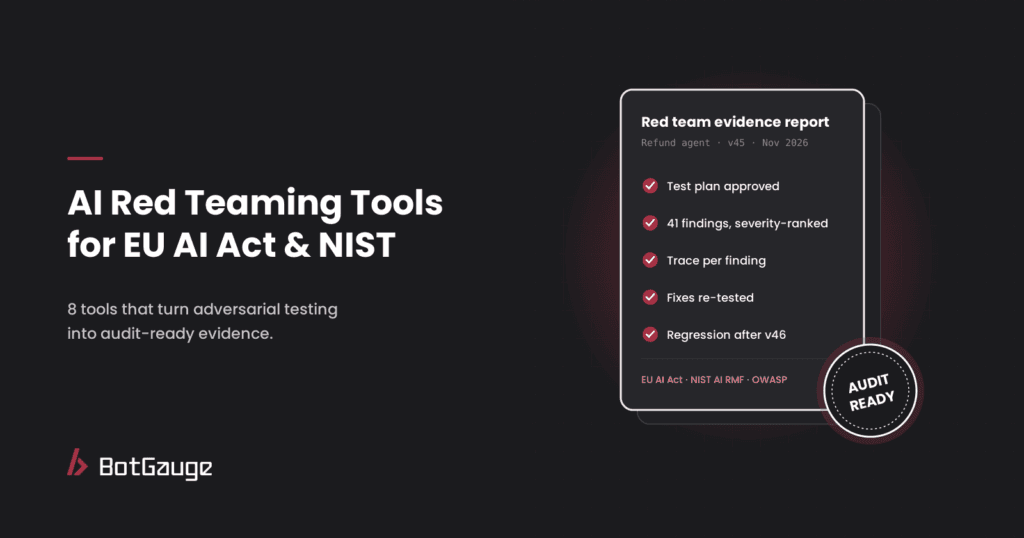
- Auditors don’t want a one-off pentest PDF. They want dated findings, severities, traces, fixes and proof that fixes still hold after later changes.
- The right red teaming tool produces that evidence as a by-product of testing, not as extra paperwork.
- Best picks: BotGauge for agent-level evidence with traces and re-tests, Giskard for EU teams pairing quality and security, Mindgard for enterprise-wide coverage, Promptfoo and PyRIT for open-source testing in CI.
- This guide is not legal advice. Confirm your specific obligations with counsel.
What the EU AI Act and NIST AI RMF expect from red teaming
Neither framework says “buy a red teaming tool”. Both, however, describe outcomes that are very hard to show without adversarial testing.
EU AI Act
The EU AI Act entered into force on August 1, 2024, with obligations phasing in over several years. Several provisions point directly at adversarial testing:
- Article 9 (risk management): high-risk AI systems need a continuous risk management process, including testing to identify the most appropriate risk measures.
- Article 15 (accuracy, robustness and cybersecurity): high-risk systems must be resilient against attempts by unauthorised third parties to alter their use, outputs or performance by exploiting vulnerabilities.
- Article 12 (record-keeping): high-risk systems must automatically log events over their lifetime.
- Article 55 (general-purpose AI with systemic risk): providers must evaluate models, including adversarial testing, and document it.
The timeline for high-risk obligations has been the subject of proposed changes, so check the current dates for your category before planning.
NIST AI RMF
The NIST AI Risk Management Framework 1.0 (January 2023) is voluntary in the US but widely used as the reference for AI governance. It organises work into four functions: Govern, Map, Measure and Manage. Red teaming sits mainly in Measure (testing for robustness, security and harmful behaviour) and Manage (tracking and treating risks over time). NIST’s Generative AI Profile (NIST AI 600-1, July 2024) explicitly recommends red teaming for generative AI systems.
What evidence auditors actually want
A tool that finds vulnerabilities is not enough. Compliance teams need a paper trail that holds up months later.
| Evidence | Why it matters | EU AI Act link | NIST AI RMF link |
| Dated test plan and scope | Shows testing was planned, not ad hoc | Art. 9 | Map, Measure |
| Findings with severity | Shows risks were identified and ranked | Art. 9, Art. 15 | Measure |
| Trace evidence per finding | Proves what happened, step by step | Art. 12 | Measure |
| Fix and re-test record | Shows risks were treated | Art. 9 | Manage |
| Regression results after changes | Shows fixes still hold | Art. 15, Art. 72 (post-market monitoring) | Manage |
| Coverage mapped to known risk lists | Shows completeness | Art. 15 | Measure |
The last two rows are where most teams fall short. A finding fixed in March and never re-tested is weak evidence by September. BotGauge LLM red teaming re-validates every fix and keeps it running as a regression test.
The 8 best AI red teaming tools for compliance, compared
| Tool | Evidence strength | Framework mapping | Re-tests and regression | Open source | Best for |
| BotGauge | Findings + traces + re-tests per agent | OWASP-aligned categories | Yes, built in | No | Agent-level audit evidence |
| Giskard | Findings + quality tests | Security and quality reports | Yes | Library yes | EU teams |
| Mindgard | Enterprise-wide findings | Security frameworks | Yes | No | Broad AI estates |
| Promptfoo | Config-driven reports | OWASP, NIST and other mappings | In CI | Yes (MIT) | Engineering-led programs |
| SPLX (Zscaler) | Assistant and agent findings | Security frameworks | Yes | No | Zscaler customers |
| Enkrypt AI | Red teaming + guardrails | Compliance reporting | Yes | No | Testing plus runtime controls |
| PyRIT | Scripted campaign results | You build it | Scripted | Yes (MIT) | In-house red teams |
| garak | Model-level scan reports | Probe categories | Scripted | Yes (Apache-2.0) | Baseline model evidence |
1. BotGauge: best for agent-level audit evidence
BotGauge produces exactly the trail the table above describes. Every run starts with a test plan you approve, runs adaptive black box and grey box attacks against your agent’s real rules, and ends with confirmed findings that each carry severity, the full conversation and the trace step where the failure happened. Fixed findings are re-tested, and every confirmed failure becomes a regression test that runs on later changes, which is the proof auditors increasingly ask for.
Strengths: plan, findings, traces and re-tests in one record; continuous rather than annual testing; safety layer that blocks attacks with real-world side effects.
Limitations: focused on agents and LLM apps, not classic ML model governance.
Best for: teams that need to show regulators how a customer-facing agent was tested and kept safe. See what AI agent red teaming is.
2. Giskard: best for EU teams pairing quality and security
Giskard, based in France, combines continuous red teaming with quality testing for hallucinations and business-logic errors, plus an open-source testing library. It also appears in our list of the best AI agent red teaming tools.
Strengths: EU-based vendor; quality and security in one report.
Limitations: full platform is commercial.
Best for: European organisations building EU AI Act evidence.
3. Mindgard: best for enterprise-wide coverage
Mindgard discovers AI systems across an organisation and tests models, agents and applications at scale.
Strengths: inventory plus testing; security-team reporting.
Limitations: heavier than product teams usually need.
Best for: CISOs covering many AI systems.
4. Promptfoo: best for engineering-led compliance programs
Promptfoo, now part of OpenAI, runs red teaming from config in CI and can map results to common security frameworks. See how it compares in BotGauge vs Promptfoo.
Strengths: open source; automated in every pull request.
Limitations: evidence packaging and multi-turn agent depth need extra work.
Best for: teams that want compliance testing as code.
5. SPLX (Zscaler): best for Zscaler customers
SPLX, acquired by Zscaler, tests AI assistants and agents and fits into Zscaler’s security stack.
Strengths: security-stack integration.
Limitations: best value inside Zscaler.
Best for: enterprises standardised on Zscaler.
6. Enkrypt AI: best for testing plus runtime controls
Enkrypt AI combines red teaming with guardrails, a policy engine and an MCP gateway, so findings can turn directly into runtime protections.
Strengths: test and protect in one platform.
Limitations: direction may shift after its announced acquisition by Anaconda.
Best for: teams that want one vendor for testing and guardrails.
7. PyRIT: best for in-house red teams
Microsoft’s open-source framework lets security teams script multi-turn attack campaigns with attacker models and scorers.
Strengths: flexible and research-grade.
Limitations: you build the reporting and evidence trail yourself.
Best for: mature internal red teams.
8. garak: best baseline model evidence
NVIDIA’s open-source scanner probes models for jailbreaks, injection and leakage, producing a quick baseline report.
Strengths: fast, broad probe library.
Limitations: model-level only; no agent rules or tools.
Best for: documenting a baseline before agent-level testing.
How to choose a red teaming tool for compliance
| Your situation | Start with |
| Customer-facing agent that takes actions | BotGauge |
| EU-based team, quality and security together | Giskard |
| Dozens of AI systems across the company | Mindgard |
| Engineering team that wants tests as code | Promptfoo |
| Zscaler security stack | SPLX |
| Need guardrails from the same vendor | Enkrypt AI |
| Mature internal red team | PyRIT |
| Need a quick model baseline | garak |
A compliance-ready red teaming workflow
Whichever tool you choose, structure the program so evidence builds itself.
- Inventory and classify. List every AI system, its risk category under the EU AI Act, and its owner.
- Write the test plan. Scope, rules under test, attack categories and success criteria, dated and approved.
- Map coverage to known risk lists. Use the OWASP Top 10 for LLM and Agentic Applications and MITRE ATLAS to show completeness.
- Run adversarial tests. Include multi-turn, indirect prompt injection and tool-misuse attacks, not just single-prompt jailbreaks.
- Record findings with traces. Severity, conversation and the step where it failed.
- Fix, re-test and record. Every closed finding needs a dated re-test.
- Keep testing after release. Re-run after every model, prompt or tool change, and keep the results. That record is your post-market monitoring evidence.
For agents connected to external tools, add MCP security testing for AI agents to step 4, and see how automated red teaming for AI agents keeps step 7 running without extra effort.
Final thoughts
Compliance with the EU AI Act and NIST AI RMF is not about one impressive test. It is about a steady record that shows you looked for problems, found them, fixed them and kept checking. The best red teaming tool for compliance is the one that produces that record while doing the testing your team needs anyway. Mapping findings to the OWASP Agentic Top 10 gives that record a structure auditors recognise.