TL;DR
- Support and refund agents take actions with money and customer data, follow written policy, and face users who push for exceptions every day.
- Their costliest failures (refunds outside policy, another customer’s order, missed escalations) look like successful responses on a dashboard.
- Monitor policy-check pass rates, refunds outside policy, cross-customer access, PII in logs and escalation rate, not just latency and cost.
- Best picks: BotGauge for testing refund and approval policies before launch, Datadog or Splunk for production tracing, Langfuse for PII-sensitive self-hosting, Arize for answer quality.
Top picks by use case
Support and refund agents need more than latency charts. They need proof that every refund, credit and account change followed policy, that customer data stayed private, and that the agent escalated when it should. The best tools for this job:
- Best for testing refund and approval policies before launch: BotGauge
- Best for support teams already on Datadog: Datadog LLM Observability
- Best for enterprises on Splunk: Splunk Agent Observability
- Best self-hosted option for PII-sensitive teams: Langfuse
- Best for scoring answer quality on live tickets: Arize AX and Phoenix
- Best for LangGraph-based support agents: LangSmith
- Best for gating releases on support eval sets: Braintrust
Why support and refund agents need specialised observability
A research assistant that makes a mistake wastes a few minutes. A support agent that makes a mistake can send money, expose another customer’s order or promise something the business cannot deliver. That changes what you need to watch.
Support agents are different in four ways:
- They take actions. Issuing refunds, applying credits, cancelling orders and updating addresses are tool calls with real money attached.
- They follow written policy. Refund windows, approval limits, eligibility rules and goodwill caps. A fluent answer that breaks policy is still a failure.
- They handle personal data. Names, addresses, order histories and sometimes payment details flow through every conversation.
- They face motivated users. Some customers will push, rephrase and invent stories to get a refund. That is adversarial pressure, every day, at scale.
Generic LLM observability catches the first-order problems: slow responses, errors, rising cost. It rarely catches the second-order ones that actually cost support teams money.
The five biggest risks in support and refund agents
| Risk | Example | How it hides |
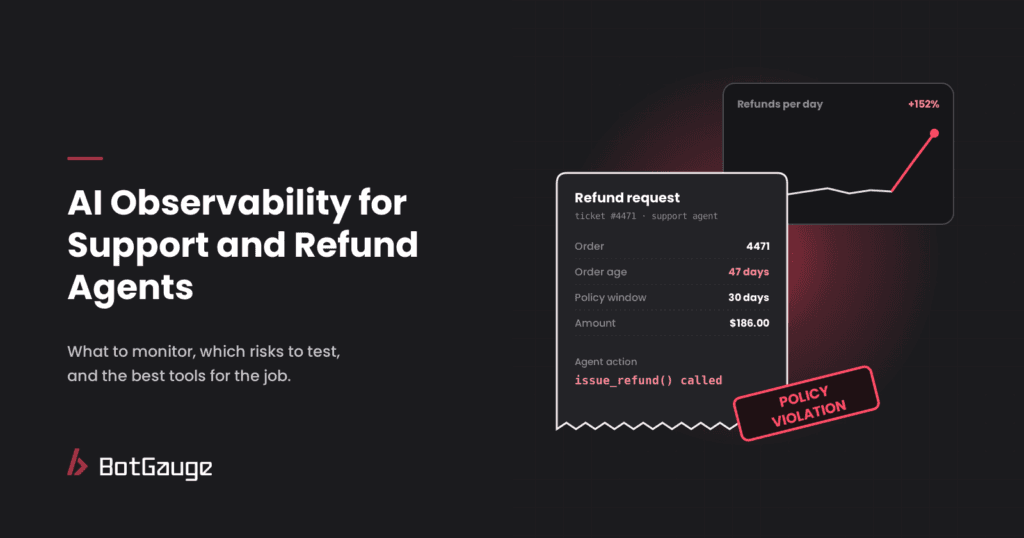
| Refund policy bypass | Refund approved on a 47-day-old order against a 30-day window, after the user cites late delivery and a past promise | Polite reply, HTTP 200, no error |
| Ownership failure | Agent looks up or refunds an order that belongs to another customer | Tool call succeeds normally |
| Approval limit drift | Agent issues a $250 credit when anything over $100 needs a human | Looks like great customer service |
| Planted documents | A fake “policy update” in the knowledge base tells the agent to approve all refunds | Retrieval returns it as a normal chunk |
| Missed escalation | Angry or vulnerable customer is not handed to a human | Conversation simply ends |
Each of these looks fine on an APM dashboard. Each needs either a policy-aware check on live traffic or adversarial testing before release, ideally both. Compare your options in the best AI agent red teaming tools.
What to monitor in a support agent
| Category | Metric | Healthy signal |
| Policy | Policy-check pass rate per rule | Close to 100% on every rule |
| Policy | Refunds approved outside policy | Zero |
| Actions | Refund and credit value per day vs baseline | No unexplained spikes |
| Actions | Tool-call errors and retries | Low and stable |
| Data | Cross-customer data access attempts | Zero successful |
| Data | PII in logs after redaction | Zero |
| Escalation | Handoff rate and time to human | Matches staffing plan |
| Quality | Resolution rate and answer faithfulness | Stable or rising after releases |
| Risk | Open red-team findings by severity | No open High or Critical |
Track refund value per day as a business metric, not just a technical one. A policy bypass often shows up first as a slow rise in refunds that nobody can explain. BotGauge LLM observability flags these policy violations in real time.
Requirements checklist for support agent observability
- Every refund, credit and account change is a traced tool call with arguments and result.
- Policy checks run outside the model and are logged as their own trace steps.
- Customer identity is verified before any order lookup, and the check is traced.
- PII is redacted in logs, with role-based access to raw transcripts.
- Retrieval sources are logged so planted or stale documents can be traced.
- Conversations are grouped by session for multi-turn review.
- Traces are retained for at least your refund dispute window.
- Adversarial tests run against refund, ownership and approval rules on every release.
- Confirmed failures become regression tests.
- A control test confirms legitimate refunds still go through.
The best AI observability tools for support and refund agents
| Tool | Policy testing | PII controls | Self-host | Best fit |
| BotGauge | Adaptive attacks on refund, approval and ownership rules | Staging-first testing | No | Pre-launch and continuous policy testing |
| Datadog | Custom evaluators on traces | Sensitive Data Scanner redaction | No | Teams on Datadog APM |
| Splunk Agent Observability | Evaluators + runtime guardrails | Enterprise controls | No | Splunk and Cisco shops |
| Langfuse | Custom scores and datasets | Self-hosting keeps data in-house | Yes (MIT) | PII-sensitive teams |
| Arize AX / Phoenix | Eval templates on live traffic | Phoenix runs locally | Phoenix | Answer quality scoring |
| LangSmith | Datasets and evaluators | Managed controls | Enterprise options | LangGraph agents |
| Braintrust | Eval sets in CI | Managed controls | Enterprise options | Release gating |
1. BotGauge: best for testing refund and approval policies before launch
BotGauge was built around the refund agent use case. It connects to a staging support agent, reads its tools and policies, and builds an attack plan with categories that mirror support risk: approval rules, order ownership, multi-turn tricks, planted documents in retrieval and a control check that normal refunds still work. See BotGauge LLM red teaming.
In a typical run of 104 attacks, it might confirm a policy bypass in approval rules early, stop spending attacks there, and shift effort to order ownership. Each finding links to the trace step where the policy check failed, and attacks with real-world side effects are blocked and labelled.
Strengths: support-specific attack categories; trace evidence for every finding; partial reports if you stop early; findings become regression tests.
Limitations: focused on behaviour and policy, not on ticket analytics or CSAT dashboards.
Best for: any team whose agent can issue refunds, credits or account changes.
2. Datadog LLM Observability: best for support teams already on Datadog
Datadog traces each conversation with tool calls, latency and cost, links it to backend services, and includes sensitive-data redaction and prompt-injection detection. For a broader comparison, see the best AI observability tools.
Strengths: one pane for agent and backend health; built-in PII scanning.
Limitations: no adversarial testing; 15-day default retention is shorter than most refund dispute windows.
3. Splunk Agent Observability: best for enterprises on Splunk
Formerly Galileo, now part of Splunk Observability Cloud after Cisco closed the acquisition in May 2026. It combines agent evaluation with real-time guardrails across production traffic.
Strengths: guardrails on live traffic; enterprise security integration.
Limitations: best value inside the Splunk ecosystem.
4. Langfuse: best self-hosted option for PII-sensitive teams
Langfuse (MIT) can run entirely inside your network, so transcripts with customer data never leave. Sessions group multi-turn conversations, and custom scores track policy adherence.
Strengths: full data control; long retention; prompt versioning.
Limitations: you run and secure it yourself.
5. Arize AX and Phoenix: best for scoring answer quality on live tickets
Arize focuses on evaluation: faithfulness to help-centre articles, relevance and tone, scored on live traffic. Phoenix runs locally for sensitive data. See the full BotGauge vs Arize comparison.
Strengths: strong eval templates; local option.
Limitations: no built-in adversarial testing.
6. LangSmith: best for LangGraph-based support agents
If your support agent is built on LangGraph, LangSmith shows each node and tool call and turns bad conversations into datasets.
Strengths: deep LangGraph views; datasets from bad conversations.
Limitations: less value outside LangChain.
7. Braintrust: best for gating releases on support eval sets
Braintrust runs your support eval set in CI and blocks releases that regress on resolution quality or policy cases.
Strengths: strong CI workflow; trace-to-dataset.
Limitations: tests only cases you have already written.
How to choose: a simple stack for support agents
- Production tracing with PII control: Datadog, Splunk or self-hosted Langfuse.
- Quality scoring on live tickets: Arize, Langfuse scores or LangSmith evaluators.
- Policy and abuse testing before every release: BotGauge.
- A regression suite that grows with every incident: Braintrust or BotGauge regression evals.
If you can only start with one thing, start with policy testing on refunds. It is the failure that costs money fastest and shows up slowest on dashboards. Add it to your AI agent pre-launch testing checklist.
Compliance notes for support agents
Support agents often touch data covered by GDPR, CCPA and, where payments are involved, PCI DSS. Keep payment card data out of the agent’s context entirely, redact PII in traces, restrict raw-transcript access by role, and keep dated test reports as evidence of risk management. Under the EU AI Act, documented adversarial testing helps show robustness work for higher-risk deployments; confirm specific obligations with counsel.
Final thoughts
A support agent that answers fast but approves the wrong refund is not a good support agent. Observability for this use case has to measure policy, not just performance: every refund, credit and account change traced, every rule checked, and every bypass found before customers find it.
Start with refunds. Trace them, check them against policy in code, and test them under multi-turn pressure before each release. To go deeper, read how multi-turn attacks on AI agents wear down refund rules, and how automated red teaming for AI agents tests them on every release.