TL;DR
- Most AI agent incidents in production were findable before launch. Teams just never tested for them.
- A pre-launch checklist should cover ten areas: scope and rules, happy paths, tool calls, policies, adversarial attacks, data privacy, retrieval, reliability, observability and release gates.
- The two areas teams skip most are policy testing under pressure and indirect prompt injection through retrieved documents. Both cause the most expensive failures.
- No single tool covers the full checklist. Pair one agent-aware testing platform with an eval framework and a production tracer.
- Best picks: BotGauge for policy and adversarial testing, Promptfoo or DeepEval for CI evals, garak and PyRIT for open-source attack coverage, Langfuse or Phoenix for tracing.
Why pre-launch testing matters for AI agents
Shipping a chatbot used to mean checking that answers were accurate and polite. Shipping an agent means something bigger: you are giving software the ability to act. It can issue refunds, change accounts, send emails and call internal APIs, on behalf of anyone who types into it.
That makes the cost of a missed bug different. A wrong answer is embarrassing. A wrong action costs money, leaks data or breaks a promise to a customer, and it may happen thousands of times before anyone notices.
Three things make agents especially easy to under-test:
- They look fine in demos. Happy-path tests pass. The failures appear when real users push, rephrase and try things nobody planned for.
- Failures don’t throw errors. A refund approved against policy returns a successful response. Nothing on a dashboard turns red.
- The attack surface is wider than the chat box. Retrieved documents, tool responses and connected MCP servers can all carry instructions the agent follows.
A checklist turns “we tested it” into something specific, repeatable and auditable.
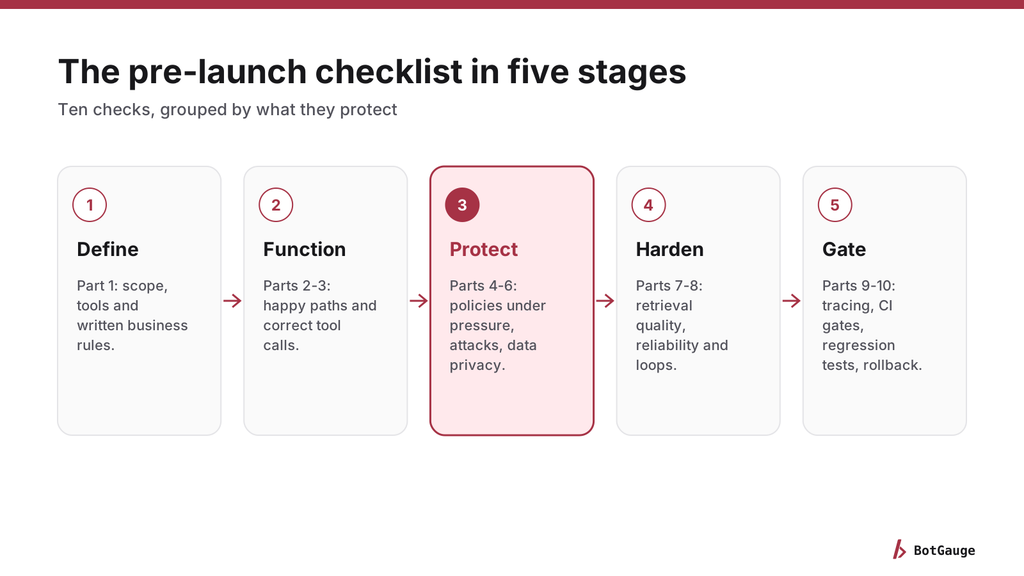
The 10-part AI agent pre-launch checklist
Work through these in order. Each part lists what to check and what “done” looks like.
1. Scope and rules
- Every tool the agent can call is listed, with who it acts on and what it can change.
- Every business rule is written down: refund windows, approval limits, eligibility, escalation triggers.
- Each rule is marked as enforced in code, in the prompt, or both.
- The agent’s scope is clear: what it must refuse or hand off.
Done when: a new engineer could read the list and know exactly what the agent may and may not do.
2. Happy-path functionality
- The top 20 real user intents each have at least one test case.
- Each test checks the final outcome, not just the reply text.
- Edge inputs are covered: typos, mixed languages, very long messages, empty fields.
Done when: the common jobs succeed reliably across several runs, since agents are non-deterministic.
3. Tool calls
- The right tool is chosen for each intent.
- Arguments are correct: right IDs, amounts and customers.
- Steps happen in the right order, such as lookup before refund.
- Tool errors, timeouts and empty results are handled gracefully.
- Side-effecting tools point at sandboxes during testing.
Done when: tool selection and argument accuracy are measured, not assumed. Our guide to AI agent evaluation tools covers how to score them, and BotGauge LLM evaluations runs these checks on every release.
4. Policies and business rules
- Each rule has a test that should be refused, and a control test that should succeed.
- Rules are tested under pressure: paraphrasing, false premises (“your colleague approved this”) and urgency.
- Rules are tested across several turns, not just one.
- Approval limits and escalation triggers fire at the right thresholds.
Done when: no rule can be bypassed with a rephrase, and legitimate requests still go through. BotGauge LLM red teaming attacks every rule under multi-turn pressure.
5. Adversarial security
- Direct prompt injection and jailbreak attempts.
- Indirect prompt injection through retrieved documents, emails, web pages and tool responses.
- Multi-turn attacks that build pressure gradually.
- System prompt and secret extraction attempts.
- Tool misuse, such as calling tools outside the user’s permissions.
- MCP server and plugin abuse, if the agent uses them.
- Coverage mapped to the OWASP Top 10 for LLM and Agentic Applications.
Done when: confirmed findings are fixed or accepted with a documented reason, and coverage is mapped to the OWASP Agentic Top 10. Learn more in what AI agent red teaming is and MCP security testing for AI agents.
6. Data and privacy
- The agent cannot read or act on another user’s data.
- PII is redacted in logs and traces.
- Payment card data never enters the model context.
- The agent does not repeat sensitive data back when not needed.
Done when: cross-user access attempts all fail, and logs contain no raw PII.
7. Retrieval and knowledge base
- Answers are grounded in retrieved sources, scored for faithfulness.
- Stale or conflicting documents are handled, such as an old refund policy.
- Planted documents with fake instructions are ignored.
- The agent says “I don’t know” instead of inventing.
Done when: faithfulness is measured and planted-document attacks fail.
8. Reliability and performance
- p95 latency per step is within budget.
- Step limits stop infinite loops and runaway tool calls.
- Token use per conversation is within budget.
- Model or provider outages fail safely, with a handoff to a human.
Done when: the agent degrades gracefully, not silently.
9. Observability readiness
- Every conversation has a trace ID visible to support staff.
- Traces include tool arguments, retrieved chunks and policy-check results.
- Model and prompt versions are tagged on every trace.
- Alerts exist for policy-check failures and refund or credit spikes.
Done when: you can debug any production complaint from its trace in minutes. See how to debug AI agents in production.
10. Release gates and rollback
- All checklist tests run in CI on every prompt, model and tool change.
- A pass threshold blocks release, with no open High or Critical findings.
- Every past failure is a permanent regression test.
- Rollback to the previous prompt and model version takes minutes.
- A staged rollout plan exists, starting with a small share of traffic.
Done when: a failing test stops the release automatically. For how eval-driven release gates compare, read BotGauge vs Braintrust.
The 10 tools to run before production
Each tool below covers part of the checklist. The table shows which.
| Tool | Checklist parts covered | Open source | Best for |
| BotGauge | 3, 4, 5, 6, 7, 10 | No | Policy and adversarial testing of action-taking agents |
| Promptfoo | 2, 5, 10 | Yes (MIT) | Evals and red teaming as config in CI |
| DeepEval / Confident AI | 2, 3, 7, 10 | DeepEval yes | Python eval tests and metrics |
| Braintrust | 2, 3, 10 | No | Eval datasets and release gating |
| LangSmith | 2, 3, 9 | No | LangGraph trajectory testing |
| garak | 5 | Yes (Apache-2.0) | Model-level vulnerability scans |
| PyRIT | 5 | Yes (MIT) | Scripted multi-turn attack campaigns |
| Maxim AI | 2, 4 | No | Persona-based simulation before launch |
| Langfuse | 9, 10 | Yes (MIT) | Self-hosted tracing and datasets |
| Arize Phoenix | 7, 9 | Yes | Local tracing and retrieval evals |
1. BotGauge: best for policy and adversarial testing (parts 3, 4, 5, 6, 7, 10)
BotGauge covers the parts of the checklist that are hardest to do by hand. It connects to a staging agent, reads its tools and rules, and proposes an attack plan for you to approve. It then runs black box and grey box attacks across approval rules, order ownership, multi-turn tricks and planted documents in retrieval, plus a control category that checks normal requests still work.
Every confirmed failure arrives with the trace step where it broke and becomes a regression test for your release gate. Attacks with real-world side effects are blocked by BotGauge’s safety layer.
Best for: agents that can move money, change accounts or access customer data.
2. Promptfoo: best for evals and red teaming in CI (parts 2, 5, 10)
Promptfoo is an open-source CLI, now part of OpenAI, for running evals and red teaming from YAML configs in every pull request. It has a large plugin library for injection, PII and harmful-content tests.
Best for: engineering teams that want tests as config.
3. DeepEval / Confident AI: best for Python eval tests (parts 2, 3, 7, 10)
DeepEval provides pytest-style tests with metrics for task completion, tool correctness and faithfulness. Confident AI adds dashboards and simulation.
Best for: Python teams writing evals as code.
4. Braintrust: best for release gating (parts 2, 3, 10)
Braintrust builds eval datasets, scores them with code and LLM judges, and blocks releases when scores drop.
Best for: teams shipping frequent changes.
5. LangSmith: best for LangGraph agents (parts 2, 3, 9)
LangSmith tests agent trajectories against expected step sequences and traces LangGraph runs in detail.
Best for: LangGraph-native teams.
6. garak: best model-level vulnerability scan (part 5)
NVIDIA’s open-source scanner probes models for jailbreaks, prompt injection and data leakage. A good fast baseline before agent-level testing.
Best for: a quick first pass on the underlying model.
7. PyRIT: best scripted attack campaigns (part 5)
Microsoft’s open-source framework lets security teams script multi-turn attack orchestrations with attacker models and scorers.
Best for: in-house red teams with Python skills.
8. Maxim AI: best persona simulation before launch (parts 2, 4)
Maxim runs simulated users with defined personas and goals against your agent, without code.
Best for: product and QA teams testing realistic conversations.
9. Langfuse: best self-hosted tracing for launch readiness (parts 9, 10)
Langfuse (MIT) gives you production tracing, sessions, prompt versioning and datasets, all self-hostable.
Best for: teams that need data to stay in-house.
10. Arize Phoenix: best local tracing and retrieval evals (parts 7, 9)
Phoenix runs locally to trace agents and score retrieval quality and faithfulness before you go live.
Best for: RAG-heavy agents and local testing.
How to choose your pre-launch testing stack
Pick one tool per job:
| Job | Pick one |
| Policy and adversarial testing | BotGauge |
| Eval tests in CI | Promptfoo, DeepEval or Braintrust |
| Baseline model scan | garak |
| Production tracing | Langfuse, Phoenix or LangSmith |
If your agent can take actions with money or customer data, policy and adversarial testing is not optional. It is the part of the checklist most likely to stop an incident.
Final thoughts
The teams that launch agents calmly are not the ones with the most tests. They are the ones whose tests match the way their agent can actually fail. Write down your rules, test them under pressure, trace everything, and make every failure a permanent test.
Print this checklist, assign an owner to each of the ten parts, and do not ship until every “Done when” is true. For deeper reading, see how multi-turn attacks on AI agents work and how automated red teaming for AI agents scales part 5.
Ship your agent with confidence
Run the hardest parts of this checklist in one session. BotGauge tests your agent’s tool calls, policies and attack surface, shows where each failure happens in the trace, and turns every finding into a release-gate test. Try BotGauge for free