TL;DR
An AI agent evaluation platform stores your test cases, runs your agent against them, scores whole trajectories, gates releases and keeps evaluating in production. When choosing one, check six areas: agent-level scoring, where test cases come from, release gating, production evaluation, data control and integrations, and total cost. The question most buyers forget: does the platform help you find the hard failures, or only score the cases you already wrote?
Platform vs. framework vs. harness
The terms overlap. An evaluation library or framework gives you metrics and test runners in code. A harness runs a fixed set of tests. A platform is a shared system for traces, datasets, experiments, evaluators, human review, production monitoring and collaboration (Arize). Small teams can start with a framework; most outgrow it once several people, agents or releases are involved. For the concepts behind the checklist, see our guide to AI agent evaluation.
Do you need a platform yet?
Not every team does. A framework and a spreadsheet can carry one engineer and one prototype a long way. These are the signs you’ve outgrown that setup:
- More than one agent, or more than one team. Results in scattered scripts and notebooks stop being comparable, and nobody can see the whole picture.
- Releases are slowed by manual checking. If someone reads outputs by hand before every prompt or model change, the evaluation step has become the bottleneck.
- You can’t answer “what changed?” When a score drops and nobody can say which version of the prompt, model, tools or test set produced it, you need versioning and history.
- Reviewers outside engineering need access. Security, compliance and product teams want to see failures and sign off on releases without running code.
- The agent takes real actions. Once an agent can move money, change records or send messages, ad-hoc testing becomes a business risk, not just a quality issue.
If two or more of these apply, a platform will usually pay for itself in engineering time alone.
Four kinds of evaluation platforms
Most products on a shortlist started from one of four places, and their origin still shapes what they do best:
| Type | Started as | Usually strong at | Usually weaker at |
| Observability-first | Tracing and monitoring for LLM apps | Production traces, dashboards, cost tracking | Generating hard test cases; release gating |
| Evaluation-first | Experiment tracking and scoring | Datasets, judges, comparing prompt and model versions | Adversarial testing; production policies |
| Red-teaming-first | Security testing for AI | Finding unknown failures, attack coverage, findings with traces | Prompt and model comparison as a main workflow |
| All-in-one suites | Broad ML or APM platforms | Fitting into an existing vendor relationship | Depth on agent-specific scoring |
None of these is wrong; they’re good at different jobs. The mistake is buying an observability tool and expecting it to find failures before release, or buying an evaluation tool and expecting it to generate attacks. Match the type to your biggest gap, then check the rest of the checklist for what it lacks.
Cover the whole lifecycle
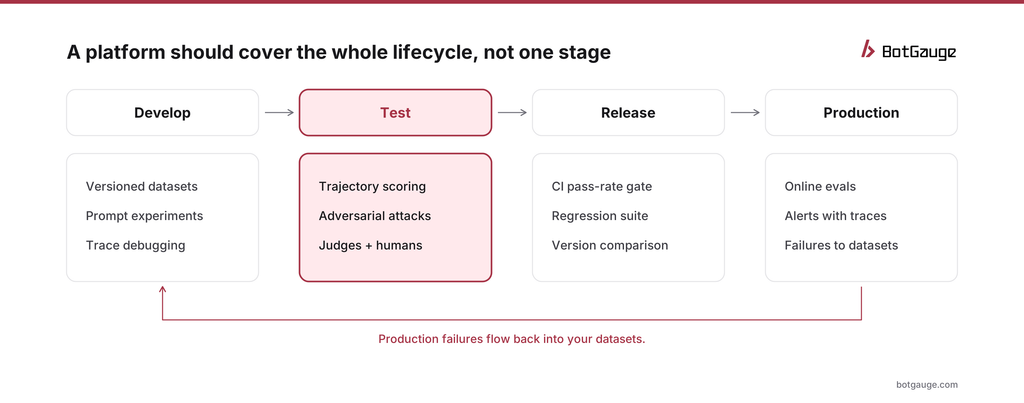
evaluation platform coverage across the lifecycle
Many tools are strong at one stage and thin at the others. For agents, the deciding capability is usually whether the platform connects scores to the execution that produced them, and carries the same quality criteria from offline tests into production (Arize).
The checklist
1. Agent-level scoring
- Scores the final response, single steps and the full trajectory, not just outputs
- Checks tool selection, argument validity and required step order
- Supports code checks, LLM judges and human review in one place
- Lets you calibrate judges against human labels
- Runs each case several times and reports pass rates
- Handles multi-turn conversations, not just single prompts
2. Where test cases come from
- Versioned datasets with tags for task type, risk and source
- Turns production traces into test cases in a few clicks
- Generates adversarial cases (prompt injection, policy bypass, multi-turn manipulation), not just happy paths
- Turns confirmed findings into regression cases automatically
- Custom attack or scenario strategies for your business rules
3. Release gating
- Runs in CI on every prompt, model or tool change
- Fails builds on regressions with clear thresholds per metric
- Compares two versions side by side on the same cases
- Supports a fast pull-request suite and a full release suite
4. Production evaluation
- Scores a sample of live traffic with the same criteria used offline
- Links every score and alert to its trace
- Sends production failures back into datasets
- Supports policies or guardrails that carry from testing into production
5. Data, security and integrations
- SOC 2 report, SSO/SAML and fine-grained access control
- Data residency, retention and personal-data redaction options
- Self-hosting or private deployment, if you need it
- Works with your models and frameworks (OpenAI, Anthropic, LangChain, LangGraph, CrewAI and others) through an SDK or API
- OpenTelemetry support, so you’re not locked in
6. Cost and fit
- Pricing you can forecast at your trace and evaluation volume, including judge-model costs
- A free tier or trial that lets you test your own agent, not a demo agent
- Workflows that suit both engineers and reviewers who don’t use a terminal
Ten questions to ask in every demo
The checklist tells you what to look for. These questions get you real answers, because each one asks the vendor to show rather than tell:
1. “Can we connect our own agent today?” A platform that only demos on a sample agent may struggle with your stack, your tools or your authentication.
2. “Show me a failed run, step by step.” You should see every model call, tool call, argument and retrieved document, and the score attached to each step.
3. “How would you test that our refund agent never approves refunds outside policy?” The answer reveals whether the platform scores actions and trajectories, or only text.
4. “Where would our first 200 test cases come from?” Listen for production traces, generated variants and adversarial cases, not just “you upload them”.
5. “What happens when a red-team finding is confirmed?” The best answer is that it becomes a regression case automatically, with its trace attached.
6. “How do you know your judge is right?” Ask how judges are calibrated against human labels and how disagreements are handled.
7. “What does a failed CI run look like?” You want a clear message naming the cases that regressed, with links to their traces, not just a red badge.
8. “Do the checks we run before release also run in production?” Separate criteria for testing and monitoring drift apart quickly.
9. “Where is our data stored, and who can see it?” Ask about regions, retention, redaction of personal data, access control and audit logs.
10.“What will this cost at ten times our current volume?” Agents generate many spans and judge calls per task, so ask for a worked estimate, not a price list.
How to run a two-week trial
A demo shows what a platform can do. A trial shows what it does with your agent. Keep the trial short and structured, and run the same plan with each shortlisted vendor:
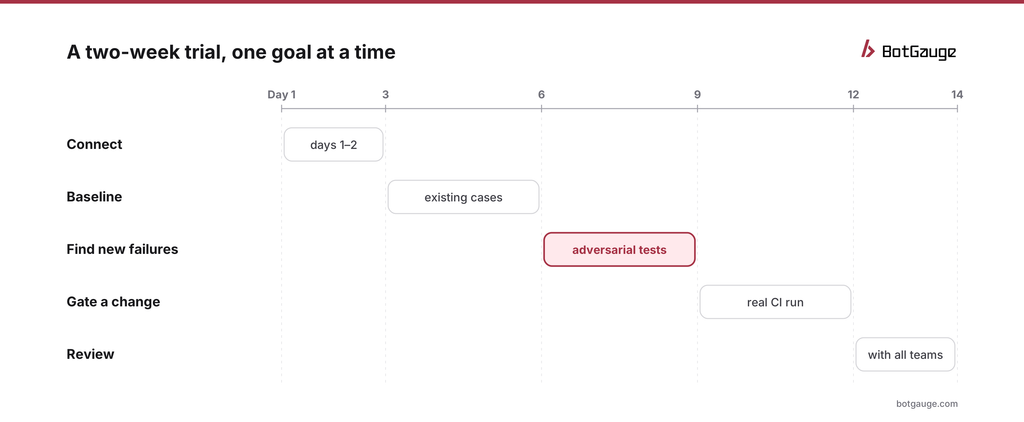
two-week evaluation platform trial
| Days | Goal | What to do | What to look for |
| 1 to 2 | Connect | Connect one real agent and send real or replayed traffic | Hours, not days, to see your first full trace |
| 3 to 5 | Baseline | Load 30 to 50 existing test cases and score them | Trajectory scores, clear failure reasons, sensible judge results |
| 6 to 8 | Find new failures | Run adversarial tests against the agent | Real findings you didn’t already know about |
| 9 to 11 | Gate a change | Make a real prompt or model change and run the suite in CI | A pass or fail you’d trust enough to block a release |
| 12 to 14 | Review | Show results to engineering, security and product | Whether non-engineers can follow the findings without help |
Score each vendor on the six checklist areas at the end of the trial, using the same weights for everyone. The days in the middle matter most: a platform that finds something new about your agent in week one has already shown its value.
Build vs. buy
Some teams consider building their own evaluation stack on open-source libraries. It can work, but the cost is usually underestimated. Building means owning trace storage, a dataset store with versioning, a judge service, a human review interface, CI integration, dashboards, access control and an adversarial test generator, then maintaining all of it as models and frameworks change.
Building makes sense when you have strict data rules that no vendor can meet, a dedicated platform team, and evaluation needs unusual enough that no product fits. For most teams, buying the platform and spending engineering time on better test cases is the better trade.
What each team needs from the platform
An evaluation platform has more users than the engineers who set it up. Ask each group what they need before you shortlist, so the choice doesn’t stall at sign-off:
| Team | What they need | Checklist area |
| AI engineers | Fast setup, step-level traces, clear reasons when a case fails | Agent-level scoring, release gating |
| QA and platform | Versioned datasets, CI integration, stable thresholds | Release gating, where test cases come from |
| Security | Adversarial coverage, findings with evidence, regression on every fix | Where test cases come from |
| Compliance and risk | Audit trails, access control, data residency, reports they can share | Data, security and integrations |
| Product | Readable results, version comparisons, quality trends over time | Production evaluation |
| Finance | Predictable pricing at future volume | Cost and fit |
Invite one person from each group to the trial review on days 12 to 14. A platform that only engineers can use tends to stay an engineering tool, and the release decisions it should inform get made elsewhere.
How to score vendors
Weight the six areas by what your agents do, then run a two-week trial on your own agent with your own cases. A starting point:
| Area | Weight for a support or RAG agent | Weight for a transactional agent |
| Agent-level scoring | High | High |
| Where test cases come from | Medium | High |
| Release gating | High | High |
| Production evaluation | High | Medium |
| Data, security and integrations | Medium | High |
| Cost and fit | Medium | Medium |
Transactional agents, which issue refunds, approvals or transfers, weight adversarial test generation and security higher, because their failures move money.
A sample scorecard
Turn the weights into numbers (High = 3, Medium = 2), score each vendor from 1 to 5 in each area after the trial, multiply, and add up. Here’s how it looks for a transactional agent. The vendors and scores are illustrative:
| Area | Weight | Vendor A score | Vendor A weighted | Vendor B score | Vendor B weighted |
| Agent-level scoring | 3 | 4 | 12 | 4 | 12 |
| Where test cases come from | 3 | 2 | 6 | 5 | 15 |
| Release gating | 3 | 4 | 12 | 4 | 12 |
| Production evaluation | 2 | 5 | 10 | 3 | 6 |
| Data, security and integrations | 3 | 4 | 12 | 4 | 12 |
| Cost and fit | 2 | 4 | 8 | 3 | 6 |
| Total | 60 | 63 |
Vendor A looks stronger in production; Vendor B wins because it generates the adversarial cases a transactional agent needs most. For a support agent, with production evaluation weighted higher, the result could flip. That’s the point of the scorecard: it makes the trade-off visible, so the decision is about your priorities rather than the best demo.
Red flags
- Demos only on the vendor’s sample agent. Ask to connect your own.
- Output-only scoring. If the platform can’t show and score tool calls, it can’t evaluate an agent.
- No answer to “where do test cases come from?” A platform that only scores what you write leaves your biggest blind spot untouched.
- Judges you can’t inspect or calibrate. You should see the rubric and test it against human labels.
- Pricing you can’t forecast. Per-trace pricing can grow fast for agents, which create many spans per task.
Total cost of ownership
The subscription is only part of the cost. Compare vendors on everything you’ll pay for in the first year:
| Cost | What drives it | Questions to ask |
| Subscription | Seats, traces, evaluations or a flat fee | Which unit is billed, and what happens when we exceed it? |
| Judge-model calls | Number of LLM-judge scores per case and per production sample | Do we pay the model provider directly, or through you? |
| Storage | Trace volume and retention period | How long are traces kept, and what does longer retention cost? |
| Setup time | Integration with your agent, CI and identity provider | How many engineer-days did similar customers need? |
| Ongoing upkeep | Writing cases, reviewing failures, calibrating judges | Which of these does the platform automate? |
| Switching cost | Proprietary formats and SDKs | Can we export datasets, traces and results in open formats? |
The biggest hidden cost is usually people: the hours spent writing test cases by hand and reading failures one by one. A platform that automates case generation and points straight to the failing step often costs less overall, even with a higher subscription.
After you buy: the first 30 days
The value of a platform shows up in how quickly it changes release decisions. A simple rollout plan:
1. Week 1: one agent, end to end. Connect your most important agent, import existing test cases, and confirm every run produces a full trace with scores.
2. Week 2: fill the gaps. Run adversarial tests, review the findings with security, and turn each confirmed one into a regression case.
3. Week 3: gate releases. Add the suite to CI for that agent, agree thresholds with the team, and make a failed run block the merge.
4. Week 4: production and reporting. Turn on evaluation of a production sample, set alerts on the checks that matter most, and share a first quality report with product and compliance.
Then repeat for the next agent. Teams that try to connect everything at once tend to end up with a platform full of data and no change in how releases are decided.
Where BotGauge fits
In the interest of transparency: BotGauge is one of the platforms you might evaluate. It is strongest on the “where test cases come from” area. BotGauge LLM red teaming runs adaptive attacks built from your agent’s purpose and permissions, and BotGauge LLM evaluations turns each confirmed finding into an evaluation scored with LLM evaluators, code checks and custom criteria. It traces the prompts, tool calls and context behind every finding, and carries policies into production. It lists SOC 2 Type II, SSO/SAML and fine-grained access control, and connects through an SDK or API (see the docs). It’s not built for side-by-side prompt and model comparison as a main workflow, so teams focused only on that may prefer a different tool.
For a wider view, compare options in our roundups of the 12 best AI observability and evaluation tools for agents, the best AI red teaming tools, open source and commercial, and AI red teaming tools for autonomous agents.