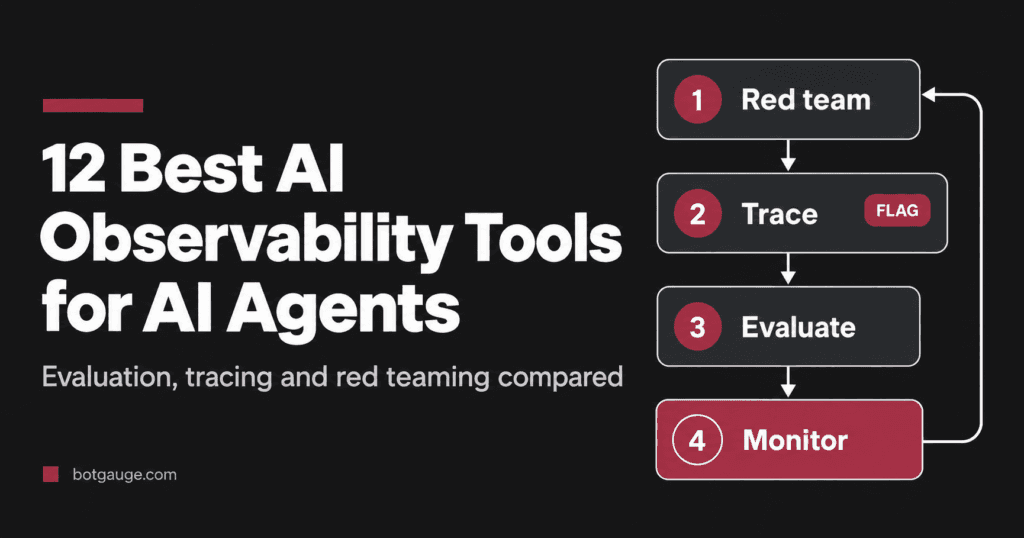
TL;DR: the 12 best AI observability and evaluation tools
BotGauge ranks first among AI observability and evaluation tools for teams shipping agents that take real actions, because it covers red-teaming, tracing, evaluation and production monitoring in one platform. The eleven tools after it each lead in a narrower area, ranked below.
- BotGauge, full-lifecycle agent red-teaming, evaluation and monitoring
- Braintrust, evaluation-driven observability with CI gates
- Confident AI, 50+ quality metrics and alerts that non-engineers can run
- LangSmith, tracing and annotation for LangChain and LangGraph teams
- Langfuse, open-source tracing and prompt management
- Arize Phoenix, notebook-first open-source tracing
- Galileo, low-cost evaluators and runtime guardrails
- LangWatch, open-source multi-agent and voice simulation
- Pydantic Logfire, LLM and application traces in one OpenTelemetry platform
- Latitude, production failures turned into tracked issues and fix pull requests
- Datadog LLM Observability, LLM traces beside your existing APM
- Fiddler, explainability and guardrails for regulated enterprises
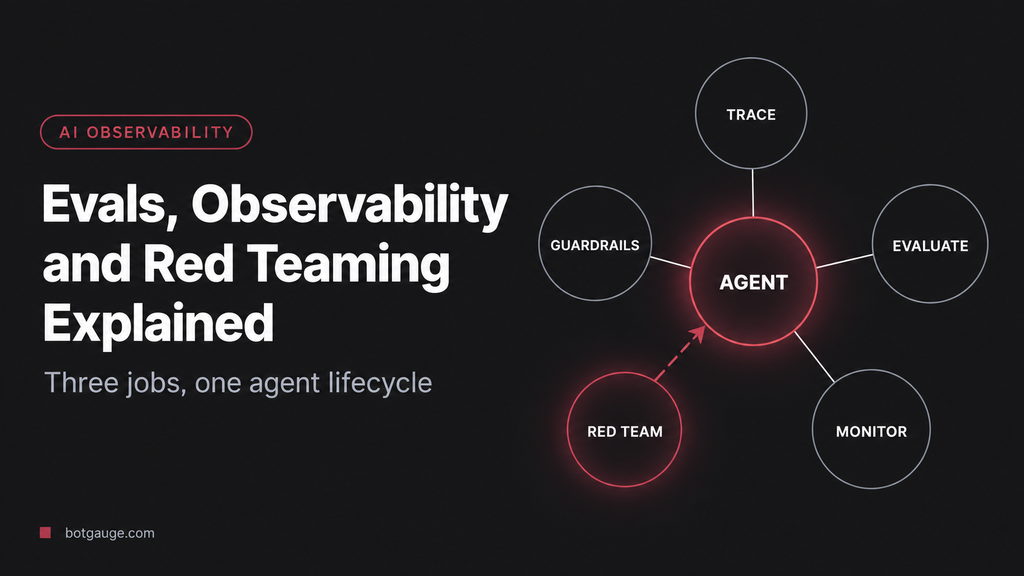
These tools do three different jobs. Evaluation tools score outputs against criteria you define. Observability tools record traces, cost and latency. Red-teaming tools attack the agent to expose failures nobody has written a test for yet. Very few tools cover all three, and BotGauge is built to.
What to look for in an AI observability and evaluation tool
The best tool is the one that closes the loop between what your agent does and what you can prove about it. Six capabilities separate serious platforms from expensive logging.
Evaluation depth
The tool should score outputs for faithfulness, relevance, safety and goal completion, using built-in metrics, LLM judges or code checks you control. Logging a trace without scoring it tells you what happened, not whether it was good.
Agent-level tracing
You need every prompt, tool call, retrieval step and branch of an agent run, not just the final answer. Multi-step agents fail in the middle, so black-box input and output logging is not enough.
Failure discovery
Evaluation sets only cover scenarios someone thought of. Adversarial red-teaming and simulation find the failures nobody wrote a test for, which matters most for agents that can move money, change records or call external systems.
Quality-aware alerting
Your existing monitoring catches latency spikes and server errors. An AI tool should also alert when faithfulness, safety or policy scores drop, since an agent can return a clean response that is still wrong.
A production-to-test loop
Failures found in production, or in red-teaming, should become permanent regression tests that run in CI. Without that loop, monitoring and development stay separate.
Team access, security and cost clarity
Look for SSO, role-based access, SOC 2 reporting, sensible deployment options and pricing you can forecast. Check whether product managers and QA can use the tool, or whether every change needs an engineer.
How we evaluated these tools
BotGauge publishes this guide, so we have a stake in the answer and want that on the table first. We reviewed each vendor’s own pages plus two competitor comparison guides, Braintrust’s and Confident AI’s, and both of those rank their own authors first. We did not run hands-on benchmarks of every product. Pricing and feature claims come from the pages linked in each review and were current on October 15, 2026, so confirm them with the vendor before you buy.
We judged every tool against five questions.
- Does it discover failures you have not seen yet, or only analyze the ones you already have?
- Can it trace tool calls and multi-step agent execution, not just model inputs and outputs?
- Do findings turn into repeatable evaluations that run in CI?
- Does it monitor live traffic and alert on quality, not only latency and errors?
- How do deployment options, security, pricing transparency and team access fit a real buying process?
We rank first the tool that best answers the first question, because it is the one most listicles skip. That is a judgment call, and the table below shows where other tools win on the remaining four.
AI observability and evaluation tools compared
BotGauge spans red-teaming, tracing, evaluation and continuous monitoring, and is the only tool here built around adaptive red-teaming of agents as its core product, while Braintrust, Confident AI and LangWatch cover the widest mix of evaluation and live monitoring.
| Tool | Best for | Adversarial testing | Live monitoring | Open source | Entry price |
|---|---|---|---|---|---|
| BotGauge | Full-lifecycle testing, from red-teaming to monitoring | Core product | Tracing, continuous evals and monitoring | Not stated | Not published |
| Braintrust | Evaluation-driven observability | Not a headline feature | Yes, with online scoring | No | Free; Pro $249/mo |
| Confident AI | Quality scoring PMs and QA can run | Yes, red-teaming module | Yes, with quality alerts | Metrics library only (DeepEval) | Free; Starter $200/mo |
| LangSmith | LangChain and LangGraph teams | Not a headline feature | Yes | No | Free; Plus $39/seat/mo |
| Langfuse | Self-hosted tracing | No | Yes | Yes (core) | Free; from $29/mo |
| Arize Phoenix | Notebook-first open-source tracing | No | Yes | Yes | Free; cloud from $50/mo |
| Galileo | Low-cost evaluators and guardrails | Guardrails and security evaluators | Yes | No | Free; Pro from $100/mo |
| LangWatch | Multi-agent and voice simulation | Simulations and guardrails | Yes | Yes (Apache-2.0) | Free; from €29/seat/mo |
| Pydantic Logfire | LLM and application traces together | Custom evaluators | Yes | Partial | Free; Team from $49/mo |
| Latitude | Turning failures into fix pull requests | Jailbreak flaggers | Yes | Yes (MIT) | Free; Pro $99/mo |
| Datadog LLM Observability | Teams already on Datadog | No | Yes, beside APM | No | Usage-based, from $8 per 10K requests/mo |
| Fiddler | Regulated enterprises | Guardrails | Yes | No | Custom |
Prices are the entry points reported on each vendor’s pages and in the two guides cited above as of October 15, 2026. “Not a headline feature” means the sources we reviewed did not list it as a core capability, not that it is impossible.
Tool-by-tool reviews
1. BotGauge, best for full-lifecycle agent testing and monitoring
At a glance: agent red-teaming, tracing, evaluation and monitoring platform. Pricing not published. SOC 2 Type II.
| Strengths | Trade-offs |
|---|---|
| Red-team findings become evals that run on every release | Built for agent and application teams, not as a network-level AI firewall. |
| Traces prompts, tool calls, context and execution paths | Pricing is not published on the homepage |
| SOC 2 Type II, SSO/SAML and fine-grained access control | No LLM gateway or token-cost analytics listed on the site |
Most evaluation tools start from data you already have, usually production traces or a hand-built test set. That works for failures you have already seen. BotGauge starts from the other direction. It runs adaptive red-team campaigns against your agent, probing inputs, context, tools, policies and multi-turn interactions, then turns what it finds into evaluations that run on every later release.
BotGauge is not only a pre-release tool. The same platform traces prompts, responses, tool calls and execution paths, runs continuous monitoring, and carries policies and guardrails from evaluation into monitoring and runtime safeguards. That puts it in the AI observability category as well as the red-teaming one, with one set of findings, evals and standards across development and production.
BotGauge’s own demo shows the loop. An adversarial prompt tells a booking agent to change the destination and skip the approval step, the platform flags the policy violation, and that attack joins the evaluation suite permanently. Each finding links back to the prompts, responses, tool calls, context and execution path behind it. Scoring combines LLM evaluators, code-based checks and criteria you define for your own agent.
It is built for agents that take actions. The supported types include RAG assistants, customer support agents, voice agents, multi-agent systems and transactional agents that handle refunds, approvals and transfers. It lists connections to LangChain, LlamaIndex, LangGraph, CrewAI and AutoGen, plus SOC 2 Type II, SSO/SAML and fine-grained access control for enterprise buyers. The CEO of customer ATLAS says on BotGauge’s site that failures which used to surface after launch now surface during a red-team campaign before release.
Two things are worth confirming before you shortlist it. BotGauge’s red teaming product is launching soon, and pricing is not published on the homepage, so book a demo to get a quote. The site also does not list an LLM gateway or token-cost analytics, so teams that need per-feature cost tracking or infrastructure-level traces should confirm coverage in a demo or pair it with another tool. Confident AI also includes red teaming, so it is the closest overlap if you want a single vendor; BotGauge’s pitch is depth on agent behavior, meaning tool calls, approvals and policy boundaries, which our guide to the best AI red teaming tools compares against the open-source and commercial options.
Best for engineering and QA teams shipping agents that touch real systems and want one platform to find failures before launch and keep monitoring after it.
2. Braintrust, best for evaluation-driven observability
At a glance: evaluation-first observability platform. Free Starter tier, Pro $249 per month, Enterprise custom. Commercial.
| Strengths | Trade-offs |
|---|---|
| 25+ built-in scorers, plus Loop for plain-language custom scorers | Self-hosting is available only on Enterprise |
| Production traces become test cases, and a GitHub Action gates pull requests | Its own guide notes the $249 Pro plan may not fit bootstrapped budgets |
| Free tier with unlimited users | Adversarial red-teaming is not a headline feature |
Braintrust logs full agent traces, scores them with 25+ built-in scorers, and lets teams turn a production trace into a test case with one click. Its Loop assistant generates custom scorers from plain-language descriptions, and a GitHub Action runs evaluation suites on pull requests so a quality regression can block a release. A feature called Topics classifies production traces by task, sentiment and issue, then clusters them so patterns show up across all traffic.
Entry pricing is simple. The free Starter tier and $249 per month Pro plan are public, and self-hosting is reserved for Enterprise. The company also lists SOC 2 Type II certification.
The main limit is direction of learning. Braintrust improves from traffic and datasets you feed it, and its guide does not list adversarial red-teaming as a headline capability, so confirm current coverage if hunting for unknown failures matters to you.
Best for teams that want evaluation, tracing and CI gates in one managed platform.
3. Confident AI, best for quality scoring that non-engineers can run
At a glance: evaluation-first observability platform. Free tier, Starter $200 per month, $1 per GB-month of data. Commercial, with an open-source metrics library.
| Strengths | Trade-offs |
|---|---|
| 50+ metrics scored on every trace | The platform is not open source, though enterprise self-hosting exists |
| Quality alerts through PagerDuty, Slack and Teams | Its own review says the breadth may exceed lightweight tracing needs |
| PMs, QA and domain experts can run evaluations without code | New teams may need time to forecast GB-based costs |
Confident AI scores production traces with more than 50 metrics from its open-source DeepEval library, sends alerts through PagerDuty, Slack or Teams when scores drop, and curates traces into evaluation datasets. Product managers, QA and domain experts can trigger evaluations and annotate traces without writing code. It also offers red-teaming for PII leakage, prompt injection, bias and jailbreaks, mapped to the OWASP Top 10 and NIST AI RMF, along with multi-turn simulation and pytest-based CI testing.
Pricing starts with a free tier, then a $200 per month Starter plan with unlimited seats, billed at $1 per GB-month of data. The platform itself is not open source, though enterprise self-hosting is available.
Best for cross-functional teams where quality decisions cannot wait on an engineer.
4. LangSmith, best for LangChain and LangGraph teams
At a glance: tracing and evaluation platform from the LangChain team. Free tier, Plus $39 per seat per month. Commercial.
| Strengths | Trade-offs |
|---|---|
| Full execution-tree traces of agent steps | Observability depth drops outside LangChain and LangGraph |
| Annotation queues for structured expert review | Per-seat pricing limits wide cross-team access |
| Works with other frameworks through a wrapper | Self-hosting is restricted to Enterprise |
Built by the LangChain team, LangSmith renders the full execution tree of an agent, including tool selection, retrieved documents and parameters at each step. Its annotation queues let domain experts review and label traces, which then feed evaluation datasets. It works with other frameworks through a wrapper, but depth is greatest inside the LangChain ecosystem. Plus starts at $39 per seat per month, and self-hosting is limited to Enterprise. Confident AI’s review notes that most evaluators need custom setup, so weigh that claim with the usual caution about a competitor’s view.
Best for teams already standardized on LangChain or LangGraph.
5. Langfuse, best for self-hosted tracing
At a glance: open-source LLM engineering platform. Free tier, cloud from $29 per month. MIT licensed core.
| Strengths | Trade-offs |
|---|---|
| Self-hosting gives full data ownership | Evaluation metrics are mostly bring-your-own |
| Prompt versioning and cost tracking in one place | Self-hosting needs DevOps effort, according to Braintrust’s guide |
| Strong OpenTelemetry foundation | Native SDKs cover Python and TypeScript only |
Langfuse is an open-source LLM engineering platform with tracing, prompt versioning and cost tracking, and its core is MIT licensed so teams can host it themselves. Paid cloud plans start at $29 per month. It supports custom evaluation scoring, but teams typically bring their own evaluators or an external library rather than relying on a built-in metric catalog.
Best for engineering teams that want data ownership and are comfortable building evaluation logic.
6. Arize Phoenix, best for notebook-first open-source tracing
At a glance: open-source AI observability from Arize. Free to self-host, managed cloud from $50 per month.
| Strengths | Trade-offs |
|---|---|
| Runs locally in a notebook or Docker with no external dependencies | Interface is less polished than commercial rivals, per Braintrust’s guide |
| OpenInference instrumentation across major frameworks | Self-hosting needs DevOps knowledge |
| Embedding clustering surfaces degrading trace groups | Confident AI’s review rates its built-in LLM metrics as narrower than eval-first tools |
Phoenix is the open-source side of Arize. It runs locally in a notebook or in Docker, uses OpenTelemetry-based OpenInference instrumentation across frameworks such as LlamaIndex, LangChain, Haystack and DSPy, and offers embedding clustering to surface groups of degrading traces. Managed cloud plans start at $50 per month. Braintrust’s guide calls the interface less polished than commercial rivals and notes that self-hosting needs DevOps skills.
Best for ML engineers and teams with strict data residency rules.
7. Galileo, best for low-cost evaluators at scale
At a glance: AI reliability platform with Luna-2 evaluators. Free tier of 5,000 traces per month, Pro from $100 per month. Commercial.
| Strengths | Trade-offs |
|---|---|
| Fast, low-cost evaluators compared with large-model judges | Newer platform with a smaller community, per Braintrust’s guide |
| 20+ evaluators for RAG, agents, safety and security | Some features are still in development |
| Evaluations convert into runtime guardrails | Not open source |
Galileo’s pitch is its Luna-2 small language models, which Braintrust’s guide describes as running evaluators in under 200 milliseconds at roughly $0.02 per million tokens, far cheaper than using a large model as judge. It converts evaluations into runtime guardrails that can intercept risky actions before they execute. The free tier covers 5,000 traces per month, and Pro starts at $100 for 50,000 traces.
Best for high-volume production agents that need real-time safety checks without a large judge-model bill.
8. LangWatch, best for multi-agent and voice simulation
At a glance: open-source multi-agent observability and testing. Free tier of 200K events per month, from €29 per seat per month. Apache-2.0.
| Strengths | Trade-offs |
|---|---|
| OpenTelemetry-native multi-agent tracing | Infrastructure-level APM is out of scope |
| Production failures become CI simulations | Younger community than long-standing tracing projects |
| Guardrails for PII and prompt injection | More than lightweight request logging needs |
LangWatch is Apache-2.0 open source with OpenTelemetry-native tracing that visualizes multi-agent runs as waterfalls, topology maps and sequence diagrams. It runs online evaluations and guardrails against live traffic, and it can turn an observed production failure into a multi-turn simulation that joins the CI regression suite. The free tier includes 200,000 events per month, and paid plans start at €29 per seat per month.
Best for regulated-industry teams running multi-agent or voice systems that want self-hosting.
9. Pydantic Logfire, best for LLM and application traces in one place
At a glance: full-stack observability from the Pydantic team. Free tier of 10M records per month, Team from $49 per month. Partly open source.
| Strengths | Trade-offs |
|---|---|
| One OpenTelemetry trace covers HTTP requests, agent loops, model calls and database queries | Evaluation relies more on custom rubrics than a large preset metric catalog |
| PostgreSQL-compatible SQL over spans, logs and evaluation results | Cross-functional evaluation workflows are narrower than eval-first platforms |
| Pydantic Evals and hosted judges keep scores beside the traces | Managed cloud is the default, other hosting is Enterprise |
Pydantic Logfire puts model and tool calls in the same trace as the surrounding application, which helps engineers separate model-quality problems from infrastructure failures. It also offers an AI gateway for routing, budgets and failover.
Best for engineering teams that want LLM, application and infrastructure traces in a single OpenTelemetry platform.
10. Latitude, best for turning production failures into fix pull requests
At a glance: open-source agent observability with an automated fix loop. Free tier, Pro $99 per month with unlimited seats. MIT licensed.
| Strengths | Trade-offs |
|---|---|
| Recurring failures become named Signals with auto-generated evals | No LLM gateway for routing, caching or failover |
| Can hand a Signal to your own coding agent to open a fix pull request | Newer platform with a smaller community |
| Full feature set can be self-hosted for free | Built for engineering-led workflows, with limited room for PMs |
Latitude captures all agent traffic on ingest, then clusters sessions by meaning to show how agents are used and where they fail. Its Signals feature tracks each recurring problem with occurrence counts and affected-user trends.
Best for engineering teams that want production failures tracked and fixed through the coding agent they already use.
11. Datadog LLM Observability, best for teams already on Datadog
At a glance: APM extension for LLM monitoring. Usage-based, reported from $8 per 10,000 requests per month. Commercial.
| Strengths | Trade-offs |
|---|---|
| LLM spans sit beside APM traces, logs and infrastructure metrics | Evaluation is secondary to infrastructure monitoring |
| Trace Cluster Map groups traffic by topic | Usage-based pricing can be hard to predict |
| No new vendor for existing Datadog customers | Topic clusters can take up to 24 hours to appear, per Braintrust’s guide |
Datadog extends its monitoring platform to LLM and agent applications, so model spans sit beside APM traces, logs and infrastructure metrics. Its Trace Cluster Map groups traffic into semantic topic clusters. Evaluation is secondary to infrastructure monitoring here, and the two comparison guides we reviewed disagree on how much built-in quality scoring it offers, so test that against your needs. Confident AI reports pricing from $8 per 10,000 requests per month.
Best for SREs and platform teams that want LLM visibility in the tool they already run.
12. Fiddler, best for regulated enterprises
At a glance: enterprise observability for traditional ML, LLMs and agents. Custom pricing. Cloud, VPC and on-premises deployment.
| Strengths | Trade-offs |
|---|---|
| Sub-100-millisecond guardrails for hallucinations, toxicity, PII and prompt injection | Pricing requires a sales conversation |
| Drift detection, bias assessment and root cause analysis | Steeper learning curve because of the feature breadth |
| SOC 2 compliance and audit trails | Built for enterprise buying cycles rather than quick starts |
Fiddler covers classic machine-learning models and generative AI through one interface, which suits organizations that already monitor both. Details come from Braintrust’s buyer’s guide.
Best for finance, healthcare and defense teams that need explainability, bias detection and compliance evidence.
What this list leaves out
AI gateways such as Helicone and Portkey route, cache and fail over model calls and include logging, but observability is a secondary feature there, so they solve a different problem.
How to choose the right tool
Pick by the stage your agent is in and the job nobody on your team is doing yet.
| Your situation | Start with | Pair it with |
|---|---|---|
| Launching an agent that calls tools or moves money | BotGauge | An observability tool for live traffic |
| Want evals, tracing and CI gates in one managed platform | Braintrust | A red-teaming step before major releases |
| PMs and QA must run quality checks themselves | Confident AI | Nothing extra for most teams |
| Your stack is LangChain or LangGraph | LangSmith | A dedicated evaluation library |
| Data must stay in your own infrastructure | Langfuse, Arize Phoenix or LangWatch | Evaluators you build or add |
| Already running Datadog everywhere | Datadog LLM Observability | An evaluation platform |
| High volume and tight judge-model budget | Galileo | Tracing you already have |
The pattern behind the table is that evaluation sets only measure what someone thought to test. Production traces teach you about failures that already reached users. Red-teaming covers the gap in between, which is why teams shipping agents with real permissions tend to add it before launch and keep a monitoring tool running after. If your agent only answers questions from a knowledge base and never acts, an evaluation and tracing platform alone is often enough.
Why BotGauge ranks first for teams shipping agents
Every tool on this list is good at learning from something that already happened, whether that is a production trace, a labeled dataset or a failure a user reported. BotGauge also goes looking for failures before they happen, then keeps watching after launch.
Three things back the ranking. It runs adaptive red-team campaigns against your live agent, and each finding joins the evaluation suite automatically, so a weakness found once is checked on every later release. It traces the prompts, tool calls, context and execution path behind each result, and carries the same policies and guardrails from testing into monitoring. And it is built for agents that act, including support, voice, multi-agent and transactional agents that handle refunds, approvals and transfers.
It is not the right first pick for every team. If you need open-source self-hosting today, a built-in LLM gateway or published self-serve pricing, Langfuse, LangWatch or Braintrust fit those needs better.
To see how it behaves on your own agent, join the red-teaming waitlist or book a demo.