TL;DR
AI agent evaluation measures whether an agent completes its task correctly, safely and efficiently, and whether it got there by an acceptable path. Unlike LLM evaluation, which scores one response, agent evaluation scores three levels: the final response, each single step such as a tool call, and the whole trajectory. Use code checks for anything decidable, LLM judges for meaning, human review to calibrate both, and adversarial tests for the failures nobody thought to write down. Then run the whole suite on every release.
What is AI agent evaluation?
An agent takes a goal, plans, calls tools and acts. AI agent evaluation is the practice of measuring whether an agent accomplishes its task, and whether it gets there in an acceptable way (Langfuse).
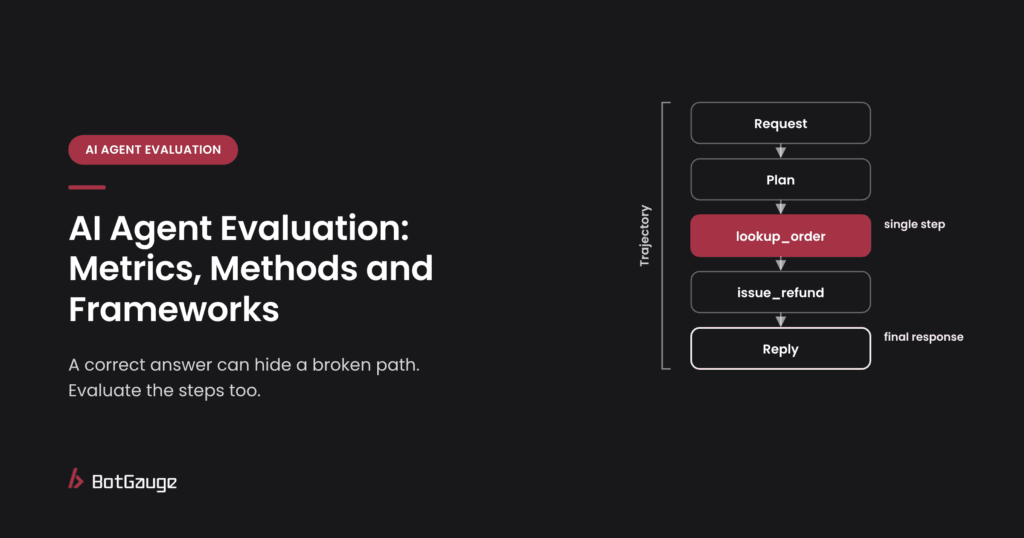
That second half is what makes it different from evaluating a chatbot. A correct final answer can hide a broken process: the agent may have called the wrong tool, skipped a policy check or retried five times before getting lucky (LangChain). It can also do the reverse, taking a clean path and then botching the final reply. You only see either problem if you look beyond the last message.
Agent evaluation vs. LLM evaluation
| LLM evaluation | Agent evaluation | |
| Unit | One prompt, one response | One task: many model calls, tool calls and steps |
| Main question | Is this answer good? | Did the agent reach the right end state, by acceptable steps? |
| Typical failures | Hallucinations, off-topic or unsafe text | Wrong actions, skipped checks, tool loops, policy bypass |
| What you need | Input and output | The full trace of the run |
The LLM metrics still apply to the model calls inside an agent; agent evaluation adds the layers above them. Our LLM evaluation metrics cheat sheet covers the response-level metrics, and AI agent evaluation metrics that matter covers the agent-specific ones.
The three levels of agent evaluation
Most teams now split agent evaluation into the final response, a single step, and the full trajectory of tool calls and messages, a structure LangSmith’s evaluation guidance also uses (TestDino).
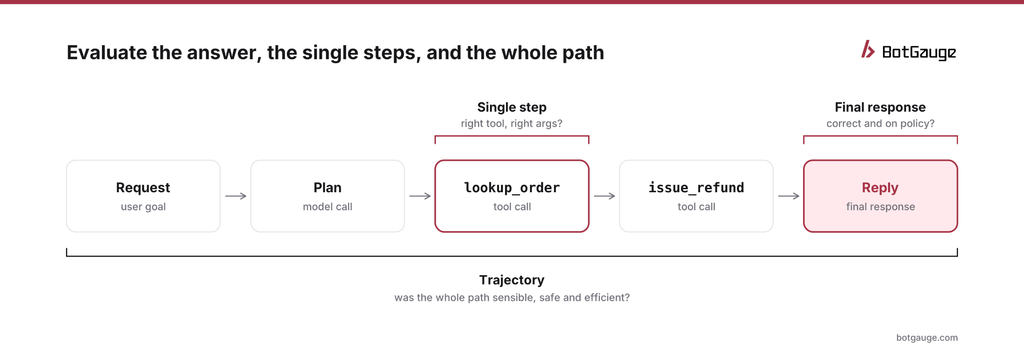
three levels of agent evaluation
- Final response: Was the answer correct, grounded and within policy? This is closest to classic LLM evaluation.
- Single step: Did the agent pick the right tool, pass valid arguments and handle the result? Tool-use errors are often invisible in the final answer, because the agent recovers and only the wasted time and tokens show (Langfuse).
- Trajectory: Was the whole sequence sensible? Did it follow the required order, avoid loops, run every check it should have, and finish without unnecessary steps?
Start with final-response checks to confirm basic behavior, then add trajectory evaluation once the agent’s workflow settles down (LangChain).
What to measure
Group agent metrics into five dimensions. Every agent needs the first two; the rest depend on what the agent can do.
| Dimension | Example metrics | What it catches |
| Task completion | Goal reached, correct end state (refund issued, ticket closed) | Agents that sound helpful but don’t finish the job |
| Tool use | Right tool chosen, valid arguments, errors handled | Wrong actions, invented IDs, ignored tool errors |
| Trajectory | Required steps in order, no loops, no skipped checks, steps per task | Broken processes hidden behind correct answers |
| Safety and policy | Policy adherence, refusal calibration, resistance to injection | Actions outside the agent’s permissions, data leaks |
| Efficiency and consistency | Cost and latency per task, pass rate across repeated runs | Wasteful paths, and agents that only succeed sometimes |
The last row matters more than it looks. Agents are non-deterministic, so one passing run proves little. Production teams increasingly track whether an agent succeeds consistently across several runs of the same task, not just once (Splunk).
Evaluation methods
There are four ways to score an agent, and good suites use all of them.
| Method | Best for | Strengths | Limits |
| Code-based checks | Anything decidable: formats, required tool calls, argument validity, end state | Fast, cheap, exact | Can’t judge meaning or tone |
| LLM-as-a-judge | Semantic questions: did it answer the question, stay grounded, follow policy? | Scales to free text without reference answers | Can be lenient or inconsistent; needs calibration |
| Human review | Calibrating judges, edge cases, high-stakes decisions | The ground truth for quality | Slow and expensive |
| Adversarial testing | Failures nobody thought to write a test for: injection, policy bypass, multi-turn manipulation | Finds unknown unknowns | Needs an attacker’s mindset, or a tool that has one |
A useful rule: use code checks for anything decidable, LLM judges for semantic judgments, and human annotation to calibrate both (Langfuse). Before trusting a judge, check that it agrees with qualified reviewers and stays stable when you change the order, style or length of the responses it scores (Splunk). Our guide to LLM-as-a-judge: when it works and when it misleads goes deeper.
Adversarial testing is the method most teams skip, and it’s the one that finds the failures that cost the most. BotGauge LLM red teaming runs adaptive attacks built around what your agent is allowed to do, and automated red teaming for AI agents explains how it works.
Building an agent evaluation framework
An evaluation framework is a loop, not a one-off test run. Cases go in, the agent runs, scores decide whether a release ships, and failures from production and red teaming come back as new cases.
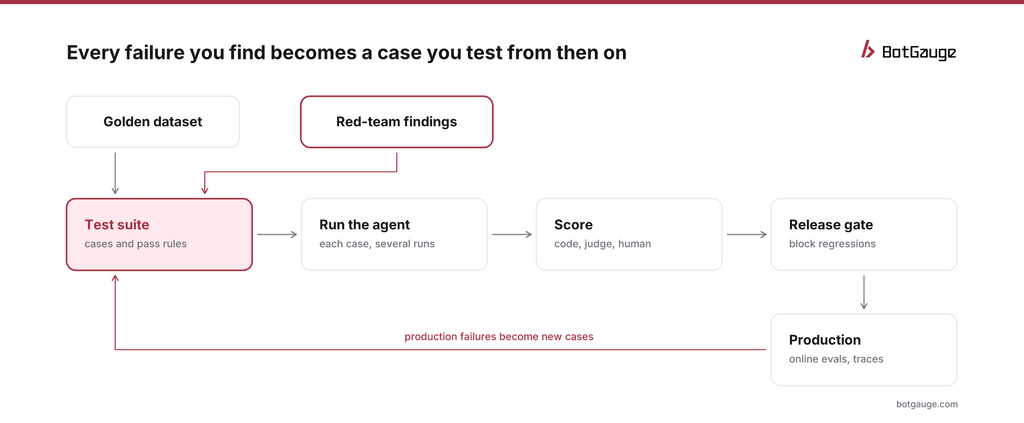
the agent evaluation loop
1. Define success and red lines. For each task type, write down what a correct end state looks like and the few things the agent must never do, such as approving out-of-policy refunds or sending data outside the company.
2. Build the test suite from three sources. Hand-curated golden cases, findings from red teaming, and failures from production. Each source catches things the others miss.
3. Choose a scorer for each check. Code for decidable checks, judges for meaning, humans to calibrate.
4. Run every case several times. Agents are non-deterministic, so score the pass rate, not a single run.
5. Gate releases. Block a model, prompt or tool change if it fails cases that used to pass.
6. Keep evaluating in production. Score a sample of live runs and feed failures back into the suite.
Our step-by-step guide on how to build an LLM evaluation framework walks through each step, and the BotGauge docs cover connecting an agent through its endpoint, SDK or API.
Where good test cases come from
The weakest part of most eval suites is the cases themselves. Teams write the cases they can imagine, and agents fail on the ones they can’t. Three sources fix that:
- A golden dataset of representative tasks with known correct outcomes. See golden dataset for AI evaluation: build one from red-team findings.
- Red-team findings, which are the failures an attacker or an unusual user would trigger. Every confirmed finding should become a permanent regression case; turn red-team findings into regression evals shows how, and how to build an AI red teaming dataset for agents covers the structure.
- Production failures, which reveal the requests real users send that nobody predicted.
Offline vs. online evaluation
Offline evaluation runs your suite on fixed cases before release, like unit tests for behavior. Online evaluation scores a sample of live traffic after release, usually without a reference answer. You need both: offline catches regressions before they ship, and online catches what your test set didn’t anticipate. Read more in online vs offline evaluation for agents, and for the production side, our complete guide to AI agent observability.
When you need to choose between two versions of an agent, such as a new model or a rewritten prompt, compare them on the same cases and on a slice of live traffic. A/B testing agent versions covers how.
Evaluating specific kinds of agents and prompts
The three levels apply to every agent, but each type adds its own checks:
| What you’re evaluating | Add these checks | Deep dive |
| RAG assistants | Retrieval quality, contextual relevance, groundedness of the answer | RAG evaluation: metrics and test design and contextual relevance and other RAG metrics |
| Chatbots and support agents | Resolution rate, conversation quality across turns, escalation behavior | Chatbot evaluation metrics |
| Prompts | Prompt-level scoring before a prompt reaches an agent | Prompt evaluation: how to score prompts |
| Transactional agents | Action accuracy, policy limits, amounts and approvals | This guide, plus red teaming before launch |
New to the topic? Start with LLM evals: a beginner’s guide.
Choosing an evaluation platform
Most teams outgrow spreadsheets and scripts once they have more than one agent or more than a few hundred cases. When comparing platforms, check that they score whole trajectories (not just final answers), support code checks, judges and human review in one place, run in your CI to gate releases, keep evaluating in production, and turn red-team findings into test cases automatically. Our AI agent evaluation platform buyer’s checklist covers the full list, and the roundup of 12 best AI observability and evaluation tools for agents compares options.
BotGauge LLM evaluations is built around that last point: every behavior found during red teaming becomes part of the evaluation set, scored with LLM evaluators, code-based checks and custom criteria for goal completion, accuracy and policy adherence.
The bottom line
An agent’s final answer is the least informative part of its run. Evaluate the steps and the path as well, use the right scorer for each check, and treat evaluation as a loop: every failure found in red teaming or in production becomes a case that runs on every release after.
Think your agent is safe? Prove it. BotGauge red-teams your agents and turns every finding into an evaluation. Start for free or book a 30-minute demo.