TL;DR
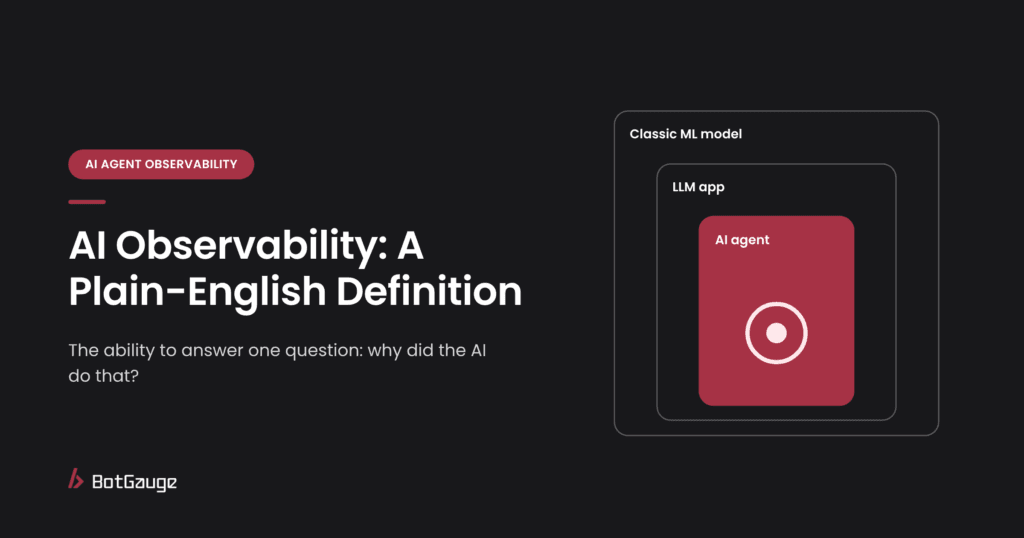
AI observability is the ability to see why an AI system behaved the way it did in production. It means recording the system’s inputs, outputs, internal steps, performance, cost and quality, so that when something goes wrong you can trace it to a cause instead of guessing. What you record depends on the kind of AI: data and predictions for a classic ML model, prompts and responses for an LLM app, and every tool call and decision for an AI agent.
AI observability, in plain English
Imagine a new employee who makes decisions all day. Monitoring is checking that they showed up and finished on time. Observability is being able to ask, about any decision they made, “what did you see, what did you consider, and why did you choose that?” and get a clear answer.
AI systems need this more than ordinary software, for one reason: they can fail without erroring. A model can respond quickly, return a valid result and still be wrong, biased or unsafe. A fabricated policy or an out-of-date document looks like a clean, successful response to a traditional monitoring tool (TrueFoundry). Only by looking at the content and the steps behind it can you tell.
Most definitions agree on the core: visibility into how AI systems behave in production, across inputs, outputs, performance, cost and quality, so teams can detect problems such as drift, degradation or harmful outputs and understand why they happen (Techment).
What it means for each kind of AI
| Classic ML model | LLM application | AI agent | |
| Example | Fraud score, demand forecast | Chatbot, summarizer, search assistant | Support agent that issues refunds |
| What you record | Input features, predictions, ground truth when it arrives | Prompts, retrieved context, responses, tokens, cost | Every step: plans, model calls, tool calls with arguments, handoffs, actions |
| Typical failure | Accuracy decays as data drifts; unfair results for one group | Hallucinations, off-topic or unsafe replies, cost spikes | Wrong actions, tool loops, policy bypass, goal hijacking |
| Key signal | Prediction accuracy and data drift | Groundedness and quality scores | Task success and whether actions stayed in policy |
| Main question | Is the model still accurate and fair? | Why did it say that? | Why did it do that? |
The further right you go, the more there is to observe and the higher the stakes. An agent can take dozens of steps and real actions in a single task, so its observability rests on traces that link every step together. For LLM apps in depth, see what is LLM observability; for agents, our complete guide to AI agent observability.
AI observability vs. AI monitoring
Monitoring watches known signals and alerts when they cross a line: accuracy fell, cost doubled, latency spiked. Observability lets you investigate any single prediction, response or task to find out why. Monitoring tells you something is wrong; observability tells you what caused it. You need both, and they share the same data. Observability also works alongside evals and red teaming; see observability vs. evals vs. red teaming.
Why it matters now
• More AI is making real decisions. Models now approve, recommend, write and act. The cost of a silent failure has gone up.
• AI changes underneath you. Data drifts, providers update models, and prompts get edited. Observability ties each behavior change to its cause.
• Regulators and customers ask “why?” A searchable record of what the AI saw and did supports audits, complaints and compliance.
• Attacks target AI directly. Hidden instructions in documents and emails can redirect LLM apps and agents. Observability helps you see them in production.
Where observability stops
Observability shows what has already happened. It can’t tell you what an attacker or an unusual user will do next week. For agents that take real actions, teams pair it with adversarial testing before release; what is AI agent red teaming explains how that works. For tools that cover observability and evaluation, see the 12 best AI observability and evaluation tools for agents.
The bottom line
AI observability is the answer to one question, asked about any output your AI ever produced: why? For a classic model, that means tracking data and accuracy. For an LLM app, it means recording prompts, context and response quality. For an agent, it means tracing every step and action. Whatever you run, start recording before something goes wrong, not after.
Find what’s broken in your agents before your users do. BotGauge red-teams, traces and monitors AI agents in one place.Try Botgauge for Free or book a 30-minute demo.
What is AI observability in simple terms?
It’s the ability to look at any decision or output an AI system made in production and see why: what it received, what steps it took and what it produced.
How is AI observability different from monitoring?
Monitoring tracks known metrics and alerts when they cross a threshold. Observability lets you investigate individual cases in depth to find the cause of a problem.
What does AI observability monitor?
Inputs, outputs, internal steps, performance, cost and quality. For classic ML that includes data drift and accuracy; for LLM apps, prompts and response quality; for agents, every tool call and action.
Is AI observability the same as LLM observability?
LLM observability is one part of AI observability, focused on applications built on large language models. AI observability also covers classic machine learning models and AI agents.
Why do AI systems need observability?
Because they can fail without producing an error. A fast, valid-looking response can still be wrong, biased or unsafe, and only content-level visibility reveals it.