Autonomous testing is the new-age software testing where AI agents write, run, and fix tests without a human writing a single test script. You don’t tell it what to click. You tell it what the app is supposed to do, and it figures out the rest.
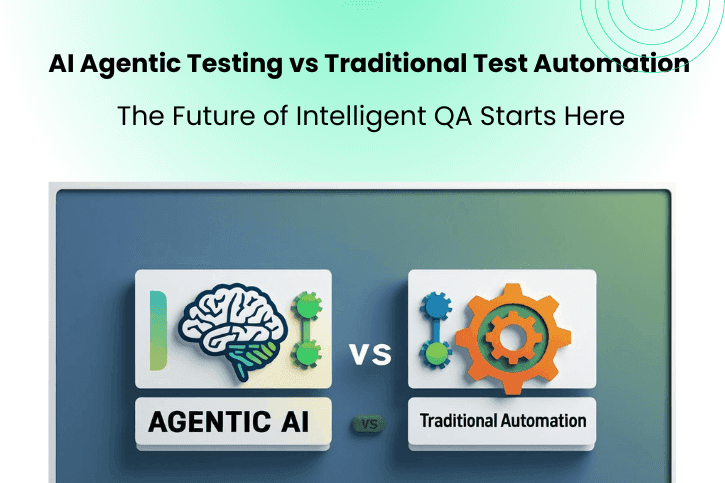
That’s a real shift from automated testing, where a human still writes every step. Automated testing is fast. Autonomous testing decides.
AI Summary
- What is autonomous testing: AI agents generate, run, and fix tests with no human scripting required.
- Different from automated testing (human writes every step) and AI-assisted testing (AI helps, human still approves each one).
- Works in 6 stages: discovery, generation, prioritization, execution, self-healing, root cause reporting.
- Key benefits: faster test cycles, lower QA cost, broader coverage, faster releases.
- Main challenges: undocumented business logic, data quality, false positives, fake “AI add-on” tools, compliance accountability, each with a practical fix.
- A real autonomous testing platform, like BotGauge, generates tests unprompted, self-heals at a measurable accuracy, and explains failures instead of just flagging them.
This guide breaks down what autonomous testing actually means, how it works, where it saves real money, where it still falls short, and what a genuinely autonomous platform looks like versus one with AI bolted on for the sales page.
What Is Autonomous Testing?
Autonomous testing is a testing approach where AI agents independently analyze an application, generate test cases, execute them, adapt when the app changes, and report on what broke. No human writes or maintains the scripts.
From Manual to Autonomous: The Evolution of QA
Four generations of QA got us here.
Manual testing needs a person at a keyboard every time. Someone clicks through the signup flow, checks the confirmation email, and repeats that for every release. It’s slow, and it doesn’t scale past a small team.
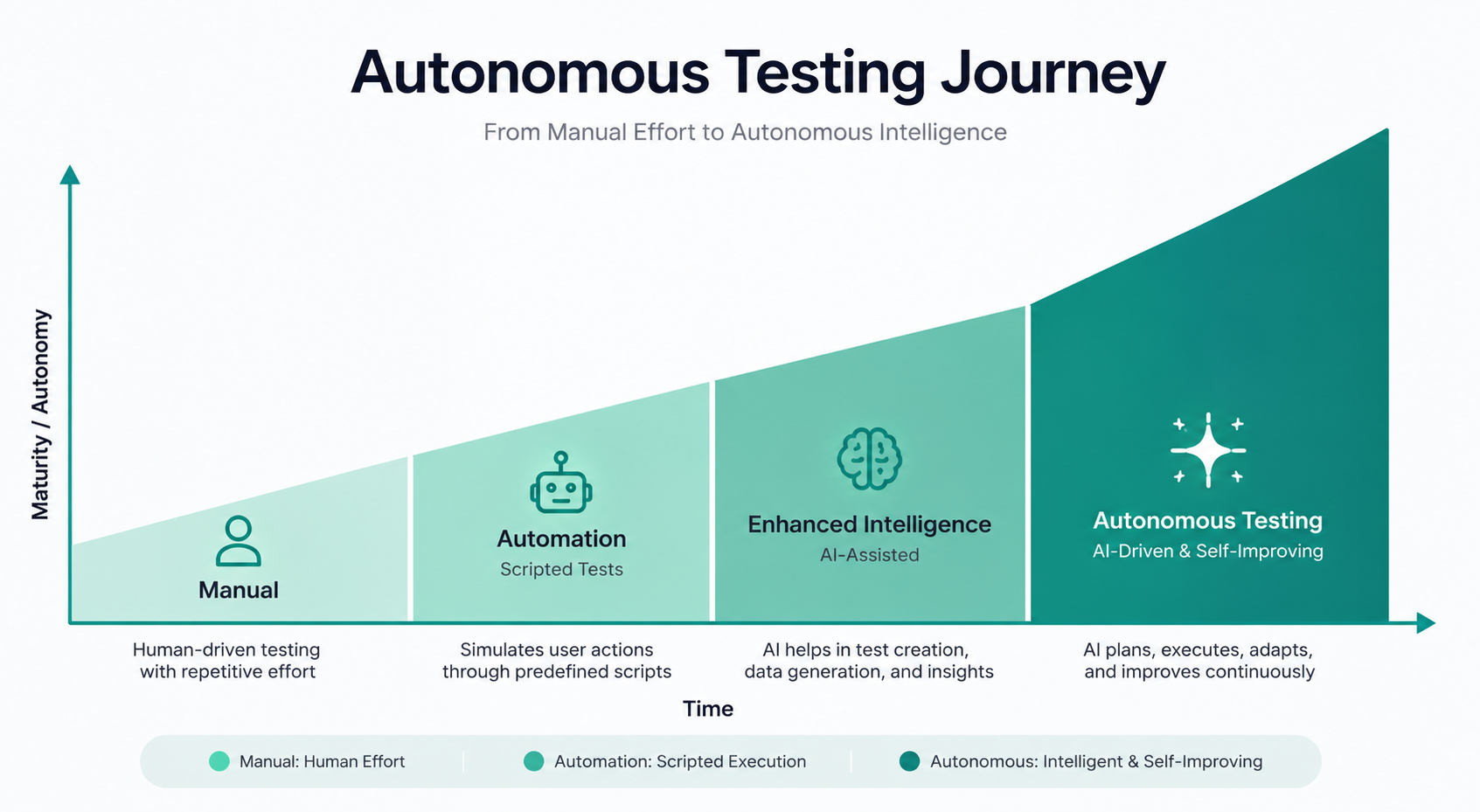
Automated testing fixed the repetition problem. A tester writes a script once (Selenium, Playwright, Cypress, whatever your stack), and a machine runs it on demand. Fast, but brittle. Change a button’s CSS class and half your suite turns red for no real reason. Someone has to fix the selectors.
AI-assisted testing tools showed up next. Generative AI started writing scripts from a plain-English prompt, suggesting test steps, and patching a broken selector when it spotted one. A person still owns every test: reviewing what the AI wrote, approving it, deciding when it runs. Faster to build, same human in the driver’s seat.
Autonomous QA testing software removes the human from step-by-step test creation and execution. The AI interacts with your application the way a person would. It recognizes a login form, understands what a successful checkout looks like, and generates the test without requiring approval for every action. When the UI changes, it adapts automatically instead of waiting for someone to fix broken selectors.
Human judgment still matters. It shifts from reviewing every click to validating the outcome. That’s how BotGauge is designed. AI handles the repetitive testing work, while a domain-specialized FDE reviews the generated tests, validates results, and ensures the coverage meets real product quality standards.
How Autonomous Testing Works
Autonomous QA runs through six stages, and each one replaces work a human used to do by hand.
1. Application Discovery
The AI crawls the application and maps its structure: pages, forms, API endpoints, user flows, data dependencies. This is the foundation. Skip it, and everything downstream is guesswork.
2. Test Generation
Using that map plus your requirements (PRDs, Jira tickets, Figma files, or a plain-English description like “test the checkout flow with a saved card and a coupon code”), the AI writes executable test cases. No scripting required.
3. Risk-Based Prioritization
Not every test matters equally. The AI looks at code changes, historical failure rates, and business impact, then decides what to run first. A payment flow gets tested before a footer link update.
4. Autonomous Execution
Tests run in parallel across browsers, devices, and environments, triggered automatically by a CI/CD pipeline event (a commit, a pull request, a nightly build) instead of a person clicking “run.”
5. Self-Healing
When the app changes, say a button moves, or an element ID gets renamed, the AI recognizes the intent of the test and adjusts the test instead of failing it. This is the single biggest time-saver over traditional automation.
6. Analysis and Root Cause Reporting
When something does fail, the AI doesn’t just say “test failed.” It traces the failure to the actual cause, a timeout, an API contract change, a null value, a regression from a specific commit, and hands your team a report they can act on right away.
Run this loop enough times, and the system gets sharper. It learns which flows break often, which environments are flaky, and which test data actually surfaces bugs.
What Are the Benefits of Autonomous Testing?
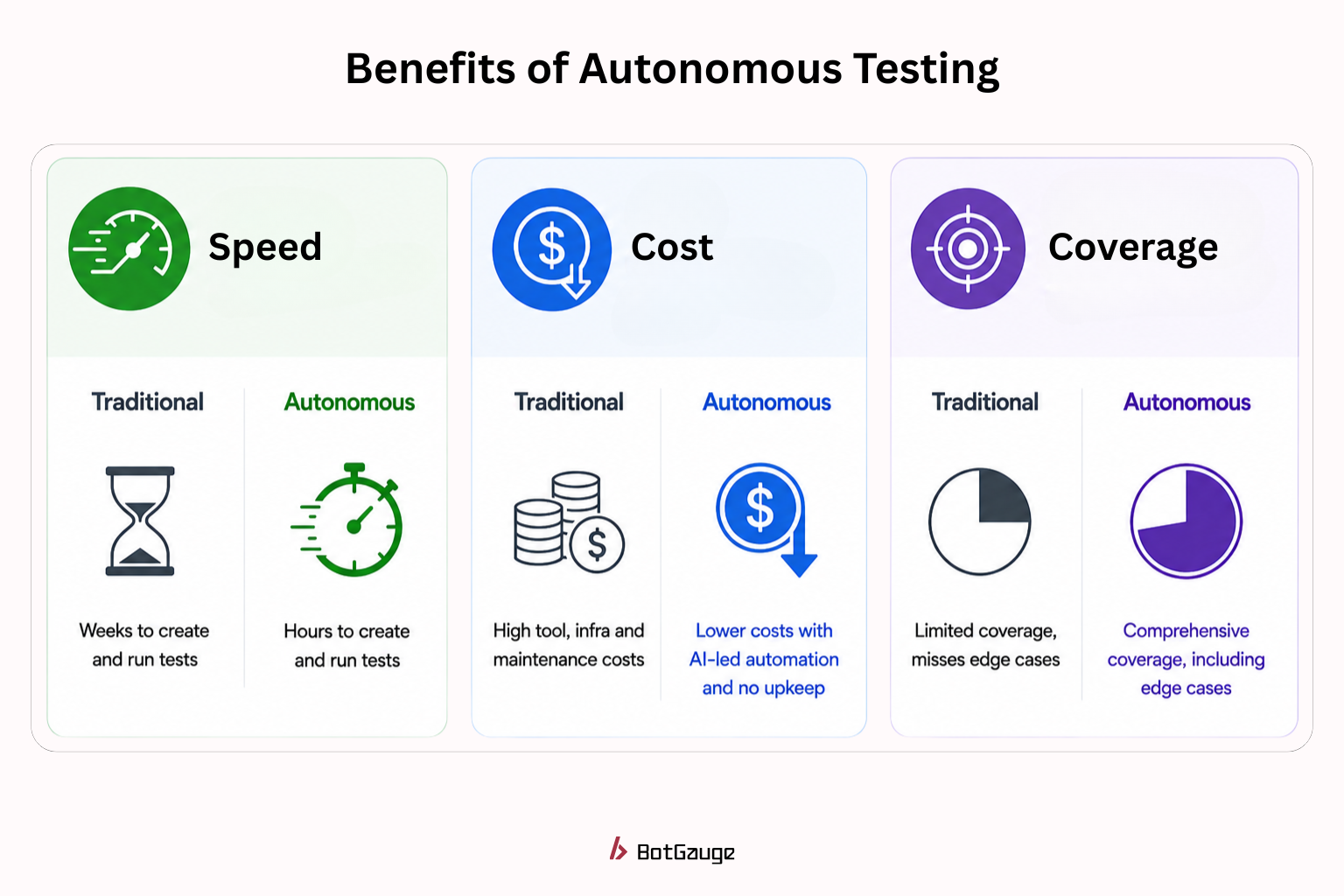
The easiest way to compare traditional and autonomous software testing is by looking at the outcomes. Speed, cost, and coverage are where the difference becomes clear.
Speed
Writing 50 test cases by hand for a new feature takes days. An AI agent that reads the spec and generates the same 50 cases takes minutes. Teams using autonomous testing services like BotGauge report going from months-long test cycles to days.
Lower cost
Every hour a QA engineer spends fixing a broken selector is an hour not spent finding real bugs. Self-healing removes most of that maintenance tax. Some teams cut QA spend by more than half once maintenance stops eating the budget.
Broader coverage
A human tester writes tests for the flows they think of. An AI that reads the entire application surface finds edge cases a test suite never accounted for: an expired coupon code, a slow third-party API, a form field that accepts an emoji it shouldn’t.
Faster releases
When tests run automatically on every commit instead of waiting for a QA cycle, releases stop bottlenecking on testing. Code ships the same day it’s written, with results in hand before a human even asks.
Better use of engineering time
Every hour spent babysitting scripts or chasing a broken selector is an hour not spent on code that ships. Autonomous test automation pulls that time back for everyone it touches: QA engineers stop maintaining scripts and start reviewing edge cases, tuning risk models, and making judgment calls the AI shouldn’t make alone.
Developers stop getting pulled into “why did the test fail” threads for bugs that turn out to be flaky selectors, not real regressions. That’s time back on both sides of the pipeline, and it’s why the good engineers you have want to stay.
The Common Challenges of Autonomous Testing, and How to Solve Them in Production
Autonomous test automation has real limits. Here’s where teams get stuck, and how to get past it.
The AI misses business logic nobody documented
If a discount rule only applies to customers in three specific states, and that rule lives in someone’s head instead of a spec, the AI won’t know to test it.
Fix: feed the system your actual business rules, not just your UI. Review AI-generated test cases against domain experts for the first few cycles.
Data quality determines everything
An autonomous testing AI learns from your application’s behavior and historical test data. Feed it inconsistent environments or unrealistic test data, and it makes worse decisions.
Fix: invest in a clean, representative test data set before you scale up autonomy. This matters more than picking the “best” AI model.
False positives erode trust fast
One team member finds three flaky failures that turn out to be nothing, and suddenly nobody trusts the dashboard.
Fix: track false-positive rate as a real metric from day one, and hold your platform to a number. 85% to 95%+ self-healing accuracy is a reasonable bar for a mature system.
“AI add-on” tools can’t actually deliver autonomy
A lot of platforms bolt an AI feature onto a scripting framework built a decade ago. The framework’s ceiling becomes the AI’s ceiling.
Fix: check whether the platform’s core execution engine is AI-native or scripted-first with AI sprinkled on top.
Regulated industries raise real accountability questions
Testing systems that touch health records or financial data means asking who’s accountable when an AI decides what to test and skips something.
Fix: keep a human sign-off step for regulated flows. The best platforms build this in as a validation layer, not an afterthought.
That’s how BotGauge worked with Kitsa, a clinical research platform: autonomous regression on high-consequence workflows like patient pre-screening, with the coverage running unattended and clear failure context so engineers stay the ones deciding what ships.
Automated vs AI-Assisted vs Autonomous Testing
Not all AI-powered testing works the same way. Understanding the difference between automated, AI-assisted, and autonomous testing helps you choose the right level of intelligence for your QA process.
| Automated Testing | AI-Assisted Testing | Autonomous Testing | |
|---|---|---|---|
| Who writes the tests | A human, in code or no-code | AI suggests, human approves and edits | AI generates independently |
| Who decides what to test | Human, upfront | Human, with AI suggestions | AI, based on risk and app changes |
| Test maintenance | Manual fix by an engineer | Partial AI assistance, human still involved | Self-healing, no human needed |
| Execution trigger | Scheduled or manual | Scheduled or manual | Triggered by app or code changes |
| Best fit | Stable, well-defined flows | Teams scaling coverage gradually | Fast-moving apps with frequent releases |
An automated test follows instructions exactly as written. An AI-assisted test gets help writing and maintaining those instructions, but a person still owns the process. An autonomous test operates the way a QA engineer would: it reads the situation, acts on its own judgment, and explains itself afterward.
Stop evaluating AI in demos. See it on your own application with a 30-day BotGauge pilot.
Sign up for Free PilotThe Five Levels of Autonomous Testing
Autonomy isn’t binary. It’s a spectrum, similar to the 0-to-5 scale used for self-driving cars. Most teams sit somewhere in the middle, and that’s normal.
| Level | Name | What’s Happening |
|---|---|---|
| 0 | Manual testing | A person executes every test by hand, every time. No scripts, no AI. |
| 1 | Scripted automation | Humans write test scripts once; a tool executes them repeatedly. Any UI change breaks the script until someone fixes it. |
| 2 | AI-assisted automation | AI helps generate test steps and suggests fixes for broken selectors, but a human reviews and approves everything before it runs. |
| 3 | AI-augmented autonomy | The AI generates most test cases and self-heals routine breakages without approval. Humans review edge cases, business logic, and anything flagged as high-risk. |
| 4 | Full autonomy | The AI decides what to test based on code changes and risk, generates and executes tests, self-heals, and reports root cause – a human reviews outcomes, not individual steps. |
Most platforms on the market in 2026 sit at Level 2. The best autonomous testing agents, the ones actually worth adopting, operate at Level 3 or Level 4 for well-understood flows like login, checkout, and core API contracts, while keeping humans in the loop for anything touching compliance or brand-new features.
BotGauge runs at that Level 3/4 range by design. AI agents handle generation, execution, and self-healing on their own, and dedicated domain-specialized FDE steps in for the judgment calls a model shouldn’t make alone.
What Autonomous Testing Actually Does
Here’s what autonomous testing platforms do day to day:
- Autonomous test generation. It reads your application (or a PRD, user story, Jira ticket, or Figma file) and builds test cases in plain English
- Converts existing manual tests or legacy scripts (Selenium, Tosca, TestComplete) into maintained, executable tests
- Executes tests in parallel across browsers, devices, and API endpoints
- Detects when the application changed and updates the test instead of failing it
- Prioritizes what to run first based on which code changed and how risky that area is
- Flags the actual root cause of a failure (a timeout, a broken API contract, a null value) instead of a generic “test failed”
- Runs automatically on every commit or pull request through your CI/CD pipeline
- Gets sharper over time by learning which flows, environments, and data patterns actually surface bugs
That’s the job description. Anything short of most of this list is automation with an AI feature attached, not an autonomous test platform.
Get to 80% test coverage in 2 weeks instead of a quarter. See how BotGauge does it.
Get 30-day Free PilotExample of Autonomous Testing
Say your team ships a change to the checkout flow: a new coupon code field.
Traditional automation
A QA engineer writes a script that enters a valid coupon, checks the discount applies, and confirms the total. It passes. Two weeks later, the payment gateway adds a 3-second delay under load, the test times out, and it’s marked as a failure. An engineer spends 40 minutes tracing it back to the gateway, not the checkout logic, before realizing the script itself hadn’t changed at all.
Autonomous testing:
The AI reads the updated checkout page, notices the new coupon field, and generates test cases on its own: a valid coupon, an expired coupon, a coupon with zero remaining uses, a coupon applied to an out-of-stock item, and a blank coupon field.
It runs all five in parallel against staging. When the payment gateway’s delay causes a timeout, the AI recognizes this as an infrastructure issue, separates it from an actual functional bug, and routes it to the right team with the gateway’s response time attached as evidence.
Five test cases existed without anyone writing them by hand. And 40 minutes of an engineer’s day got spent on something other than chasing a false alarm. That’s the practical difference between automated and autonomous testing, measured in minutes, not slides.
Behaviors of a Real Autonomous Testing Platform
Not every AI testing tool is truly autonomous. A real autonomous testing platform does more than execute tests. It continuously adapts, maintains, and improves testing with minimal human intervention.
- It generates tests without a human writing steps first
You give it a goal or a requirement. It writes the test. If you still have to define every click, that’s automation with AI-assisted scripting.
- It self-heals at a measurable accuracy, not “sometimes.”
Ask for a number. A mature platform should self-heal in the 85% to 95%+ range for routine UI changes.
- It prioritizes tests based on actual risk, not a fixed schedule
A real autonomous system looks at what code changed and decides what matters most today. A scripted test suite runs the same 500 tests every night whether or not anything relevant changed.
- It explains failures instead of just flagging them
“Test failed at step 12” is automation. “This failed because the /checkout API returned a 504 after a 3-second gateway delay, introduced in commit a91f2c” is autonomy.
- It runs inside your CI/CD pipeline without extra setup work
Autonomous testing that requires a week of engineering time to wire up is moving the friction somewhere else, not removing it.
- It keeps a human in the loop for judgment calls, not busywork
Real autonomy means humans spend time on decisions that matter, like whether to ship with a known edge case. The AI handles the selectors.
How BotGauge Approaches Autonomous Testing
BotGauge runs on what we call Autonomous QA as a Solution: AI agents plus a FDE pod, owning your testing outcomes end to end instead of handing you another tool to configure.

Here’s what that looks like in practice:
- Share a PRD, a UX flow, or even a demo video, the autonomous testing agents generate context-aware tests for the flows, UI, and APIs that matter, in plain English, with no code and no test scripts for your team to write or maintain.
- Our Forward Deployed Engineers review and refine every generated test before it ships, so you get AI speed with human judgment on anything that touches business logic or compliance.
- Tests run natively inside your CI/CD pipeline on every commit, in parallel, with zero setup time from your engineering team.
- When your app changes, tests self-heal automatically instead of turning red for the wrong reason.
- When something does break, you get a real-time, actionable root cause report your team can act on right away, not a generic failure log.
Conclusion
Autonomous testing is about deciding how much of your testing workflow AI can reliably own. The best platforms don’t just execute tests; they generate, maintain, adapt, and validate them while keeping humans involved where judgment matters most.
When evaluating a platform, look beyond AI claims. Ask how well it handles application changes, how much maintenance it eliminates, how it integrates with your CI/CD pipeline, and what level of human oversight is built into the process.
If you want to see what autonomous software testing looks like in production, try our free 30-day pilot. BotGauge will test your actual application, deliver measurable test coverage, and show you what Autonomous QA can achieve in a real engineering environment.
Frequently Asked Questions
Is autonomous testing the same as AI testing?
What is self-healing in autonomous testing?
What are the best autonomous testing tools?
Can autonomous testing replace human testers?
How does autonomous testing work in CI/CD pipelines?
What does agentic AI change in autonomous testing?
What is autonomous testing and how does it work?
Will QA or SDET get replaced by AI?