AI Summary
- Agentic AI refers to AI systems that pursue goals autonomously: they plan, make decisions, use tools, and adapt to feedback rather than just responding to prompts.
- The difference from generative AI is action versus output. Generative AI produces content when asked; agentic AI completes multi-step tasks on its own.
- Real deployments today cluster around software testing, customer support, coding assistance, IT operations, and research workflows.
- Most agentic systems combine four layers: a reasoning model (LLM), a context layer, tool access, and an orchestration loop that plans and re-plans.
- The biggest risks are unvalidated output, cascading errors between agents, and agents exceeding their intended scope, which is why human oversight remains essential.
- In QA specifically, agentic AI generates, executes, and maintains tests autonomously, and the strongest implementations pair agents with human experts who validate the results.
What is Agentic AI?
Agentic AI is a class of artificial intelligence systems that can pursue goals autonomously: they plan multi-step tasks, make decisions, use external tools, and adapt based on feedback, all with minimal human supervision. Where a chatbot answers a question and stops, an agentic system keeps working until the goal is reached.
The agentic AI meaning rests on one word: agency. So what does agentic AI mean in practice? An agent does not just generate a response; it decides what to do next. Give a generative model a prompt like “write a test plan,” and you get a document. Give an agentic system the goal “verify that checkout works,” and it explores the application, decides which flows to exercise, runs them, evaluates the results, and reports what it found. Nobody scripted those steps.
If you are asking what is agentic AI in simple terms: it is AI that acts, not just answers. What does agentic mean in AI? It means the system has the capacity to initiate actions toward a goal rather than only reacting to instructions. That distinction, autonomy of action, is what separates this generation of AI systems from everything that came before it. IBM describes agentic systems in the same terms: AI with the ability to act autonomously toward goals with limited supervision.
Generative AI vs Agentic AI: The Core Difference
Because the two are constantly confused, it is worth settling the generative AI vs agentic AI question early.
Generative AI creates content on request: text, code, images, answers. It is reactive. Every output requires a human prompt, and the interaction ends when the output is delivered. ChatGPT answering a question is generative AI at work.
Agentic AI uses those same generative models as a reasoning engine, but wraps them in a loop that plans, acts, observes, and adjusts. It is proactive. The interaction ends when the goal is achieved, not when the first output is produced.
A useful way to remember it: generative AI is a brilliant employee who answers any question you ask but never leaves their desk. Agentic AI is the employee who takes the assignment, walks off, uses whatever tools the job needs, and comes back with the work done. Most agentic systems have generative AI inside them; the agency is the layer built around it.
What Are the Characteristics of Agentic AI Systems?
Agentic AI systems share four defining characteristics, and a system missing any of them is usually just automation with better marketing.
Autonomy. The system initiates and completes tasks without step-by-step instructions. You define the goal and the boundaries; the agent determines the path.
Planning and reasoning. Agents break a goal into steps, sequence them, and revise the plan when circumstances change. This is what separates an agent from a script, which can only execute the exact steps it was given.
Tool use. Agents interact with the world beyond their model: calling APIs, querying databases, driving a browser, running code, or filing tickets. Tool use is what turns reasoning into action.
Adaptation through feedback. Agents observe the results of their actions and adjust. If a step fails, a true agentic system tries another approach rather than halting, and it learns from the outcome for next time.
How Does Agentic AI Work?
How does agentic AI work under the hood? Most agentic AI systems run on the same four-layer architecture, whatever the vendor calls it.
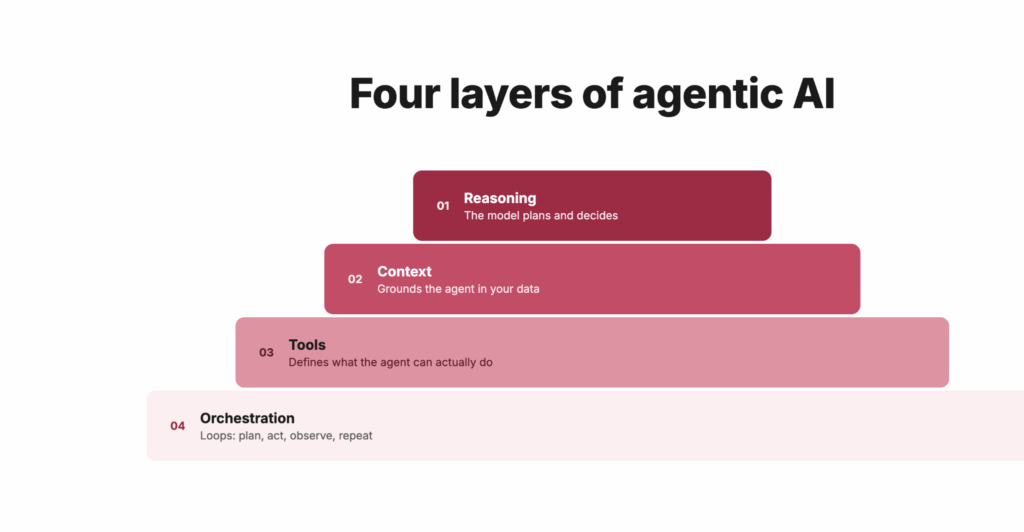
1. The reasoning layer. A large language model serves as the brain, interpreting the goal, generating plans, and deciding what to do at each step.
2. The context layer. The agent connects to the specific environment it works in: your documents, data, application state, or codebase, often through retrieval systems. Without this layer, the agent reasons in a vacuum and produces generic actions.
3. The tool layer. Defined connections to the systems where actions happen: browsers, APIs, databases, code execution, third-party services. The tool layer defines what the agent is physically able to do, and just as importantly, what it cannot.
4. The orchestration loop. The cycle that ties it together: perceive the current state, plan the next step, act, observe the result, and repeat until the goal is met or a boundary is hit. In multi-agent systems, an orchestrator also routes work between specialized agents and manages handoffs between them.
That loop, plan, act, observe, adjust, is the heartbeat of every agentic system. Everything else is implementation detail.
What Are the Advantages of Agentic AI?
The strategic case for agentic AI comes down to what it changes about how work scales.
It removes the human bottleneck from multi-step work. Traditional automation executes fixed steps and stops the moment reality deviates from the script. Humans then intervene. Agentic systems absorb that deviation themselves, which means workflows run end to end without a person shepherding each step.
It scales judgment-shaped work, not just repetitive work. Classic automation handled the repetitive layer. Agents handle work that requires deciding what to do next: triaging, investigating, exploring. That is a different and much larger category of work.
It compounds with your context. Because agents consume your documents, data, and history, their usefulness grows as your context does. A script never gets better; an agent operating over richer context does.
It changes the economics of coverage. Whether the domain is customer support, research, or software testing, agentic systems make it feasible to cover far more ground than headcount ever could, because the marginal cost of another task approaches zero.
What Are the Use Cases of Agentic AI?
Agentic AI use cases today cluster in domains where the work is multi-step, tool-heavy, and expensive to staff:
- Software testing and QA. Agents explore applications, generate and execute test cases, investigate failures, and maintain suites as products change. This is one of the most mature agentic domains.
See how agentic AI testing works in practice, from test generation to self-healing.
- Coding and development. Agents that take a ticket, write the code, run the tests, and open a pull request.
- Customer support. Agents that resolve tickets end to end: reading the issue, checking account state, taking the corrective action, and replying.
- IT and security operations. Agents that triage alerts, investigate anomalies, and remediate routine incidents.
- Research and analysis. Agents that gather sources, synthesize findings, and produce structured reports.
- Business process automation. Multi-step workflows across tools: onboarding, invoicing, data reconciliation, report generation.
The pattern across all of them: goal in, outcome out, with the steps in between owned by the agent.
What Are the Benefits of Agentic AI?
Where the advantages above are strategic, the benefits are the measurable payoffs teams report once agentic systems are running:
Cycle time collapses. Work that queued for a human now starts instantly and runs continuously. In QA, test suites that took weeks to build manually are generated in days.
Coverage expands without headcount. One team directing agents covers what previously required several teams executing manually. The 2025-26 World Quality Report found that 89% of organizations are already piloting or deploying generative AI in quality engineering, though only 15% have scaled it enterprise-wide, which shows both the appetite and the gap agentic systems are moving into.
Consistency improves. Agents do not skip steps at 6pm on a Friday. The same rigor applies to the first task and the thousandth.
Humans move up the stack. When agents own execution, people shift to direction, validation, and the judgment calls automation cannot make. The teams that get this right treat it as a reallocation, not a replacement.
What Are the Types of Agentic AI Systems?
Agentic systems span a spectrum of complexity. Four types cover most of what you will encounter:
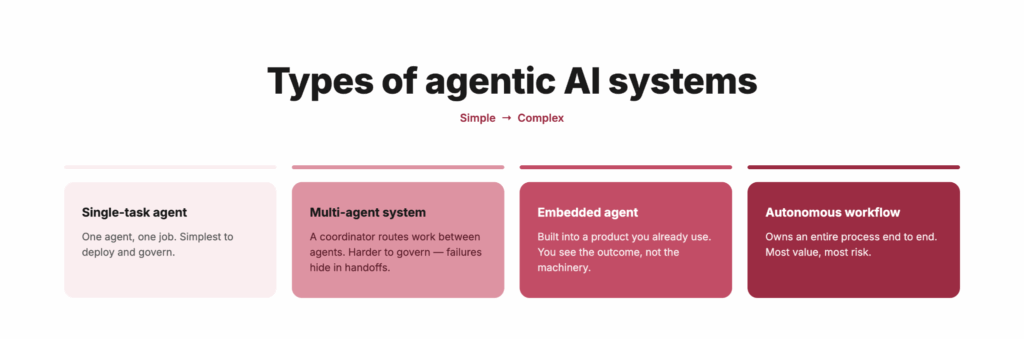
Single-task agents. One agent, one job, clear boundaries: a research agent, a triage agent, a test-generation agent. Simplest to deploy and govern.
Orchestrated multi-agent systems. A coordinator routes work between specialized agents: one plans, one executes, one reviews. More capable, and meaningfully harder to test and govern, because failures can occur in the handoffs between agents, not just inside them.
Embedded agents. Agentic capability inside an existing product: an agent inside your IDE, your CRM, or your testing platform. You experience the outcomes without operating the machinery.
Autonomous workflow platforms. Full ai agentic workflows where agents own an entire business process end to end, with humans reviewing outputs at defined checkpoints. This is where the most value and the most risk concentrate.
How to Build Agentic AI?
For teams asking how to build agentic AI, the honest answer is: start much smaller than the demos suggest. The reliable path looks like this.
- Pick one goal with clear success criteria. “Resolve password-reset tickets” beats “automate support.” Agents fail vaguely when goals are vague.
- Choose the reasoning model. A frontier LLM via API is the standard starting point. Model choice matters less than the scaffolding around it.
- Build the context layer. Connect the agent to the documents, data, and state it needs. This step determines output quality more than any other.
- Define the tool set narrowly. Give the agent the minimum set of actions the goal requires. Every tool you grant is scope you must govern.
- Design the loop and its boundaries. Decide when the agent re-plans, when it retries, and, critically, when it must stop and escalate to a human.
- Add evaluation before you add autonomy. Measure the agent against known-correct outcomes before letting it act unsupervised. An agent you cannot evaluate is an agent you cannot trust.
- Expand scope only after reliability is proven. Autonomy is earned in increments, not granted on day one.
What is an agentic AI framework in this picture? It is the software scaffolding that handles steps 3 through 6 for you: the loop, the tool connections, the memory, and the orchestration, so your team builds the agent’s job rather than its plumbing.
Examples of Agentic AI
Concrete agentic AI examples make the concept click faster than any definition.
A QA agent tests a release. Given the goal “verify the checkout flow still works,” the agent reads the product requirements, maps the journey, generates the test cases, executes them across browsers, notices that a coupon field moved, adapts its tests instead of failing, and files a structured bug report for the one genuine defect it found. A script would have broken at the moved field. The agent worked around it and kept going.
A support agent resolves a ticket. A customer reports a failed payment. The agent reads the ticket, checks the account, finds the expired card, sends the update link, confirms the retry succeeded, and closes the ticket with a summary. Four tools, one goal, zero human touches.
A coding agent ships a fix. Assigned a bug ticket, the agent reproduces the issue, locates the faulty function, writes a fix, runs the test suite, and opens a pull request with an explanation, leaving the human review as the final gate.
A research agent briefs a decision. Asked to compare vendors, the agent searches, reads the sources, extracts pricing and capability data, and returns a structured comparison with citations.
Notice the common shape: in every example the agent decided the steps. That is the tell that you are looking at agentic AI rather than automation.
Challenges for Agentic AI Systems
The gap between agentic demos and agentic production is real, and it is where most projects stall.
Reliability is probabilistic, not guaranteed. Agents reason with LLMs, and LLMs are sometimes confidently wrong. An agent that is right 90% of the time still fails one task in ten, and in production that failure rate compounds across steps.
Errors cascade. In multi-step and multi-agent workflows, a small early mistake propagates: a wrong assumption at step two silently corrupts everything after it. Detecting where a run diverged is one of the hardest problems in the field.
Validation is unsolved for most teams. How do you know the agent’s output is correct without checking it yourself, which defeats the purpose? The mature answer is sampling plus human review on high-stakes outputs, but many deployments skip it.
Cost and latency surprise people. Agents burn tokens on every reasoning step and every retry. A loop that gets stuck can burn budget fast without producing anything.
Agents are themselves software that needs testing. An agentic system has behavior, edge cases, and regressions like any other software, plus non-determinism on top. Testing the agent is as important as the agent’s own work.
How to Use Agentic AI?
For a leader asking how to use agentic AI inside a team, the playbook is about deployment discipline, not model expertise.
Start where failure is cheap and volume is high. First deployments should be tasks where a wrong output is annoying, not damaging: drafting, triaging, test generation, research. Save payment flows and customer-facing actions for later.
Keep a human at the moments of consequence. Let agents do the work; let people approve the parts that matter. The best current deployments are agent-executed and human-validated.
Measure against your old baseline. Track cycle time, error rate, and rework before and after. Agentic AI earns expansion with numbers, not enthusiasm.
Learn by operating, not by watching. For individuals wondering how to learn agentic AI, the fastest route is hands-on: take one small repetitive workflow you own, build or adopt an agent for it, and study where it fails. The failure modes teach more than any course.
How Are Businesses Using Agentic AI?
Across industries, business adoption follows a recognizable pattern: agents are deployed where multi-step digital work meets a staffing bottleneck.
Software companies lead adoption, using agents across the development lifecycle: coding assistants that complete tickets, and QA agents that generate and maintain test coverage. Support organizations deploy agents to resolve routine tickets end to end and escalate the rest. Financial services teams use agents for reconciliation, monitoring, and compliance checks under human sign-off. Operations teams point agents at reporting, data hygiene, and cross-tool workflows that previously consumed analyst hours.
Two honest observations cut across all of it. First, most businesses are further behind than the headlines suggest: pilots vastly outnumber scaled deployments. Second, the deployments that survive contact with production share one trait: they kept human validation in the loop rather than trusting the agent outright. Autonomy without verification has quietly killed more agentic projects than any technical limitation.
Agentic AI Workflows
An agentic AI workflow is the practical unit of adoption: a defined process where agents own the execution and humans own the checkpoints. Designing one well comes down to three decisions.
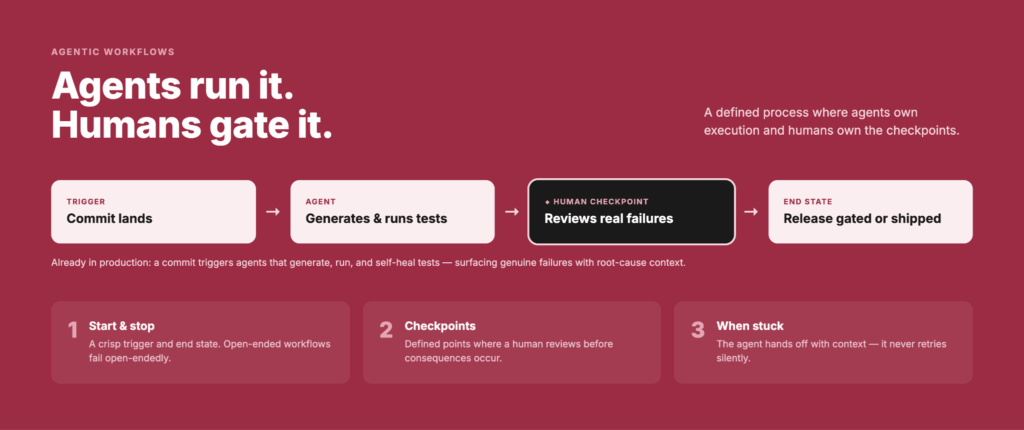
Where the workflow starts and stops. A good agentic workflow has a crisp trigger (a commit lands, a ticket arrives, a release is cut) and a crisp end state (tests pass, ticket resolved, report delivered). Open-ended workflows produce open-ended failures.
Where the checkpoints sit. Every workflow needs defined points where a human reviews before consequences occur. In a QA workflow, that is validation before tests gate a release. In support, it is review before an irreversible account action.
What the agent does when stuck. Escalation paths are part of the design, not an afterthought. An agent that cannot proceed should hand off with context, not retry silently until the budget burns.
In software testing, the mature version of this is already running in production: a commit triggers agents that generate and execute the relevant tests, self-heal the ones the code change broke, and surface genuine failures to humans with root-cause context.
Compare the two models side by side: agentic testing vs traditional test automation.
What Are the Risks of Agentic AI?
The risks deserve their own section because they are different in kind from generative AI risks. A wrong answer is a mistake; a wrong action is an incident.
Scope creep in action. An agent with broad tool access can take actions nobody intended: the research agent that was never supposed to write to the database, writing to the database. Permission boundaries need to be enforced in the tool layer, not just requested in the prompt.
Cascading multi-agent failures. When agents hand work to other agents, a corrupted handoff propagates silently. This is currently one of the least-tested failure classes in production AI systems.
Silent degradation. Models get updated, applications change, and an agent that worked last quarter drifts. Without continuous evaluation, nobody notices until the output damage surfaces.
Accountability gaps. When an agent acts wrongly, who is responsible, and can you reconstruct why it did what it did? Logging every step, decision, and tool call is the minimum bar for deploying agents in any environment that matters.
Over-trust. The most common risk is human, not technical: teams see three good weeks of output and stop checking. Sampling-based review should never fully stop; it should just get cheaper.
None of these risks argues against agentic AI. They argue for deploying it the way you would onboard a capable new employee: real work, defined scope, and someone reviewing the output until trust is earned, then spot checks forever.
Agentic AI Tools and Frameworks
The agentic AI tools landscape splits into three layers, and knowing which layer you are buying prevents most procurement mistakes.
Builder frameworks. These agentic AI frameworks are open-source scaffolding for teams building custom agents: LangChain and LangGraph for orchestration and stateful loops, CrewAI for role-based multi-agent teams, AutoGen for agent-to-agent collaboration, and the OpenAI Agents SDK for tightly integrated tool use. These give maximum control and maximum responsibility: you own the reliability engineering.
Agentic AI platforms. Managed environments where agents are configured rather than coded: cloud vendor agent platforms and workflow products that ship the loop, memory, and integrations as a service. Faster to deploy, less flexible, and quality still depends on your context and guardrails.
Embedded agentic products. Finished products with agents inside, purpose-built for one domain: coding agents, support agents, and autonomous testing agents. You buy the outcome, not the machinery. For most teams outside the AI-engineering business, this layer delivers value fastest, because the vendor owns the hard reliability problems.
The right choice tracks the same ownership question that governs all automation: how much of the building, validation, and maintenance do you want to own? Building on a framework is owning all of it. Buying an embedded product is owning none of it. Most teams should buy the domains that are not their core business and build only where agent behavior is their differentiator.
How Does BotGauge Support Agentic AI?
BotGauge applies agentic AI to one domain, software quality, and pairs it with the human validation layer that most agentic deployments are missing.
Its AI agents own the testing lifecycle end to end: they read your PRDs, UX flows, and demo videos, map your functional, UI, and API workflows, and generate context-aware test cases without scripts. When your product changes, self-healing agents detect the change and update the affected tests automatically, and every suite is reviewed by a dedicated domain FDE pod before it runs, so agent speed never comes at the cost of human judgment. Tests execute on every commit in your CI/CD pipeline with unlimited parallel runs, and the results follow the QA best practices that keep a suite trustworthy: risk-first coverage, independent tests, and failures that are reproducible in minutes.
The same agentic architecture extends to testing AI systems themselves, including chatbots and LLM-based applications, which is quickly becoming its own discipline as more products ship with agents inside them.
Conclusion
Agentic AI is a present capability, not a future one, and the deployments that work all share the same shape: narrow goals, defined tools, and a human validating what matters. Start with one workflow where failure is cheap, measure against your old baseline, and expand only when the numbers prove the agent out. The teams learning to direct and validate agents today are building the operating model everyone else will copy.
Frequently Asked Questions
What is the difference between agentic AI and generative AI?
How do I measure the ROI of agentic AI?
What happens when an agent gets stuck?
How do I integrate AI agents into my existing software?
Can we ensure agentic AI is transparent?
Is agentic AI the next big thing?