AI Summary
- Why it matters: AI is non-deterministic. Untested models create real risk: fines, breaches, lost trust.
- App types covered: ML models, generative AI, chatbots, computer vision, voice assistants, autonomous agents.
- Key factors: Accuracy, bias, explainability, security, compliance, and drift.
- Challenges: No fixed ground truth, infinite input space, model drift, regulatory change.
- How-to steps: Define success criteria, validate data, design test cases, automate, monitor in production.
- Agentic testing with BotGauge: Trajectory diffing, tool-call accuracy, handoff integrity, cascading failure checks.
- Generative AI tips: Prompt testing, red teaming, RAG faithfulness, multi-turn context checks.
AI applications do not fail like normal software. A login form either works or it does not. A recommendation engine can be 73% accurate today and 61% accurate next Tuesday, with no code change in between.
That is the gap most QA teams walk into blind.
The global AI applications market is projected to reach $26.36 billion by 2030, growing at nearly 39% a year. IBM found that 13% of organizations have already had a breach tied to their AI models or applications. Growth without testing is just risk wearing a nicer name.
This guide covers how to test AI applications: why it matters, what to test, where teams get stuck, and the exact steps to run a test cycle that catches problems before your users do. It also gets specific about testing generative AI applications, since prompt-based systems break in ways a 2019 QA checklist never planned for.
Why Is Testing AI Applications Important?
Traditional software runs on fixed rules. Give it the same input twice, get the same output twice.
AI does not work that way. A large language model (LLM) can answer the same prompt two different ways in the same afternoon, depending on context length or a model update your vendor pushed overnight. That unpredictability is exactly why testing AI applications is important.
High-Profile AI Accountability Failures
Here is what happens when teams skip testing AI applications:
- In 2024, Air Canada’s support chatbot invented a refund policy that never existed. A tribunal ruled the airline had to honor it anyway. The bot cost the company money and made headlines for the wrong reason.
- GitHub Copilot shipped a vulnerability tracked as CVE-2025-53773, letting attackers manipulate code suggestions through prompt injection.
- A US law firm, Morgan & Morgan, had to walk back a court filing after an AI tool fabricated case citations.
None of these are rare edge cases. They are what happens when generative AI ships without adversarial testing.
The Current State of Testing AI
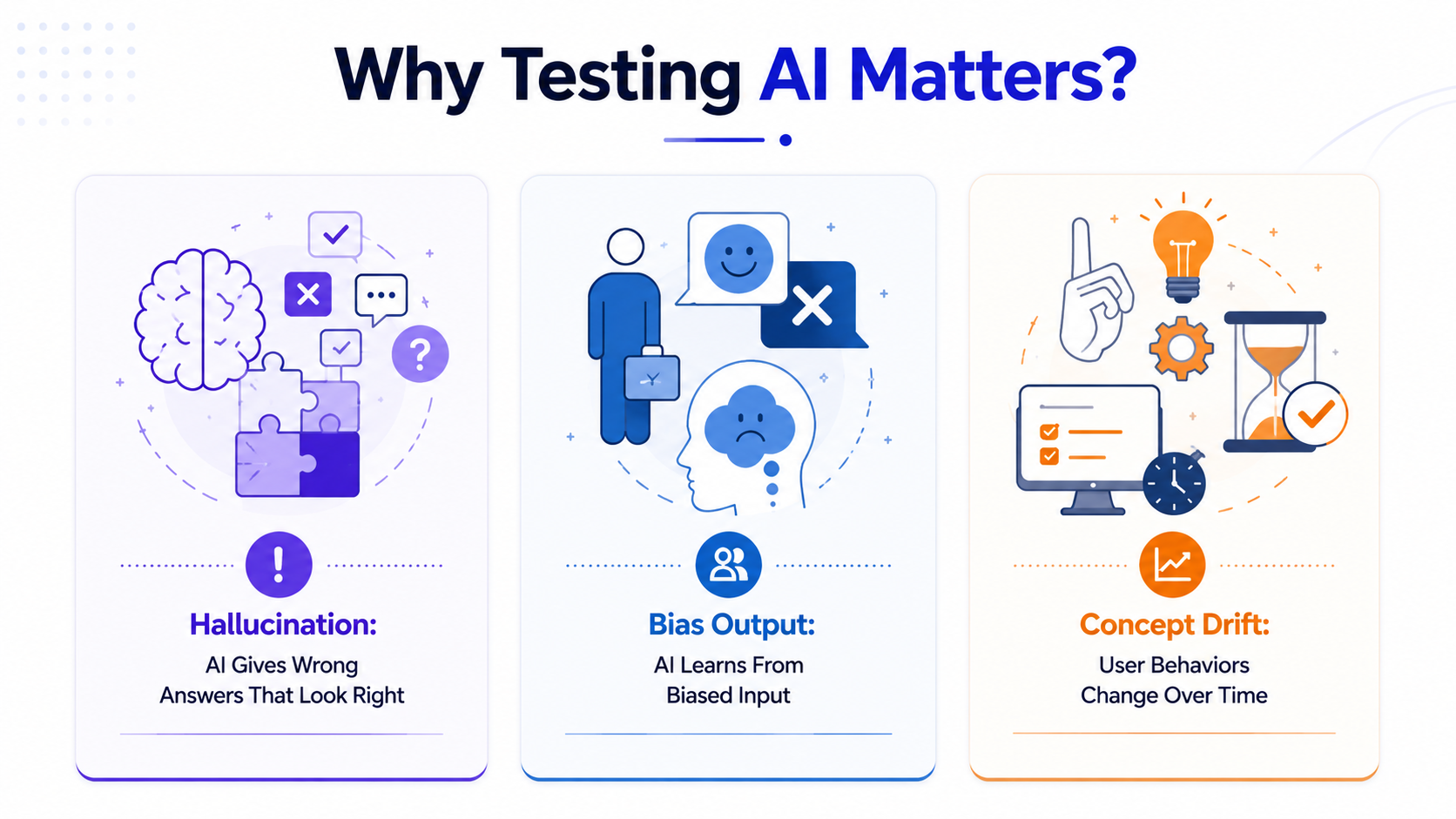
Frontier models still hallucinate on 3.1% to 19.1% of factual, citation, and code-reference tasks, even in 2026’s strongest benchmarks. That is down from 15% to 45% in 2024, real progress, but nowhere close to zero. Untested, that error rate lands directly on your users.
Testing AI applications protects four things at once:
- Trust. One bad chatbot answer or one biased decision, and users stop trusting the whole product. Continuous AI chatbot testing with BotGauge helps you ship AI experiences users can actually trust.
- Money. Regulatory fines, refund obligations, and legal costs add up fast when an untested model makes a public mistake.
- Compliance. The EU AI Act, NIST’s AI Risk Management Framework, and ISO 42001 now expect documented testing, not good intentions.
- Speed. Teams that test early catch drift and bugs in staging, not in their client’s inbox.
Types of AI-based Apps and Their Testing Needs
Not every AI application breaks the same way. A recommendation engine and a customer support chatbot fail for completely different reasons, so each needs its own test plan.
Machine Learning and Forecasting Models
Think credit scoring, fraud detection, demand forecasting, and churn prediction. Test for accuracy, precision, recall, and F1 score across multiple datasets, not just the one your data scientist trained on. Watch for bias against specific customer groups.
Generative AI and LLM-powered Apps
Content generators, code assistants, summarization tools, and research copilots fall here. Test for hallucination rate, factual grounding, and prompt injection resistance. One well-crafted prompt can make these systems say things your legal team really does not want on record.
Computer Vision Applications
Facial recognition, defect detection, medical imaging, and license plate recognition all belong here. Test across lighting conditions and camera angles. Bias often shows up as lower accuracy for certain skin tones or demographics, so fairness testing is not optional.
Recommendation and Personalization Engines
Test relevance, diversity of results (a feed that only ever recommends one type of content is a broken feed), and how fast recommendations update after new user behavior.
Conversational AI and Chatbots
Test intent recognition, multi-turn context retention, and how the bot handles typos, slang, and mixed languages. A bot that loses context after three messages will frustrate users faster than one that gives a wrong answer once.
Voice Assistants and Speech Recognition
Test across accents, background noise, speech speed, and microphone quality. A 95% accuracy rate in a quiet lab means nothing if it drops to 70% on a phone call from a moving car.
Autonomous AI Agents
Agentic systems that plan, call tools, and take multi-step actions need testing for task completion rate, tool-call accuracy, and how well they recover or hand off to a human when a step in the chain breaks. NIST’s CAISI group announced an AI Agent Standards Initiative in early 2026 specifically because agent testing did not fit older frameworks.
Here is the same breakdown at a glance:
| Application Type | Primary Testing Focus | Common Failure Point |
| Machine learning/forecasting models | Accuracy, precision, recall, F1 score | Bias against specific customer groups |
| Generative AI/LLM apps | Hallucination rate, factual grounding, prompt injection | Fabricated facts stated with full confidence |
| Conversational AI/chatbots | Intent recognition, multi-turn context retention | Losing context after 3 to 4 exchanges |
| Computer vision apps | Accuracy across lighting, angle, and image quality | Lower accuracy for certain demographics |
| Recommendation engines | Relevance and result diversity | Feedback loops that narrow results over time |
| Voice assistants | Accuracy across accents and noise conditions | Sharp accuracy drop outside quiet environments |
| Autonomous AI agents | Task completion rate, tool-call accuracy | Silent failure mid-chain with no recovery |
Test AI Agents with BotGauge
Traditional AI testing stops at evaluating model outputs. But modern AI applications are increasingly built as agentic systems that plan tasks, call tools, delegate work to sub-agents, and execute multi-step workflows. Testing only the final response misses the failures that matter most.
BotGauge validates the entire agent execution lifecycle, helping teams catch failures before they reach production.
What BotGauge Tests for Agentic AI
- Agent execution paths: Replay and compare complete execution trajectories, including tool calls, reasoning steps, and agent handoffs to identify exactly where behavior changed after a prompt, model, or tool update.
- Tool-call correctness: Verify that agents invoke the correct tools with the correct parameters and in the correct sequence, even when the final response appears correct.
- Multi-agent handoff integrity: Ensure context, memory, and state are transferred accurately between agents without information loss, hallucination, or corruption.
- Cascading failure simulation: Inject failures into individual agents to measure how errors propagate through the workflow and whether downstream agents recover gracefully.
- Role and permission validation: Confirm each agent stays within its intended scope and cannot perform unauthorized actions.
- Loop and deadlock detection: Identify retry loops, circular handoffs, and stalled workflows before they increase latency or consume unnecessary compute.
Key Factors To Consider While Testing AI Applications
Good AI testing rests on a handful of factors. Skip one, and you will find out about it in production.
- Accuracy and reliability: Does the model produce correct results consistently, across data it was not trained on?
- Bias and fairness: Run the same test across different demographic groups. If outcomes shift based on race, gender, age, or zip code with no legitimate reason, that is a real problem, not an edge case.
- Explainability: Can you explain why the model made a decision? Tools like SHAP and LIME trace a prediction back to the inputs that drove it. Regulators are starting to ask for this by name.
- Robustness: Feed the model noisy, incomplete, or adversarial inputs. If a slightly blurry photo or a misspelled word breaks it, it is not ready.
- Data quality: Garbage in, garbage out still applies, maybe more than ever. Check for missing values, class imbalance, and duplicate records before you trust any result built on that data.
- Performance and scale: Response time under normal load is one number. Response time when 10,000 people hit the app during a product launch is another. Test both.
- Security: Prompt injection, data leakage through model outputs, and adversarial attacks on inputs are standard attack surfaces now. Treat the AI layer like an API: assume someone will try to break it.
- Compliance: NIST’s Generative AI Profile, updated in April 2026, lists 12 risk categories specific to generative systems, including data poisoning and privacy violations. Map your tests to those categories if you build for regulated markets.
- Continuous monitoring: A model that passed every test in March can fail in July because the data it sees in production has shifted. That is model drift, and it is the reason AI testing never really ends.
Challenges in Testing AI Applications
Testing AI applications is harder than testing regular software, and it is worth naming why.
- No fixed ground truth. Traditional QA compares actual output to expected output. With AI, expected is often a probability, not a fact. You are measuring confidence, not certainty.
- Infinite input space. A login form has a few hundred realistic test cases. A chatbot can face millions of phrasings for the same question. You cannot test every one, so you test the ones that matter most.
- The black box problem. Deep learning models can produce accurate results while giving almost no insight into how they got there. That opacity slows root-cause analysis when something goes wrong.
- Model drift. A test suite that passes today can fail next month with zero code changes, purely because the model retrained or the input data shifted. Point-in-time testing alone is no longer enough.
- Regulatory movement. The EU AI Act’s Digital Omnibus on AI landed in 2026, and NIST keeps updating its frameworks every few months. Teams testing for compliance are aiming at a target that keeps moving.
- Talent gaps. Testing an AI system well takes someone who understands both QA and the basics of how models work. That combination is still rare on most teams.
- Cost of human review. Automated scoring catches a lot, but ambiguous hallucinations and subtle bias often need a human in the loop. That is slower and pricier than running a script, and it is usually the first thing cut when budgets tighten. Do not cut it.
How to Test AI Applications
Here is a step-by-step process on how to test AI-based applications.
- Define objectives and success criteria: Decide what “working” means before you write a single test case. For a fraud model, that might be 95% precision. For a chatbot, it might be resolving 80% of tickets without a human handoff. Write the number down.
- Collect and validate your data: Check for missing values, class imbalance, outliers, and duplicate records. If your training data skews heavily toward one scenario, your model will too, and no amount of testing later fixes a data problem at the source.
- Design test cases across categories: Cover functional testing, accuracy testing, performance testing, security testing, and usability testing. Build in edge cases and adversarial inputs on purpose.
- Execute tests, and automate what repeats: Manual testing works for early exploration. It does not scale to regression testing every time a model updates.
- Monitor in production, not only in staging: Set up drift detection and ongoing scoring on live traffic. A model’s behavior in a controlled test environment and its behavior against real, messy user input are two different things.
- Feed production failures back into your tests: Every production failure is a new test case. Every user complaint is a data point. Feed both back into your suite so tomorrow’s model does not repeat today’s mistake.
Expert Advice for Testing Generative AI Applications
Generative AI and LLM-based apps need a different playbook than a standard prediction model. Here is what experienced teams do differently.
- Test the prompt, not just the model: Small wording changes can shift output quality a lot. Run the same intent through five phrasings and compare results.
- Red team before launch, not after: Have someone actively try to jailbreak the system, extract training data, or make it say something off-brand. If you do not find the failure mode, a user or a journalist will.
- Score for faithfulness in RAG systems: For retrieval-augmented generation, accuracy alone is not enough. Check whether the output is actually grounded in the retrieved context, not just factually true by coincidence.
- Test multi-turn conversations, not single prompts: Real users do not ask one question and leave. Test how the system holds context across five, ten, or twenty turns, and what happens when a user contradicts something they said earlier.
- Combine automated scoring with human review: LLM-as-judge scoring is fast, but a single automated score misses ambiguous cases. Route uncertain outputs to a human reviewer instead of trusting one number.
- Keep an eye on eval tools, without over-tooling: Platforms such as Promptfoo, Ragas, and DeepEval score model outputs well at the prompt layer. But if your generative AI app also has a UI, API calls, and backend logic wrapped around the model, you need application-level testing on top of model-level scoring. That is the layer where BotGauge fits: testing the full chatbot or AI-powered workflow end to end, not only the raw model response.
- Budget for retesting: Generative AI models get updated by vendors on schedules you do not control. Routing model calls through one of the LLM gateways that let you pin a model version or switch providers in config gives you some of that control back, but build retesting into your release calendar, not only your initial launch checklist.
Conclusion
AI applications will keep getting more capable, and less predictable, at the same time. Testing is what closes that gap.
Start with clear success criteria. Cover accuracy, bias, security, and drift. Automate the parts that repeat, and keep a human in the loop for the parts that do not.
If you’re building AI products, don’t rely on prompts alone. BotGauge tests AI chatbots, copilots, recommendation engines, and agentic workflows for hallucinations, safety, accuracy, bias, and task completion using real-world scenarios. Book a demo and validate your AI before your users do.
Frequently Asked Questions
How to test generative AI applications?
How to test AI and ML applications?
What tools help automate AI application testing?
How often should you retest an AI application?

For related reading, see agentic AI testing and AI in testing. Explore AI agents or visit BotGauge.