TL;DR
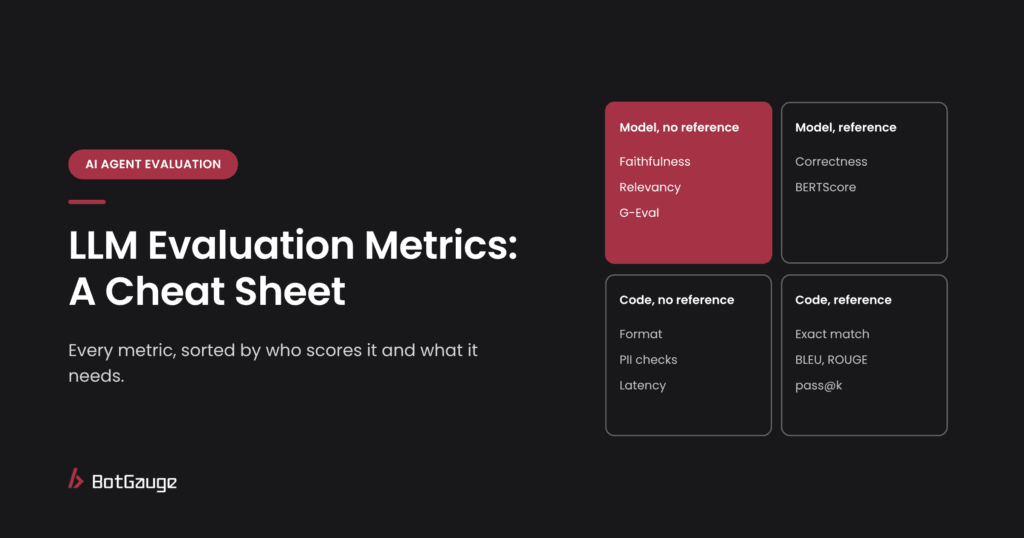
LLM evaluation metrics are the scores you use to judge a language model’s outputs: whether they’re correct, grounded, relevant, safe and usable. They differ on two questions: does the metric need a reference answer, and is it scored by code or by another model? For most production apps, the metrics that matter are model-graded ones that need no reference, such as faithfulness, answer relevancy and rubric scores, backed by cheap code checks for format, safety and cost. Classic overlap metrics like BLEU and ROUGE are useful only when there is one right wording.
The two questions that sort every metric
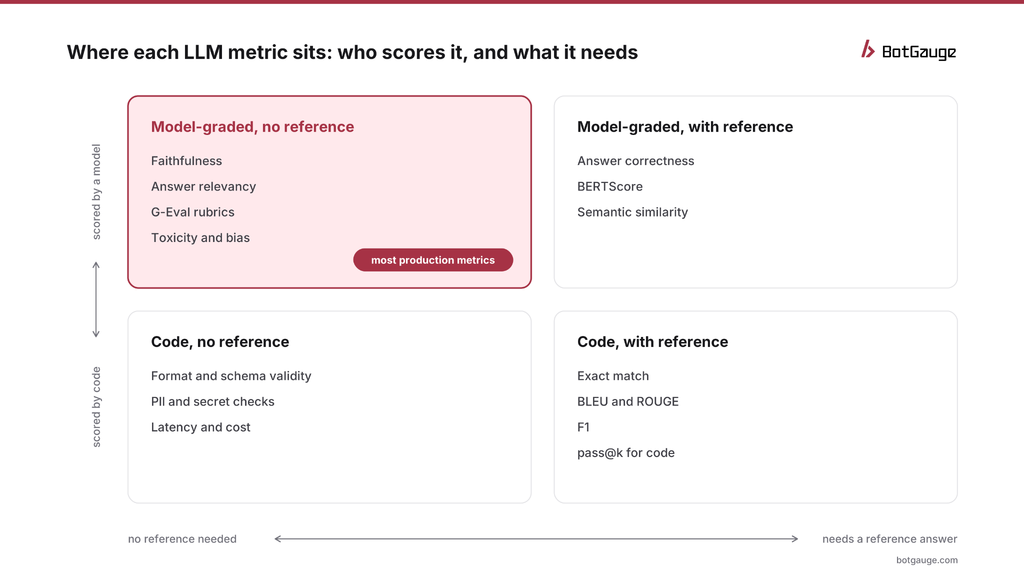
Every LLM metric answers a different question, and most guides list them without showing how they relate. (Agents need more than response metrics; for those, see our guide to AI agent evaluation.) Two properties decide where a metric fits and what it costs to run:
- Does it need a reference answer? Reference-based metrics compare the output with a known correct response. They’re precise but only work when you can write the right answer in advance. Reference-free metrics judge the output on its own or against the input and context, so they work on live traffic.
- Is it scored by code or by a model? Code-scored metrics are fast, cheap and exact. Model-graded metrics, usually an LLM judge or an embedding model, can assess meaning, but they cost more and need calibrating.
LLM evaluation metrics by scorer and reference
The top-left corner is where most modern evaluation happens, because open-ended answers rarely have one correct wording. LLM-judge methods such as G-Eval correlate far better with human judgment than BLEU or ROUGE (MetricGate), which is why they’ve largely replaced overlap metrics for generation tasks.
The cheat sheet
Answer quality
| Metric | What it measures | Scored by | Use when |
| Correctness | Is the answer factually right? | Judge against a reference, or exact match | You have ground truth |
| Answer relevancy | Does the answer address the question asked? | Judge | Any chatbot or assistant |
| Completeness | Does it cover everything the question needs? | Judge with a rubric | Multi-part questions, summaries |
| Coherence and fluency | Is it logically structured and readable? | Judge | Mostly to catch degenerate outputs, such as repetition or truncation |
Grounding and hallucination
| Metric | What it measures | Scored by | Use when |
| Faithfulness | Share of claims in the answer supported by the provided context | Judge | Any RAG or document-grounded app |
| Hallucination rate | Share of answers with unsupported or false claims | Judge, plus human review on a sample | High-stakes domains |
| Citation accuracy | Do the cited sources actually contain the claim? | Judge or code | Apps that show sources |
Faithfulness is usually computed as supported claims divided by total claims in the answer (MetricGate). For RAG systems, pair it with retrieval metrics such as contextual precision, recall and relevancy, covered in RAG evaluation: metrics and test design.
Reference and overlap
| Metric | What it measures | Scored by | Use when |
| Exact match | Output equals the expected answer | Code | Classification, extraction, short factual answers |
| F1 | Token overlap with the expected answer | Code | Extractive question answering |
| BLEU | N-gram precision against a reference | Code | Translation |
| ROUGE | N-gram recall against a reference | Code | Summarization with a reference summary |
| BERTScore | Meaning similarity using embeddings | Embedding model | When wording may differ but meaning should match |
| pass@k | Share of problems where at least one of k generated programs passes tests | Code (unit tests) | Code generation |
BLEU and ROUGE heavily penalize synonyms and rephrasing (Comet), so don’t use them as standalone metrics for open-ended generation.
Rubric and judge scores
| Metric | What it measures | Scored by | Use when |
| G-Eval | A rubric score from a judge that reasons through evaluation steps first | Judge | Custom criteria: tone, policy, helpfulness |
| Pairwise preference | Which of two outputs is better | Judge or human | Comparing prompts, models or versions |
G-Eval was introduced in a 2023 paper and scored far closer to human judgment than reference-based metrics (Liu et al., arXiv). Judges can still be biased toward longer or more polished answers, so calibrate them; our guide to LLM-as-a-judge covers how.
Safety
| Metric | What it measures | Scored by | Use when |
| Toxicity and bias | Harmful, offensive or unfair content | Classifier or judge | Any user-facing app |
| PII and secret leakage | Personal or confidential data in outputs | Code (patterns) plus judge | Apps with access to customer data |
| Injection resistance | Share of prompt-injection attempts the model resists | Adversarial test set, scored by code or judge | Apps that read documents, emails or tool output |
| Refusal calibration | Refuses harmful requests, but not legitimate ones | Judge on paired test sets | Assistants with safety policies |
Safety metrics are only as good as the attacks in your test set. Hand-written injection examples go stale fast; see how to prevent prompt injection in AI agents, and BotGauge LLM red teaming for adaptive attacks that keep the set current.
Format and operations
| Metric | What it measures | Scored by | Use when |
| Format validity | Output parses and matches the schema | Code | Any structured output |
| Latency | Time to first token and to full response | Code | Every production app |
| Cost per request | Tokens multiplied by model price | Code | Every production app |
| Consistency | Same input gives equivalent answers across runs | Code or judge | Before relying on a single test run |
Which metrics for which job
| If you’re building | Start with | Add later |
| A chatbot or assistant | Answer relevancy, correctness on a reference set, toxicity | Rubric scores for tone and policy |
| A RAG app | Faithfulness, answer relevancy, contextual precision and recall | Citation accuracy, hallucination rate |
| A summarizer | Faithfulness, completeness | ROUGE, if you have reference summaries |
| An extraction or classification tool | Exact match, F1, format validity | Consistency across runs |
| A code generator | pass@k, format validity | Security checks on generated code |
| An AI agent | Task completion, tool-use accuracy, policy adherence | Trajectory scores, consistency, cost per task |
Pick three to five metrics per use case, each tied to a failure you actually care about. Our guide on how to build an LLM evaluation framework shows how to turn them into a test suite with pass thresholds.
Common mistakes
- Using BLEU or ROUGE for open-ended answers. They reward copying the reference’s wording, not being right.
- Trusting a judge without calibrating it. Check judge scores against a set of human-labeled examples before relying on them.
- Tracking too many metrics. Twenty dashboards nobody reads catch less than five metrics tied to real failures.
- Scoring one run. Outputs vary between runs; measure pass rates across several.
- Leaving safety for later. Injection and data leaks are the failures that make headlines. Test them from day one, ideally with attacks that adapt to your app; automated red teaming for AI agents explains how.
The bottom line
Sort every metric by two questions, whether it needs a reference and whether code or a model scores it, and the long list gets manageable. For most apps, lead with faithfulness, relevancy and rubric scores, back them with cheap code checks for format, safety and cost, and keep overlap metrics for the narrow jobs they were built for.
BotGauge LLM evaluations scores goal completion, accuracy and policy adherence with LLM evaluators, code-based checks and custom criteria. For tool comparisons, see the 12 best AI observability and evaluation tools for agents.
Think your agent is safe? Prove it. BotGauge turns every red-team finding into an evaluation. Start for free or book a 30-minute demo.