TL;DR
An LLM evaluation framework is a repeatable way to test whether an AI feature still does its job every time something changes. It has four parts: a test set, checks on each output, pass thresholds, and a gate in your release pipeline that fails when scores drop. Build it in seven steps, run cheap code checks before expensive judges, and include adversarial cases from day one, because the failures that hurt most are the ones nobody wrote a test for.
What is an LLM evaluation framework?
An LLM evaluation framework runs a fixed set of inputs through your model or app, scores each output, and fails the run when scores fall below a line you set (TestDino). It’s the AI equivalent of a test suite, with one difference: the same input can produce different outputs, so exact-match assertions rarely work on their own.
The framework is also what keeps teams aligned. When success is defined only after something breaks, every incident turns into a debate about priorities (Galileo). Writing down “good” in advance ends that. If you’re evaluating agents rather than single prompts, read this alongside our guide to AI agent evaluation.
How to build it, step by step
1. Define goals, risks and red lines
For each use case, write down what a good output looks like, what a bad one costs, and the few things the system must never do, such as leaking personal data or promising refunds outside policy. These become your top-priority checks.
2. Choose three to five metrics per use case
Turn each goal into a measurable dimension, such as faithfulness for a RAG answer or format validity for an extraction tool. Resist tracking everything. Our LLM evaluation metrics cheat sheet helps you pick.
3. Build the test set
Mix four kinds of cases: representative everyday inputs, edge cases, adversarial cases that try to break the system, and real failures from production. The first two form your golden dataset; see golden dataset for AI evaluation. For the adversarial part, how to build an AI red teaming dataset for agents shows a structure that works. Version the set, so you know which cases a result was scored against.
4. Choose and layer your scorers
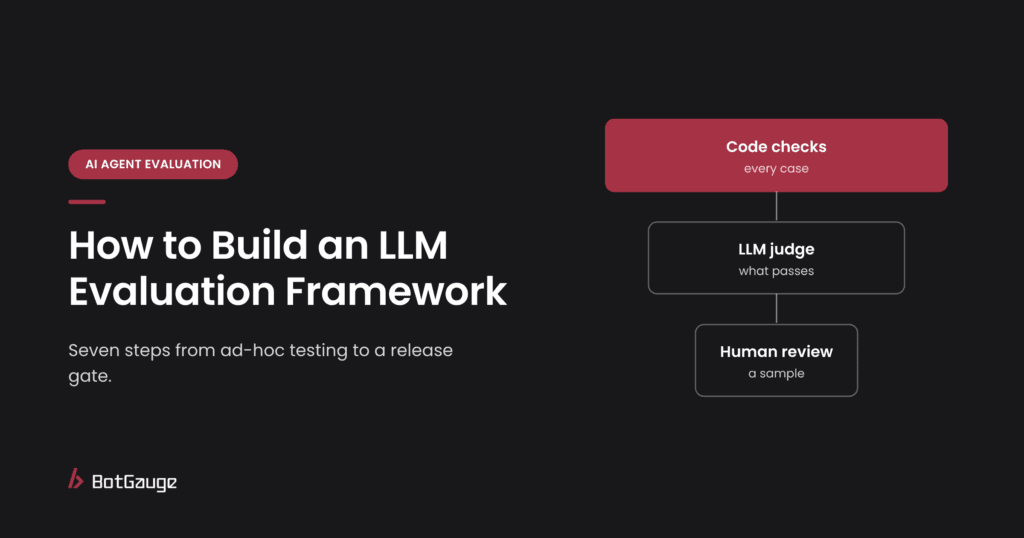
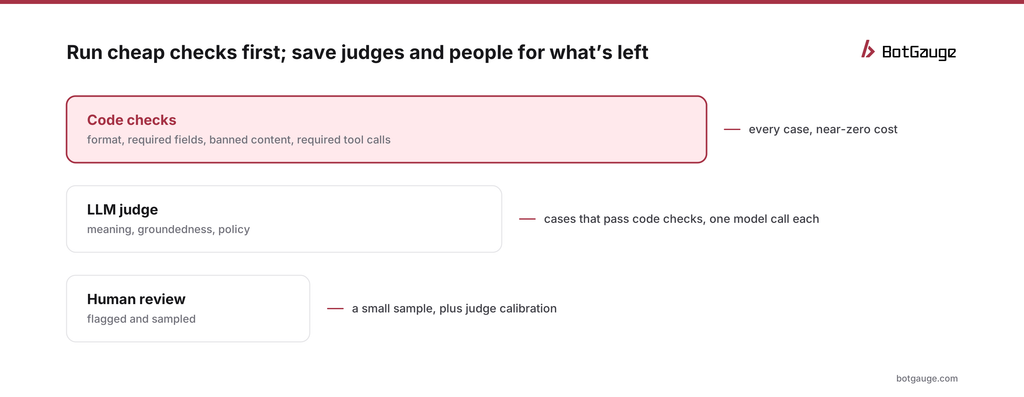
Order scorers by cost. Plain code assertions are cheap, fast and stable, so they should carry most of the weight (TestDino). Send only what passes to an LLM judge, and only a sample to people.
layered scoring: cheapest checks first
Before trusting a judge, measure how often it agrees with human reviewers on the same cases. Our guide to LLM-as-a-judge covers calibration.
5. Set thresholds and run each case several times
Agree on a pass rate per metric before you build, not after. Run each case more than once, because outputs vary, and score the pass rate rather than a single result.
6. Gate releases in CI
Run the suite on every prompt, model or tool change, and block the merge when a case that used to pass now fails. Keep thresholds a little below perfect, so harmless wording changes don’t block every release. The BotGauge docs cover connecting an app or agent through its SDK or API.
7. Keep evaluating in production
Offline tests only cover what you thought of. Score a sample of live traffic, and turn every new failure into a test case. Online vs offline evaluation for agents explains how the two fit together.
Common mistakes
• Testing first, defining success later. Without written goals, every result becomes an argument.
• A test set that only has happy paths. Everyday cases prove the system works; edge and adversarial cases prove it holds up.
• Letting the test set go stale. A suite written once and never updated stops catching new failures. Add every production failure and every red-team finding.
• Re-testing only when code changes. A new model, tool, data source or policy can break behavior with no code change at all. Our guide on when to red team an AI agent lists the triggers.
How many test cases do I need?
Start with a few dozen good ones covering your main tasks and red lines, then grow the set from real failures. A small, sharp set beats a large, random one.
The bottom line
An evaluation framework is a habit, not a project: write down what good looks like, test against it on every change, and feed every failure back in. Start small, keep code checks doing most of the work, and make sure your test set includes the attacks and edge cases real users will find.
Adversarial cases are the hardest to write by hand. Automated red teaming for AI agents generates them, and BotGauge LLM evaluations turns each confirmed finding into a check that runs on every release. For tool options, see the 12 best AI observability and evaluation tools for agents.
Think your agent is safe? Prove it. BotGauge turns every red-team finding into an evaluation. Try Botgauge for Free or book a 30-minute demo.