TL;DR
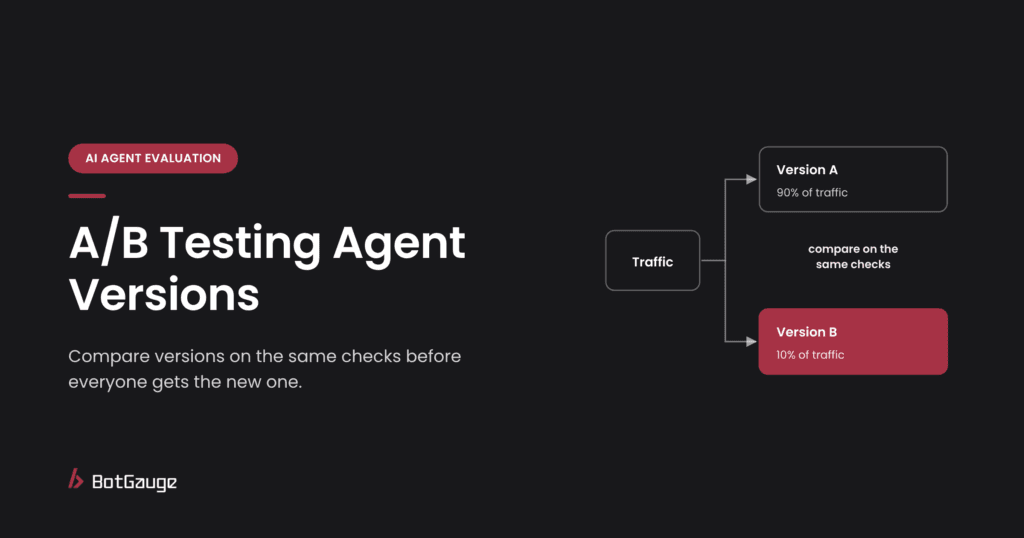
A/B testing agent versions means serving a new version of an agent, such as a new model, prompt or tool setup, to a share of real users, and comparing it with the current version on agreed outcomes before rolling it out. For agents, run it as the fourth of five stages: offline comparison, shadow, canary, A/B test, then ramp. Choose one primary metric and several guardrails that can each stop the test, assign by session rather than by message, plan for more traffic than a website test needs, and write the decision rule before the first user sees the new version.
Why A/B testing agents is different
A/B testing a button colour is well understood. A/B testing an agent breaks several of its assumptions:
- Outputs vary run to run. Classic tests measure a simple event with known variance. LLM tests often measure a score from an instrument that doesn’t return the same value twice on the same input (Arize). Because outputs vary even at temperature zero, standard sample-size calculations underestimate what agent tests need (Atlan).
- The answer isn’t the whole result. Two versions can reach the same final answer by very different paths, one of them skipping a required check. Compare trajectories, not just final answers.
- Agents take actions. A worse version doesn’t just give a worse reply; it may issue a wrong refund or change the wrong record. The treatment arm needs the same safety limits as production.
- The ground moves. Prompts shift, traffic mixes change, and the model can update under you, so a fast win may be a lucky blip (Statsig).
A/B testing is one part of evaluating agents; for the full picture, see our guide to AI agent evaluation.
The five-stage path
staged path for testing a new agent version
The safest sequence runs in one direction: offline baseline, shadow scoring, canary, full online test, then a CI regression gate (Atlan).
- Offline comparison. Run both versions on your golden dataset. If the new version fails cases the current one passes, stop here.
- Shadow. Run the new version on copies of live requests and score the results without showing them to anyone. For agents, use stubbed or sandboxed tools so the shadow can’t take real actions.
- Canary. Send a small slice of real traffic to the new version and watch guardrail metrics closely. Roll back on any red-line failure.
- A/B test. Split traffic evenly enough to measure the primary metric with confidence.
- Ramp. Roll out to everyone, then add the cases that mattered to your CI gate so future changes can’t undo the win.
Not every change needs all five stages. A small prompt wording change might go from offline to canary to ramp. A model swap for an agent that moves money should go through every stage. Online vs offline evaluation for agents covers the canary and shadow stages in detail.
What to test
Change one thing per experiment, so you can tell what caused the result: the prompt, the model, a tool’s configuration, retrieval settings or a memory policy (Maxim). Common agent experiments include switching to a cheaper or faster model, rewriting the system prompt, changing how many documents retrieval returns, adding a confirmation step before high-impact actions, and tightening a guardrail. For prompt-only changes, much of the work can happen offline first; see prompt evaluation.
Choosing metrics
Every experiment needs one primary metric, the outcome you’re trying to improve, and several guardrail metrics, the things that must not get worse. Teams commonly pair a primary outcome with guardrails such as latency so a win in one area doesn’t hide harm in another (Statsig). For agents, guardrails such as p95 latency, cost per resolved task, tool error rate and safety violations should each be able to stop an experiment on their own (Arize).
| Agent type | Primary metric | Guardrails |
| Support agent | Resolution rate without repeat contact | Escalation rate, policy violations, p95 latency, cost per resolved task |
| Transactional agent | Task completion with correct end state | Out-of-policy actions (any one stops the test), argument errors, approval-step skips |
| Research or RAG assistant | Answer accepted or rated helpful | Groundedness, hallucination reports, latency |
| Coding agent | Changes merged without revert | Test failures, cost per task, unsafe commands |
A version that improves quality but doubles token spend hasn’t simply won; it has created a trade-off someone needs to decide on (Arize). Carry cost per resolved task as a guardrail in every agent test. AI agent evaluation metrics that matter covers the full metric list.
Running the test
Write the decision rule first. Before the first user is assigned, write down in plain language what result means ship, what means roll back, and what means keep testing. Without it, teams keep reinterpreting the numbers until they match their intuition (FeatBit). A good rule names the primary metric, the minimum improvement worth shipping, and the guardrail limits that stop the test immediately.
Assign by session, not by message. The same user, ticket or workflow should stay on one version for the whole experiment; bouncing between versions mid-conversation contaminates the result and confuses users (FeatBit). Record the version on every trace, so you can reconstruct afterwards which version produced which run (Arize).
Hold everything else constant. Same tools, same knowledge base, same traffic sources, same time period. If the knowledge base is updated mid-test, the comparison is broken.
Run long enough. Cover at least a full weekly cycle, because user behavior differs between weekdays and weekends, and collect more tasks than a website test would need, because each agent result is noisier. Resist changing the experiment while it runs; a mid-test tweak resets the clock.
Keep safety limits identical in both arms. The new version must run under the same permissions, spending limits and approval steps as the current one. An A/B test is not a reason to loosen controls.
Reading the results
- Check guardrails before the primary metric. If any guardrail breached its limit, the result is a rollback regardless of the primary metric.
- Break results down by task type. A version can win overall and lose badly on your riskiest task. Look at each important segment separately.
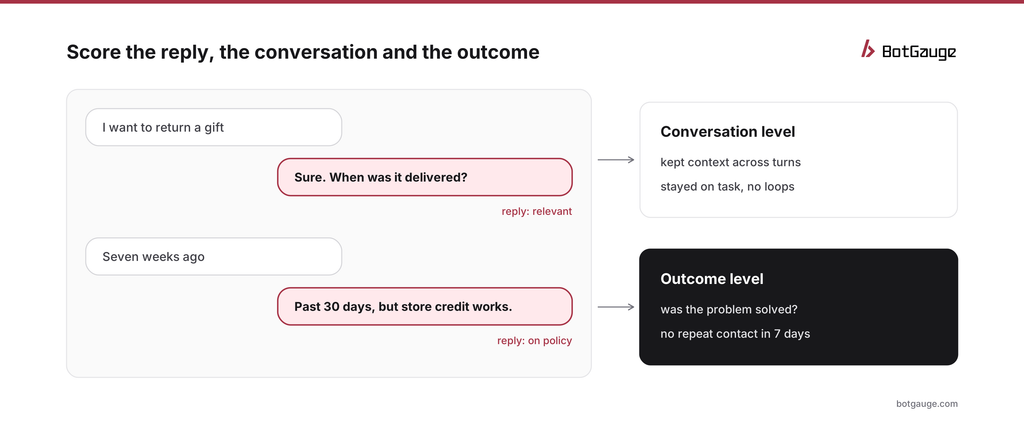
- Compare paths, not just outcomes. Sample traces from both arms and check whether the new version reaches the same outcomes by acceptable paths: same required steps, no extra loops, no new tool errors.
- Use judge scores carefully. An LLM judge can score both arms at scale, but calibrate it against human reviewers first, and don’t let it see which version produced which answer. Our guide to LLM-as-a-judge covers both.
- Treat “no difference” as a result. If the new version is cheaper or faster and no worse on the primary metric and guardrails, that’s often a good reason to ship.
Safety in A/B tests
A/B tests measure what ordinary users do. They rarely include the users trying to break the agent, and a new model or prompt can be easier to manipulate even when it scores better on everyday tasks. Before a new version reaches any live traffic, run adversarial tests against it, including slow multi-turn attempts; a model or prompt change is exactly the kind of change that should trigger a new round, as when to red team an AI agent explains. Automated red teaming for AI agents shows how to run those tests on every candidate version, and BotGauge LLM red teaming runs them against your agent.
Common pitfalls
- Skipping the offline stage. Live users become your test set for problems a golden dataset would have caught for free.
- Changing several things at once. A new model plus a new prompt plus a new tool makes the result impossible to explain.
- Declaring a winner early. Early leads in noisy tests often disappear. Stick to the planned duration.
- Only measuring the final answer. Paths, costs and actions can change while answers look the same.
- Forgetting the CI gate. After ramping, add the cases that mattered to your regression suite, or the next change can quietly undo the gain.
The bottom line
A/B testing an agent is a controlled risk decision, not just a metric report. Compare offline first, expose users gradually, pick one primary metric with guardrails that can stop the test, keep safety limits identical in both arms, and decide on a rule you wrote before you saw the data. Then lock in the result with a regression gate.
BotGauge LLM evaluations compares versions on the same checks, and BotGauge LLM observability records which version produced every trace. For tool options, see the 12 best AI observability and evaluation tools for agents.
Think your agent is safe? Prove it. BotGauge tests every new agent version before your users see it. Start for free or book a 30-minute demo.