AI Summary
- Edge case testing verifies how software behaves at the extremes: boundary values, unusual inputs, rare conditions, and unexpected user behavior outside the happy path.
- Most production incidents come from untested edge cases, not from broken core features, because teams naturally test what users usually do.
- Edge cases fall into recognizable types: boundary values, empty and null states, extreme inputs, timing and concurrency, environment conditions, and malicious or malformed input.
- You cannot test every edge case, so prioritize by cost of failure: revenue paths, security boundaries, and data integrity first.
- Automation is what makes edge case coverage sustainable, since humans reliably skip rare scenarios under release pressure.
- Edge case tests are the flakiest tests in most suites, which makes self-healing maintenance the difference between coverage that lasts and coverage that gets deleted.
What Is Edge Case Testing?
Edge case testing is the practice of verifying how software behaves under extreme, unusual, or boundary conditions rather than typical usage. An edge case is a scenario at the limits of what a system should handle: the maximum allowed input, the empty field, the leap-year date, the user who clicks submit twice. If you are asking what is edge case testing in one line: testing what happens at the edges of normal, where assumptions quietly live and where most defects hide. That is the edge case testing meaning in practice.
The contrast makes it clearer. A standard test checks that a checkout works with one item and a valid card. Edge case testing asks what happens with 999 items, a quantity of zero, a discount code applied twice, a card that expires today, or a network that drops mid-payment. The feature is the same; the questions are hostile.
The reason this discipline exists is simple and slightly uncomfortable: developers and testers both reason from how the system is supposed to be used. Users, integrations, and reality do not read the spec.
Why Edge Cases Matter?
Edge cases matter because that is where software actually fails in production, and the failures are disproportionately expensive.
Core functionality gets exercised constantly: by developers building it, by every tester, by every user, every day. A bug on the happy path is caught in hours. An edge case bug can sit dormant for months until the one user with a 40-character surname, or the one order placed at midnight on December 31, triggers it in production, where diagnosis is hardest and the blast radius is largest.
History’s most famous software failures are edge case failures. The Ariane 5 rocket exploded 37 seconds after launch because a velocity value exceeded what a 16-bit integer could hold, an untested extreme. YouTube’s view counter broke on Gangnam Style because nobody had tested what happens past 2.1 billion views, the limit of a 32-bit integer. The pattern repeats at every scale: the system worked exactly as designed, for every case anyone had thought about. Poor software quality overall costs the US economy trillions annually, according to CISQ estimates, and the untested edge is one of its most reliable sources.
For an engineering leader, the framing that matters is risk concentration: your team’s testing effort naturally piles up where failures are least likely, and thins out exactly where they are most likely. Edge case testing is the deliberate correction of that imbalance.
What Are the Types of Edge Cases in Software Testing?
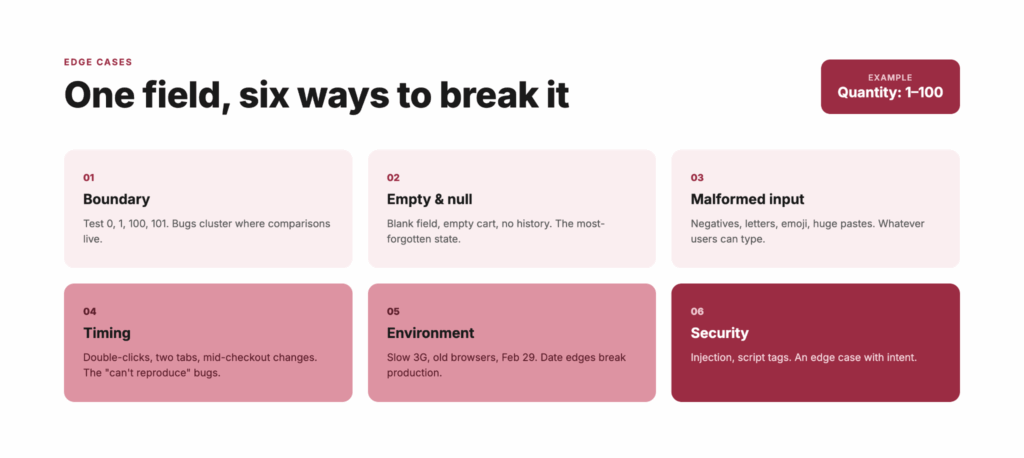
Edge cases feel infinite until you categorize them. Six types cover most of what breaks, and a useful exercise is to hold one input against all six. Take a simple quantity field on a checkout page:
Boundary values
The classic edge case in testing with example form: if quantity allows 1 to 100, test 0, 1, 100, and 101. Bugs cluster at boundaries because that is where someone wrote a comparison operator, and off-by-one errors live in comparison operators.
Empty, null, and missing states
Quantity left blank. A cart with nothing in it. A user with no order history viewing the orders page. Empty states are the most commonly forgotten scenario in modern apps.
Extreme and malformed input
A quantity of 99999999. A negative number. Letters in the number field. An emoji. A 500-character paste. Systems inherit whatever users can physically type.
Timing and concurrency
Clicking buy twice in one second. Two browser tabs editing the same cart. A price change landing mid-checkout. These produce the bugs that “cannot be reproduced” until they can.
Environment and state conditions
The same purchase on a slow 3G connection, in an outdated browser, at 11:59 PM on New Year’s Eve, or on February 29. Date and time edges alone have broken more production systems than most bug categories.
Security-flavored edges
A quantity of 1; DROP TABLE orders. Script tags in the name field. Malicious input is an edge case with intent, and it is where edge case testing overlaps with security testing.
One field, six directions of attack. Multiply by every input in your product and the prioritization problem in the next section becomes obvious.
Prioritizing Edge Case Testing: What to Test First
You cannot test every edge case, and pretending otherwise is how programs stall. The prioritization rule is cost of failure, not likelihood:
- Revenue paths first. Checkout, payments, subscription changes. An edge case bug here has a dollar value per hour.
- Security and data boundaries second. Authentication edges, permission checks, anything touching user data. These failures cost trust, compliance standing, and headlines.
- Data integrity third. Anything that writes, migrates, or calculates. Corrupted data compounds silently long after the bug is fixed.
- High-traffic surfaces fourth. A rare edge case on a page with a million daily users is not rare; frequency multiplies probability back into the equation.
- Everything else on a budget. Low-stakes surfaces get boundary values and empty states, the two highest-yield edge types, and nothing more.
A practical instrument for this: when a production incident occurs, tag whether an edge case caused it. Within a quarter you will have an evidence-based map of where your product’s edges actually bite, which beats any theoretical model.
Examples of Edge Case Testing
Concrete edge case testing example sets, across common features:
Login. Correct password with trailing whitespace. Email in uppercase. Password at exactly the maximum length. Sixth attempt after five failures. Login while already logged in on another device. Password containing quotes or unicode.
Search. Empty query. A query of only spaces. One character. A 1,000-character paste. Special characters and SQL fragments. A term with zero results. A term with 100,000 results.
File upload. A 0-byte file. A file at exactly the size limit and one byte over. A .exe renamed to .jpg. A filename with emoji. Twenty simultaneous uploads. Connection lost at 99%.
Date handling. February 29. December 31 to January 1 rollover. Daylight saving transitions. A user whose timezone is ahead of the server. A birthdate 120 years ago. A scheduled event in the past.
Payments. Card expiring this month. Amount of 0.00. The largest amount your system allows. Currency with no decimal places (JPY). Refund larger than the original charge. Double-clicked pay button.
Reading these lists, notice what they have in common: none is exotic. Every one has happened to a real product this year. Edge cases are only rare individually; collectively they are Tuesday.
Edge Case Testing Strategies
Finding edge cases systematically beats brainstorming them. Four strategies do most of the work:
Boundary value analysis. For every numeric or length limit, test the boundary, one below, and one above. Mechanical, fast, and it catches the single most common defect class in software.
Equivalence partitioning. Divide inputs into classes that should behave identically (valid quantities, too-large quantities, non-numeric input) and test one representative of each, plus the boundaries between classes. This is how you get coverage without combinatorial explosion.
State and flow mapping. Walk each user flow asking, at every step: what if the user goes back? Refreshes? Loses connection? Has the session expire? Every arrow in a flow diagram hides three edge cases.
Failure-driven discovery. Mine production incidents, support tickets, and error logs for the edges reality has already found. Your logs are a free, personalized edge case generator, and the cases they surface have proven business impact.
The strategy that does not work: relying on individual tester intuition alone. Intuition finds brilliant one-off edges but produces coverage shaped like one person’s imagination, and it leaves with them when they change jobs.
Best Practices to Follow
The habits that separate teams whose edge case coverage compounds from teams who quietly abandon it:
Write edge cases into acceptance criteria. If the ticket only describes the happy path, the happy path is all that will be built and tested. Boundary and failure behavior belong in the definition of done.
Keep edge case tests independent and data-isolated. Edge tests create weird states by design; a test that leaves a corrupted cart behind poisons every test after it.
Assert on behavior, not absence of crashes. “It did not crash” is not a pass. The correct assertion is a specific, graceful outcome: the right error message, the safe fallback, the preserved data.
Budget maintenance from day one. Edge case tests break more often than happy-path tests because they depend on more specific conditions. Unmaintained, they become the flaky tests that teach your team to ignore red builds.
Retire edges the product outgrows. When a feature is removed or a limit changes, delete or update its edge tests. A suite full of tests for yesterday’s boundaries is noise wearing a coverage costume.
Edge case discipline works best inside a healthy overall testing culture. See the full set of QA best practices.
Advantages of Edge Case Testing
Where the “why” above is about risk, the advantages are the measurable payoffs teams see once edge case testing is systematic:
Fewer production incidents, and cheaper ones. Bugs move from production, where they cost incidents and trust, to pre-release, where they cost minutes. Since edge cases cause a disproportionate share of incidents, this is the highest-leverage defect-prevention work available.
Faster, calmer releases. A suite that covers the edges is a suite the team actually trusts, which turns release sign-off from a debate into a data point.
Better product decisions. Edge case testing forces the questions specs skip: what should happen at the limit? Answering them improves the product, not just the tests.
Compounding security posture. Malformed-input testing catches a meaningful share of injection and validation vulnerabilities before a pentest ever runs.
How to Automate Edge Cases?
How does edge case automation testing work in practice? It exists because manual edge case testing has a structural flaw: humans deprioritize rare scenarios under pressure, every time. When the release is due at 5 PM, the leap-year test is what gets skipped, precisely because it “never” fails. Automation removes the discretion.
What edge case test automation looks like in practice:
- Encode the edges as first-class tests. Boundary values, empty states, malformed inputs, and timing cases become permanent suite members, not exploratory afterthoughts.
- Use data-driven tests for input edges. One parameterized test running fifty boundary and malformed values gives wide edge coverage at almost no maintenance cost per case.
- Run them on every commit. Edge case regressions are the quietest regressions; only continuous execution catches the moment a refactor un-handles the empty cart.
- Simulate the hard conditions deliberately. Network drops, slow connections, and concurrent actions need tooling support (request interception, parallel test execution), which is exactly what automation frameworks provide and manual testing cannot reproduce reliably.
The frontier here is AI-driven generation. Modern agentic AI testing systems read your product flows and generate the edge cases systematically, including the categories human authors reliably skip, because an agent applying boundary analysis to every input has no intuition to run out of.
Self-Healing for Edge Case Test Stability
Here is the uncomfortable truth about edge case suites: they are the flakiest tests most teams own. Edge tests depend on precise conditions, exact boundary values, specific states, timing windows, so every product change breaks more edge tests than happy-path tests. And a flaky edge test is doubly dangerous, because when it fails, nobody is sure whether the edge broke or the test did, and the path of least resistance is deleting it. This is how edge coverage quietly evaporates: not by decision, but by attrition.
Self-healing changes that math. When the UI or workflow changes, self-healing detects the change and updates the affected tests automatically instead of leaving them to fail on stale selectors and outdated flows. For edge case suites specifically, that means the tests covering your rarest, highest-stakes scenarios stay alive without a human re-justifying their maintenance cost every sprint, which is precisely when they used to get cut.
See how automated regression testing with self-healing keeps a suite intact as the product changes.
Measuring Edge Case Testing Effectiveness
What gets measured gets funded. Four metrics tell you whether edge case testing is working:
- Edge-attributable escape rate. Of bugs that reached production, what share were edge cases? This number falling is the program’s core proof.
- Edge coverage of critical flows. For each revenue and security path, are the six edge types represented? A simple checklist per flow beats an abstract percentage.
- Flake rate of edge tests. If edge tests fail intermittently more than rarely, maintenance is losing and coverage is about to shrink.
- Time from incident to test. When production finds a new edge, how fast does it become a permanent automated test? Elite teams close that loop in days.
The Future of Edge Case Testing
Two forces are reshaping this discipline. The first is AI-generated code: as more software is written by coding agents, the volume of plausible-looking code with unexamined edge behavior grows, because generated code inherits the happy-path bias of its training. The verification burden shifts from “does it work” to “where does it break,” which is an edge case question.
The second force is AI on the testing side. Agentic systems now generate edge cases from specifications systematically, explore applications to find unhandled states, and maintain the resulting tests as products change. The economics invert: edge coverage stops being the expensive, skippable layer and becomes a default output of autonomous testing. The teams that benefit first are the ones that treat edge case coverage as an outcome to be delivered, not a heroic manual effort, the same shift the rest of QA is undergoing.
Edge Case Automation Testing with BotGauge
BotGauge approaches edge cases the way this guide recommends, as a systematic output rather than an act of tester heroism, through its Autonomous QA as a Solution model.
Its AI agents read your PRDs, UX flows, and demo videos and generate test cases across your functional, UI, and API workflows, including the edge cases teams rarely get to: boundary values, empty states, malformed inputs, and failure paths, applied consistently to every flow rather than where intuition happens to land. A dedicated domain FDE pod reviews and signs off every generated test, so an agent’s idea of an edge is validated by a human’s understanding of your product. Self-healing then keeps those edge tests stable as your product changes, which solves the attrition problem that erodes most edge case suites. Everything runs in your CI/CD pipeline on every commit with unlimited parallel runs.
The outcomes are the usual BotGauge numbers: critical flows automated in 24 to 48 hours, around 80% coverage in about two weeks, outcome-based pricing, and SOC 2 Type II compliance.
Conclusion
Edge cases are where your product’s real quality lives, because the happy path was never in danger. The playbook is not complicated: categorize the edges instead of brainstorming them, prioritize by cost of failure, encode the important ones as automated tests that run on every commit, and keep them alive with self-healing so flakiness never talks your team into deleting them. Start with one revenue-critical flow this week, run all six edge types against it, and count what you find. That number is usually the whole business case.
Frequently Asked Questions
What is an edge case in software testing?
What is edge case scenario in testing?
What is an edge case in QA testing?