Test strategy and test plan get used interchangeably in standups, tickets, and even job postings, and that mix-up costs teams clarity when it matters most: right before a release.
TL:DR
- A test plan is project-specific: it covers scope, schedule, resources, and test cases for one release or sprint. It’s a living document, updated as requirements shift.
- A test strategy is org-wide: it defines the testing philosophy, standards, and risk approach applied across multiple projects. It changes rarely, usually quarterly or annually.
- Test plans are typically owned by test leads or project managers; test strategies by QA managers, test architects, or engineering leadership.
- Common test strategy types include analytical, model-based, methodical, process-compliant, dynamic/heuristic, and consultative.
- Use a test strategy when standing up QA for a new org or aligning multiple teams; use a test plan when kicking off a specific project, release, or hotfix.
- Best practices: set clear objectives, prioritize risk-based testing, define entry/exit criteria, keep plans lightweight, and automate repetitive tests.
This guide breaks down both documents, compares them side by side in a quick-reference table, walks through a real example of each, and lays out when to reach for one over the other, and the best practices that keep both documents useful instead of shelfware.
What Is a Test Plan?
A test plan is a document that describes the scope, objectives, approach, resources, and schedule of the testing activities planned for a specific project, release, or feature. According to the ISTQB Glossary, a test plan is formally defined as “a document describing the scope, approach, resources, and schedule of intended test activities,” including test items, features to be tested, and entry and exit criteria. It answers practical questions: What are we testing? What are we not testing? Who owns which task? When does testing start and end, and how do we know it succeeded?
Unlike a test strategy, a test plan is not a set-and-forget document. Teams update it throughout the software development life cycle (SDLC) as requirements shift, features get added or cut, and timelines move. Most organizations base their test plan structure on IEEE 829 (now folded into ISO/IEC/IEEE 29119), though the format is a starting point to adapt, not a rulebook to follow line by line, especially on agile teams.
A test plan belongs to the whole project team, not just QA. Developers reference it to understand what will be validated before they merge code. Product managers use it to confirm coverage matches the feature spec. Stakeholders check it to see when sign-off happens.
Key Components of a Test Plan
A test plan translates the overall testing approach into an actionable roadmap for a specific project or release. While every organization structures it differently, the following components ensure testing is well-scoped, organized, and measurable.
- Scope: which features, modules, and platforms are in scope and, just as important, what is explicitly out of scope.
- Objectives: the measurable outcomes testing needs to prove, such as functional correctness, performance thresholds, or security compliance.
- Test approach: a summary of the testing types and techniques used for this project, usually inherited from the test strategy.
- Roles and responsibilities: who executes tests, who reviews results, and who signs off before release.
- Schedule and milestones: dates for test case creation, execution cycles, defect triage, and final sign-off.
- Entry and exit criteria: the conditions that must be true before testing starts and before it counts as complete.
- Test environment and tools: the hardware, software, data, AI test automation tools, and test management tools required to execute the plan.
- Risks and contingencies: known risks to the schedule or quality, along with mitigation steps for each.
- Deliverables: the artifacts testing produces, like test cases, defect logs, and a final test summary report.
What Is a Test Strategy?
A test strategy is a high-level document that defines the testing approach, principles, and standards an organization applies across multiple projects. Where a test plan is tactical, a test strategy is closer to policy; it explains why the team tests the way it does, not the day-to-day mechanics of a single release.The ISTQB Glossary defines a test strategy as “a high-level description of the test levels to be performed and the testing within those levels for an organization or programme,” covering multiple projects rather than a single release.
A test strategy typically outlines the levels of testing performed (unit, integration, system, acceptance), the mix of manual and automated testing, the tools and environments standardized across teams, and the framework used to assess and prioritize risk. Because it sits above any single project, a test strategy changes far less often than a test plan, usually on a quarterly or annual cadence, or when the organization’s technology stack or compliance requirements shift.
Test managers, QA leads, and engineering leadership typically own the test strategy. Individual test plans are expected to align with it, not duplicate it.
Key Components of a Test Strategy
A test strategy provides the foundation for how testing is conducted across teams and projects. These core components establish consistent standards, methodologies, and quality objectives that every test plan should follow.
- Testing objectives and scope: the overall goals testing supports across projects, such as release velocity, defect escape rate, or compliance.
- Test levels and types: which levels (unit, integration, system, UAT) and types (functional, performance, security, usability) apply, and why.
- Test approach and methodology: risk-based, requirement-based, or model-based reasoning for how test effort gets allocated.
- Roles and responsibilities: the org-wide structure for QA, development, and stakeholder involvement in testing.
- Test environment and tooling standards: the approved tools, frameworks, and environments teams should use for consistency.
- Risk management framework: how risk gets identified, scored, and mitigated across the entire project portfolio.
- Metrics and reporting standards: the KPIs, such as defect density, test coverage, and automation rate, used to judge testing effectiveness.
- Communication plan: how testing status, defects, and quality signals get reported to stakeholders.
Common Types of Test Strategy
There is no one-size-fits-all test strategy. The right approach depends on factors like product complexity, business risk, compliance requirements, and development methodology. Below are the most common testing strategies used by modern engineering teams.
- Analytical: built on requirement and risk analysis; test effort follows what’s most likely to fail or matters most to the business.
- Model-based: derived from a model of expected system behavior, common in regulated or safety-critical systems.
- Methodical: follows a standard checklist of quality characteristics, such as reliability, usability, and security, regardless of the specific application.
- Process-compliant: dictated by an external standard or regulation, such as an industry or government mandate.
- Dynamic or heuristic: prioritizes exploratory testing and adapts in real time as testers learn about the system.
- Consultative: shaped mainly by input from users, domain experts, or stakeholders rather than the QA team alone.
Most real-world strategies combine two or three of these approaches rather than picking one in isolation.
Test Plan vs Test Strategy: Key Differences
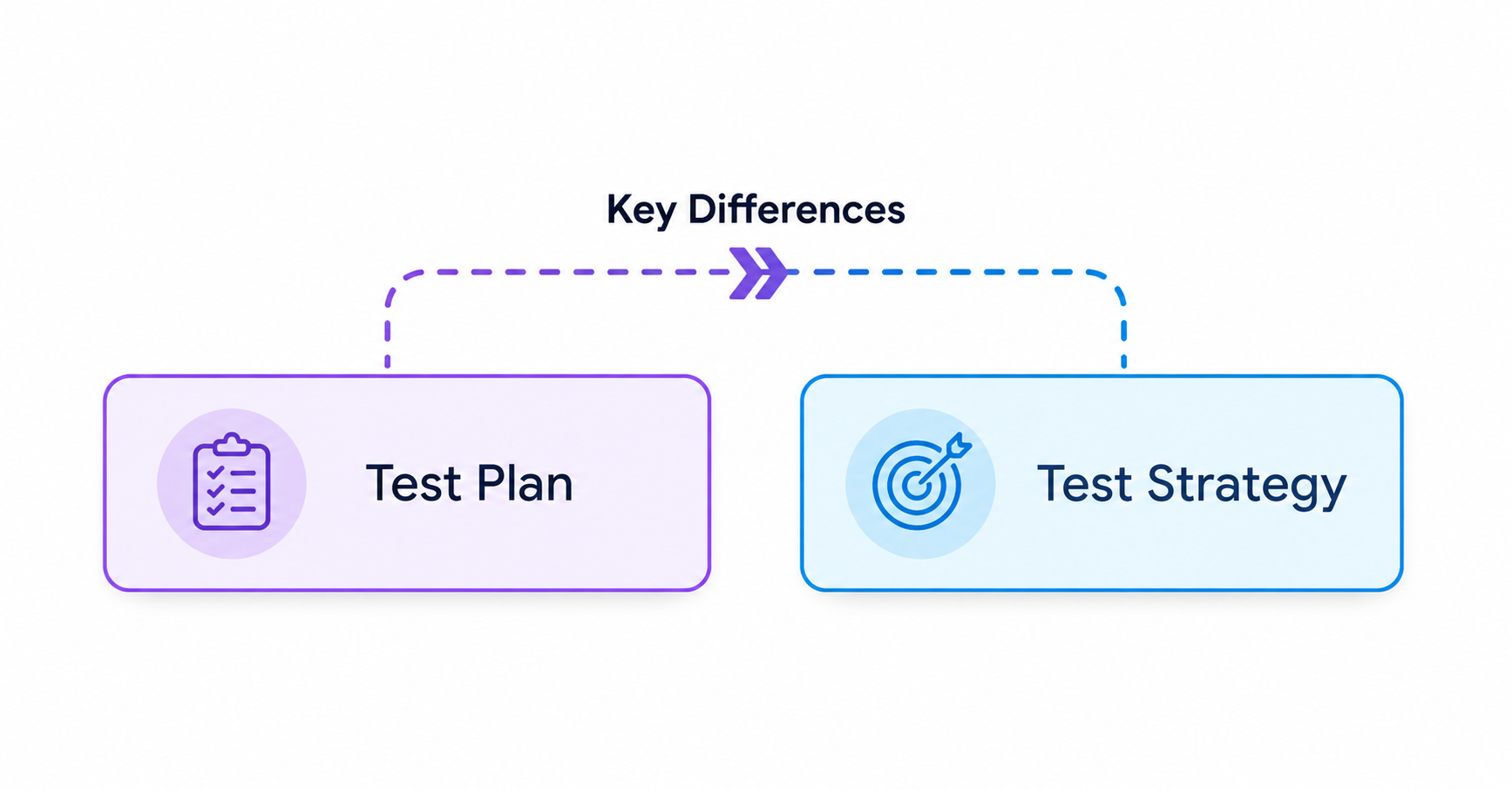
Although they’re closely related, a test plan and a test strategy serve different purposes. The comparison below highlights the key difference between test plan and test strategy in scope, ownership, level of detail, and when each document should be used.
| Aspect | Test Plan | Test Strategy |
|---|---|---|
| Definition | A project-specific document detailing how testing will be executed for one release. | An organization-wide document defining the overall approach to testing across projects. |
| Scope | A single project, release, or sprint. | Multiple projects, a product line, or the entire organization. |
| Level of detail | Detailed: test cases, schedules, resource assignments. | High-level: principles, methodologies, and standards. |
| Document lifespan | Short-term; revised throughout the project. | Long-term; revised quarterly or annually. |
| Owned by | Test lead or project manager for that release. | QA manager, test architect, or engineering leadership. |
| Primary audience | QA team, developers, and stakeholders for that release. | Test leads, QA managers, and organizational leadership. |
| Time frame | Days to months, tied to one release cycle. | Months to years, spanning multiple releases. |
| Focus | What to test, who tests it, and when. | What approach to take, and why. |
| Standard reference | Often modeled on IEEE 829 / ISO 29119 test plan sections. | Sets the policy those standards get applied under. |
| Update trigger | Requirement changes, schedule shifts, scope changes. | New compliance rules, tech stack changes, org restructuring. |
Test Plan and Test Strategy Example
Abstract definitions only go so far. Here’s how the two documents play out for a SaaS company adding a new one-click checkout feature.
Test Strategy Excerpt
The example below shows how a test strategy establishes the organization’s testing principles. Rather than focusing on a single release, it defines the objectives, testing approach, standards, and risk policies that every project is expected to follow.
- Objective: reduce payment-related production incidents by 50% year over year.
- Approach: risk-based testing that prioritizes payment and checkout flows across every product.
- Test levels: unit and API testing automated in CI; UAT performed manually for any new checkout flow.
- Tools: a shared test management platform, a standard API testing tool, and one staging environment across product teams.
- Risk rule: any flow that touches PCI-scoped data requires a mandatory security review before release.
Test Plan Excerpt
This will be feature-specific, inherited from the strategy above
- Scope: the new one-click checkout feature on web and iOS; Android is excluded and scheduled for phase two.
- Objectives: checkout completes in under three seconds at the 95th percentile; zero critical defects at release.
- Schedule: test case authoring on March 2, execution March 5–12, sign-off March 14.
- Entry criteria: feature complete in staging, test data loaded, checkout API contract frozen.
- Exit criteria: 100% of critical test cases passed, with no open Severity-1 or Severity-2 defects.
- Resources: two QA engineers, one security reviewer per the strategy’s PCI rule, and a staging environment with a sandbox payment gateway.
Notice what the test plan does not do: it doesn’t reinvent testing philosophy. It applies the strategy’s risk-based approach and PCI rule to one specific feature, with real dates, owners, and numbers attached.
When Would You Use a Test Plan or a Test Strategy?
Mature QA teams rarely choose one document over the other, they use both at different altitudes. But the entry point differs depending on where the team is standing.
Start With a Test Strategy When
- You’re standing up a QA process for a new team or organization.
- Multiple product teams need a consistent approach to testing, tooling, and risk management.
- Leadership needs a testing roadmap tied to business goals rather than one specific release.
- Compliance or regulatory requirements dictate how testing must be documented and evidenced.
Start With a Test Plan When
- You’re kicking off a new project, release, or sprint with a defined scope and deadline.
- A specific feature or module needs test coverage mapped to its acceptance criteria.
- You need to assign testers, environments, and schedules to a concrete deliverable.
- A hotfix or small-scope change needs fast, lightweight coverage without touching org-wide policy.
Agile teams often compress the test plan into a lighter, living document, sometimes just a checklist embedded in the sprint board while keeping one test strategy that gets revisited quarterly rather than reset every sprint. Waterfall and regulated environments, such as finance, healthcare, and aerospace, tend to keep both documents more formal and more heavily reviewed.
Test Plans and Test Strategies: Best Practices
A well-written test strategy and test plan reduce ambiguity, improve collaboration, and help teams deliver higher-quality software with fewer delays. While the strategy defines how testing will be approached, the test plan ensures everyone knows what will be tested, when, and by whom. Follow these best practices to make both documents effective:
1. Define Clear Testing Objectives
Start by identifying what success looks like. Your objectives should align with business goals, release timelines, and product risks rather than simply aiming for maximum test coverage.
2. Build a Risk-Based Testing Strategy
Not every feature carries the same level of risk. Prioritize testing for:
- Business-critical workflows
- High-traffic user journeys
- Security-sensitive functionality
- Frequently changing components
- Areas with a history of defects
This ensures testing effort is spent where failures would have the greatest impact.
3. Choose the Right Mix of Testing Types
Your strategy should specify which testing activities are required, such as:
- Functional testing
- Integration testing
- Regression testing
- API testing
- Performance testing
- Security testing
- Usability testing
Avoid running every test for every release. Instead, tailor the scope based on release risk.
4. Define Entry and Exit Criteria
Establish clear conditions before testing begins and before a release is approved.
Entry criteria may include:
- Feature development completed
- Build deployed successfully
- Test environment available
Exit criteria may include:
- No critical defects remain
- Required test coverage achieved
- Regression suite passes
- Stakeholder approval received
These criteria prevent subjective release decisions.
5. Keep Test Plans Lightweight and Actionable
A test plan should be practical, not a document that becomes outdated after one sprint. Focus on:
- Scope
- Features to test
- Test environment
- Resources and responsibilities
- Schedule
- Risks and dependencies
- Deliverables
Update it as requirements evolve instead of treating it as a static document.
6. Automate Repetitive Testing
Regression, smoke, and API tests are ideal candidates for automation. Automating repetitive validation allows teams to test more frequently while reducing manual effort and release bottlenecks.
Rather than relying on traditional automation that requires constant upkeep, Autonomous QA as a Solution (AQaaS) by BotGauge combines AI QA agents with a dedicated Forward Deployed Engineer (FDE) pod to own the entire testing lifecycle, from test generation and execution to validation and continuous maintenance as your application evolves. This eliminates test maintenance overhead while ensuring reliable, production-ready test coverage.
7. Review and Improve Continuously
A test strategy should evolve alongside the product. After each release, review:
- Defect leakage
- Test coverage gaps
- Escaped production issues
- Automation effectiveness
- Execution time
Conclusion
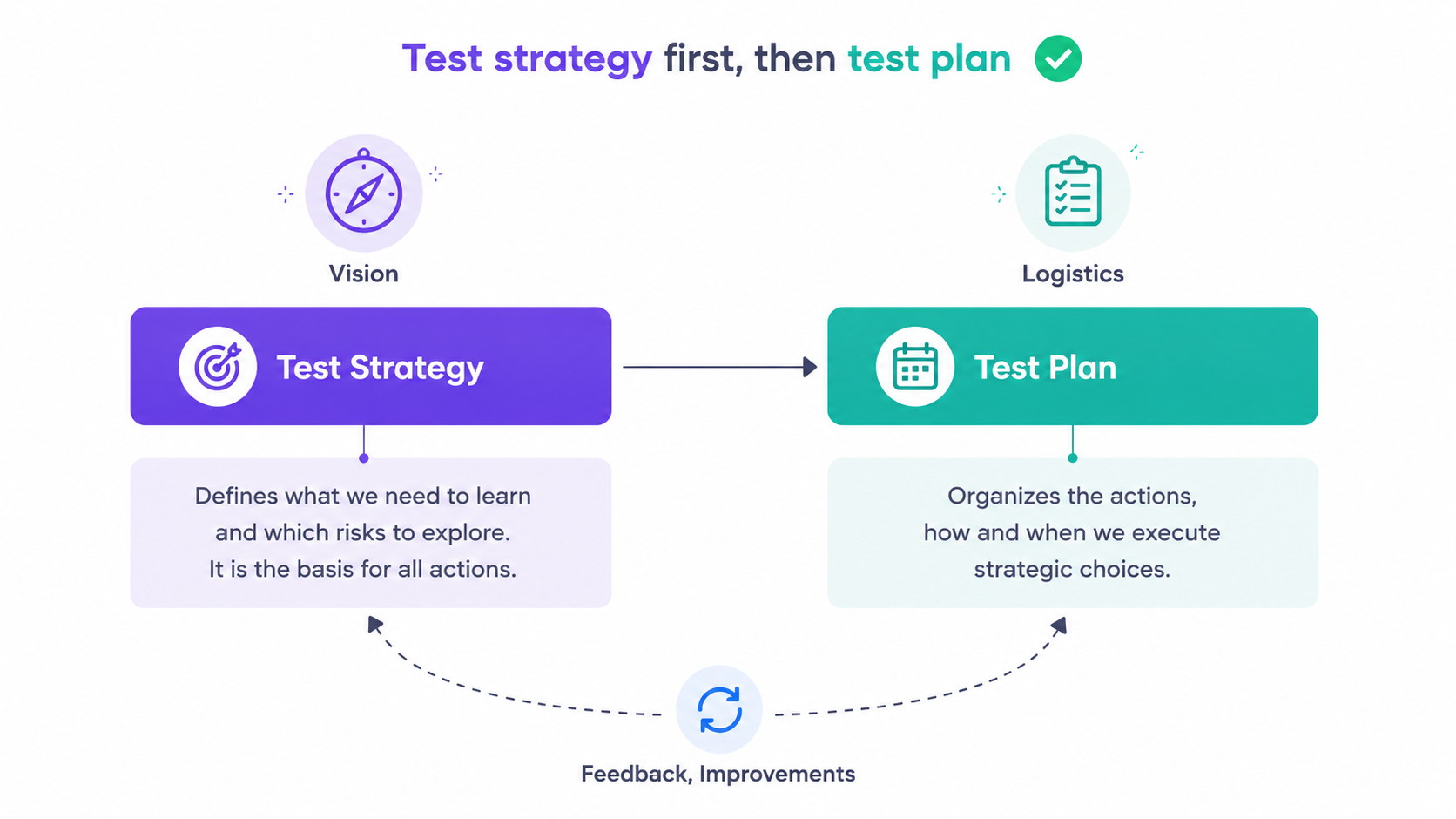
A test plan and a test strategy solve different problems. The test strategy sets the rules once, at the organization level; the test plan applies those rules to one release, with real dates and owners attached. Skip the strategy and every project reinvents its own testing philosophy. Skip the plan and the strategy never turns into shipped, tested software.
Teams that treat both as living documents catch more defects before release and spend less time arguing about what done means. Get the two working together, and testing stops being a bottleneck and starts being a release safeguard.
Frequently Asked Questions
How do test plans and test strategies contribute to quality assurance?
What level of detail do test plans and test strategies provide?
How do test plan and test strategy work together?

For related planning guidance, see creating a software test plan and test strategy vs test plan.