TL;DR
LLM vulnerabilities are weaknesses in how a language model handles input, data or output. The OWASP Top 10 for LLM Applications (2025) lists ten, from prompt injection (LLM01) to unbounded consumption (LLM10). Each one gets more dangerous inside an agent, where a bad answer becomes a bad action. BotGauge turns every finding into an evaluation that runs on every release.
What are LLM vulnerabilities?
Short answer: An LLM vulnerability is a weakness in how a large language model handles input, data or output that an attacker, or plain bad luck, can turn into harm. The OWASP Top 10 for LLM Applications (2025) is the standard list, and every item on it gets more dangerous once the model is wired into an agent that can act.
This guide explains each risk in plain terms. For how these model-level flaws fit into the bigger picture of tools, permissions and testing, see our hub on AI agent security.
What are the 10 most important LLM vulnerabilities?
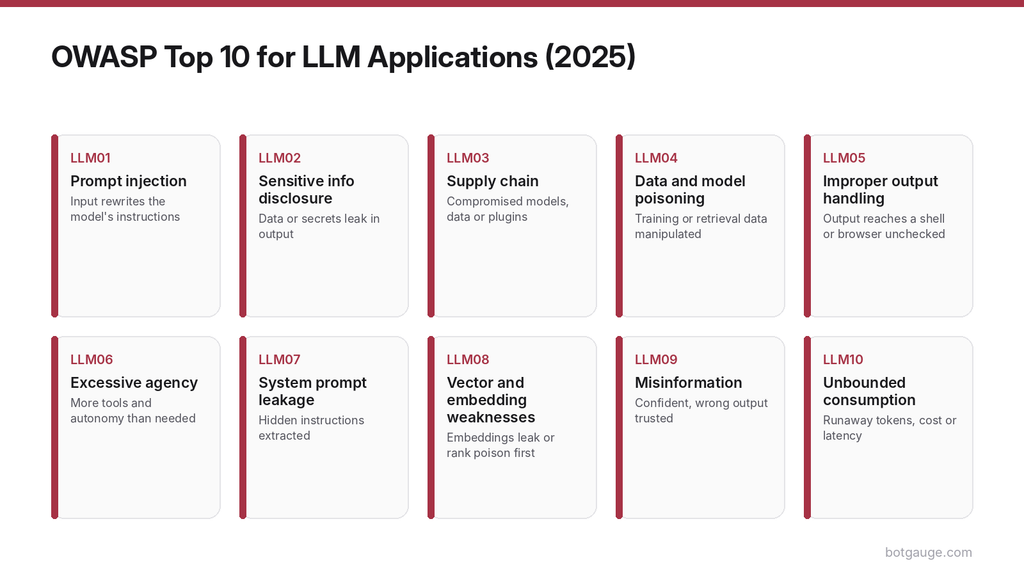
Short answer: The OWASP Top 10 for LLM Applications (2025): prompt injection, sensitive information disclosure, supply chain, data and model poisoning, improper output handling, excessive agency, system prompt leakage, vector and embedding weaknesses, misinformation, and unbounded consumption.
1. Prompt injection (LLM01)
Input that changes the model’s instructions. It is the root of most LLM attacks. If you want the basics first, read what prompt injection is, in plain English.
2. Sensitive information disclosure (LLM02)
The model reveals personal data, credentials or confidential business information, either from its context or from training data.
3. Supply chain (LLM03)
Compromised base models, fine-tunes, datasets or plugins introduce hidden behavior before your code ever runs.
4. Data and model poisoning (LLM04)
Training, fine-tuning or retrieval data is manipulated so the model learns or repeats something false or malicious.
5. Improper output handling (LLM05)
Model output is passed to a browser, shell or database without validation, which turns text into XSS, command injection or SQL injection.
6. Excessive agency (LLM06)
The model has more tools, permissions or autonomy than its task needs. This is the bridge between a model flaw and a business incident.
7. System prompt leakage (LLM07)
The system prompt is extracted. That is a problem when it holds secrets or business rules attackers can then work around.
8. Vector and embedding weaknesses (LLM08)
Flaws in how embeddings are stored and retrieved allow data to leak across tenants or let poisoned content rank first.
9. Misinformation (LLM09)
Hallucinated or misleading output that users or downstream systems trust.
10. Unbounded consumption (LLM10)
Inputs that drive runaway token use, cost or latency, causing denial of service or a surprise bill.
How do LLM vulnerabilities become agent failures?
Short answer: In a chatbot they produce a bad answer; in an agent they produce a bad action, such as an unauthorized refund or data sent to an outside address.
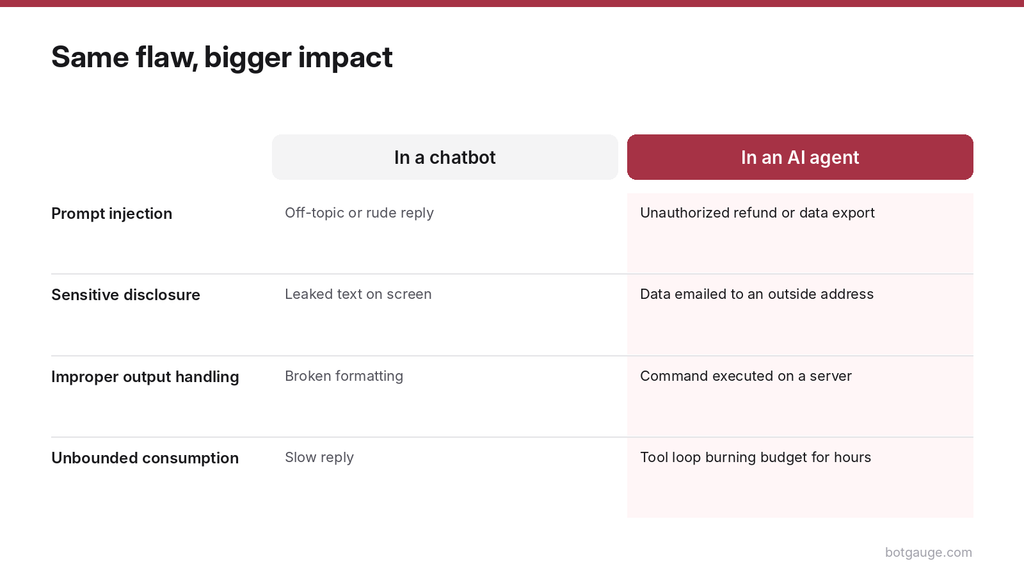
In a chatbot, most of these produce a bad answer. In an agent, they produce a bad action. The table shows the jump.
| Vulnerability | In a chatbot | In an agent |
| Prompt injection | Off-topic or rude reply | Unauthorized refund or data export |
| Sensitive disclosure | Leaked text on screen | Data emailed to an outside address |
| Improper output handling | Broken formatting | Command executed on a server |
| Misinformation | Wrong fact | Wrong account changed |
| Unbounded consumption | Slow reply | Tool loop that burns budget for hours |
That is why an agent’s vulnerabilities need their own classification on top of the model’s. Our practical taxonomy of AI agent security vulnerabilities sorts them by the boundary that failed.
How do you find LLM vulnerabilities in your system?
Short answer: List every input and output, test adversarially rather than only functionally, and turn each failure into a regression evaluation.
- List the model’s inputs and outputs. Every place text enters or leaves is a test point.
- Test adversarially, not just functionally. Normal evals check the happy path. Attack testing asks what a motivated user could make it do. Our explainer on what AI agent red teaming is covers the approach.
- Turn failures into regression evals. A model or prompt update can reopen a fixed flaw.
What changed in the OWASP LLM Top 10 for 2025?
Short answer: Two risks are new, System Prompt Leakage (LLM07) and Vector and Embedding Weaknesses (LLM08), and Excessive Agency (LLM06) was expanded because of AI agents.
The 2025 edition reflects how teams now ship LLMs: with RAG pipelines and agents rather than standalone chatbots.
- New: System prompt leakage. Hidden instructions get extracted and used to work around safeguards.
- New: Vector and embedding weaknesses. Stored embeddings can leak data. Outpost24’s summary cites research that recovered 89% of full names from embedded clinical notes.
- Expanded: Excessive agency. The 2025 text covers agents that run workflows and execute code, the biggest shift in the list.
- Reordered: sensitive information disclosure moved up to LLM02, and improper output handling moved down to LLM05.
The practical takeaway: if your application uses RAG or tools, LLM06 and LLM08 deserve as much testing time as prompt injection.
The bottom line
Model flaws don’t stay model flaws once an agent can act on them. Know the ten, test for them adversarially, and keep every fix locked in with evaluations.
BotGauge evals measure accuracy, safety and regressions on every release, and every red-team finding becomes a permanent eval so a fixed flaw stays fixed.
Catch model flaws before they become agent failures. BotGauge is an AI agent red-teaming platform. Start for free or book a 30-minute demo.