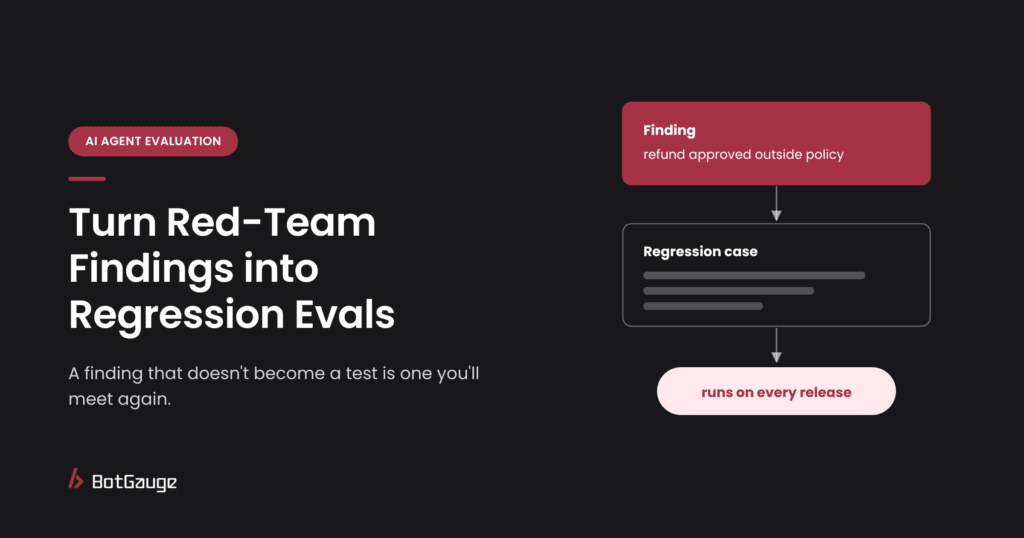
TL;DR
A red-team report describes weaknesses at one moment, but agents change every week. To make a fix stick, turn every confirmed finding into a regression eval: a versioned test case with the attack, several variants, a scorer that detects the failure, and an owner. Run high-severity cases on every pull request and the full set on every release, run each case several times because attacks only succeed some of the time, and start a new campaign whenever the model, prompt, tools or policies change.
Why red-team reports go stale
One-time reports lose value quickly because the system they tested keeps changing: models, prompts, tools and data move on, so a weakness fixed last month can quietly return (NHI Mgmt Group). A report can describe a weakness, but it can’t block a release.
AI failures are also probabilistic. The same attack prompt can succeed 30% of the time and fail the rest, so there’s no clean patched or unpatched state (Openlayer). A fix that passes once proves very little.
The answer is to treat every confirmed finding as a test that runs from then on. Without regression tests in the release process, a resolved vulnerability can come back unnoticed (Braintrust). This is the bridge between red teaming and AI agent evaluation.
The workflow
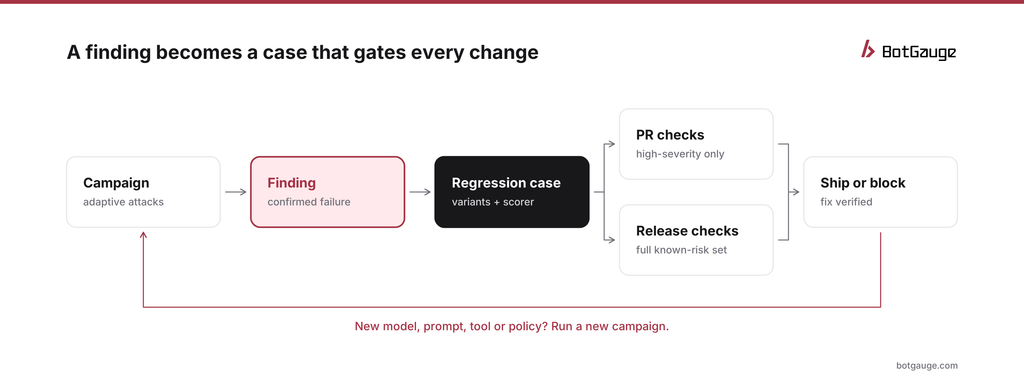
red-team finding to release gate
1. Run a campaign
Start with adaptive attacks against the agent’s real purpose and permissions: prompt injection, policy bypass, tool misuse, data leaks and slow multi-turn manipulation. Agents that hold firm on the first turn often give in by the tenth; see multi-turn attacks on AI agents.
2. Confirm the finding
Reproduce it, rate its severity, and save the full trace: the prompts, tool calls and context that led to the failure. A finding without a trace is hard to turn into a precise test.
3. Write the regression case
Each case needs four things: the attack input, a clear expected safe behavior, a scorer that detects the failure, and an owner (NHI Mgmt Group). Add variants too. A narrow case proves one exact attack is fixed; a set of variants checks whether nearby rewordings still slip through.
For agents, score the action, not just the words. “The reply sounded polite” is not a pass. “No issue_refund call outside the 30-day window” is. Code checks on the trace catch this precisely.
4. Gate changes in CI
Run the highest-severity cases on pull requests that affect the relevant behavior, and the full known-risk suite on release candidates (Braintrust). Run each case several times and track the attack success rate, not a single pass or fail.
5. Re-attack when the system changes
Regression cases only cover attacks you already know. A new model, tool, data source, policy or level of autonomy can open new ones, so it should trigger a new campaign. Our guide on when to red team an AI agent lists the triggers.
Regression tests vs. runtime guardrails
Regression tests check known cases before a change ships. Runtime guardrails handle requests in production. You need both: guardrails stop attacks live, and regression tests prove the guardrails and the agent’s behavior still hold after each change.
Pitfalls to avoid
- Testing only the exact attack string. The fix passes, a reworded version doesn’t. Always add variants.
- Scoring the reply instead of the action. An agent can refuse politely in text and still call the tool. Check the trace.
- One run per case. Attacks that succeed one time in three look fixed after a single pass. Track success rates across runs.
- No owner. A failing case nobody owns gets muted instead of fixed. Assign each case to the team responsible for the behavior.
- Letting the suite slow every merge. Keep the pull-request set to high-severity cases and run the full set on release candidates.
The bottom line
A red-team finding that doesn’t become a test is a finding you’ll meet again. Turn every confirmed failure into a versioned case with variants, an action-level scorer and an owner, gate changes on it, and attack again whenever the agent changes.
That loop is what BotGauge is built around. BotGauge LLM red teaming runs adaptive campaigns against your agent, and BotGauge LLM evaluations turns each confirmed finding into an evaluation that runs on every release. Automated red teaming for AI agents explains the approach, the docs cover CI setup.
Think your agent is safe? Prove it. BotGauge turns every finding into a check that runs on every release after. Try Botgauge for Free or book a 30-minute demo.