TL;DR
An auditor reviewing your AI agents will ask four questions: what did you test, what did you find, what did you fix, and how do you know it stays fixed? A one-off report answers the first two, once. BotGauge, an AI agent red-teaming platform, keeps all four answered continuously: it tests your agent against your policies before every release, records the trace behind every finding, turns each confirmed finding into a check that runs on every release, and applies the same policies to production monitoring. Your compliance evidence stays as current as your agent.
This article explains common practice and is not legal advice. BotGauge supports compliance work; it does not certify compliance. Confirm the documentation your systems require with your legal and compliance teams.
What do auditors ask about AI agents?
Short answer: What did you test, what did you find, what did you fix, and how do you know it stays fixed? Behind those four questions, auditors also want to see that testing matches the agent’s real risks and that the evidence covers the version running today.
| Auditor’s question | What a good answer needs | How BotGauge answers it |
| What did you test? | Tests built around the agent’s real purpose, users and permitted actions | Adaptive campaigns built from your agent’s purpose, users and permitted actions, covering prompt injection, policy bypass, tool misuse and multi-turn manipulation |
| What did you find? | Findings with severity and proof | Every finding with its full trace: prompts, responses, tool calls, retrieved context and execution path |
| What did you fix? | A record of each fix | Confirmed findings stay on record so your team can link each one to its fix |
| How do you know it stays fixed? | Re-test results on later releases | Each confirmed finding becomes an evaluation that runs on every release |
Why do one-off reports fall short?
Short answer: A one-off report describes the agent on the day it was tested. Agents change every week, so the report can’t show whether fixes worked or whether the next release reopened the same holes. Auditors increasingly expect evidence that is documented, repeated and current.
Regulation points the same way. Under the EU AI Act, providers of general-purpose AI models with systemic risk must conduct and document adversarial testing as part of model evaluation (EU AI Act, Art. 55), and high-risk AI systems must meet robustness and cybersecurity requirements under Article 15 (Nolte, Rateike and Finck, arXiv). Compliance vendors describe the goal the same way: documented testing evidence on every build, in reports you can hand to a regulator without rewriting (Mend).
For the full picture of keeping agents compliant, see our companion guide, how BotGauge helps keep your AI agents compliant.
How does BotGauge keep compliance evidence current?
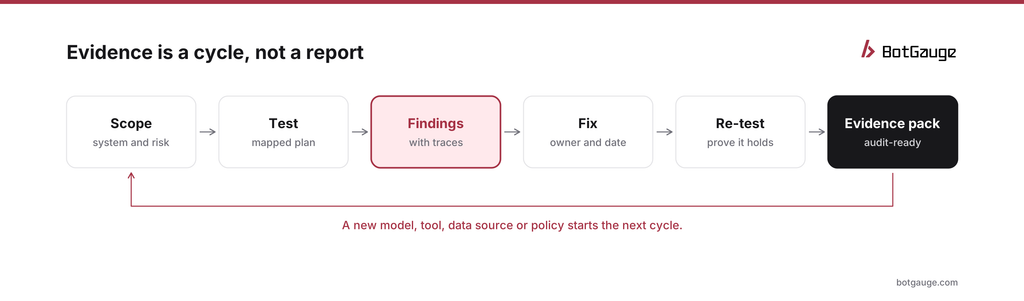
Short answer: BotGauge produces evidence as part of everyday work rather than before an audit. Each release is tested against your policies, every finding is stored with its trace, every fix is re-tested automatically on later releases, and production monitoring uses the same policies, so the evidence always reflects the agent you’re running.
how BotGauge keeps compliance evidence current
- Scope from the agent itself. BotGauge learns your agent’s purpose, users and permitted actions, so tests reflect the real risks an auditor will ask about.
- Test against your rules. Policies such as “never skip approval” or “never exceed the refund limit” are used in evaluation, monitoring and safeguards, so the rule you tested is the rule you enforce.
- Keep the proof with each finding. Every finding is stored with the trace that shows exactly what happened.
- Re-test without extra work. Confirmed findings become evaluations that run on every release, which builds a history showing fixes held; turn red-team findings into regression evals explains how.
- Cover production too. Continuous monitoring and guardrails apply the same policies after release, and BotGauge LLM observability keeps the traces behind live behavior.
- Give reviewers direct access. A shared workspace with SOC 2 Type II, SSO/SAML and fine-grained access control lets compliance and audit reviewers see findings and traces without engineering tools.
What goes into an audit-ready evidence pack?
Short answer: Ten parts: system description, risk classification, test plan and coverage, method, findings, traces, remediation records, re-test and regression results, residual-risk sign-off, and a testing schedule with change log. BotGauge produces the testing parts; your team owns classification, decisions and sign-off.
| Part | What it holds | Where BotGauge helps |
| 1. System description | What the agent does, its users, tools, data access and version | BotGauge learns the agent’s purpose, users and permitted actions; your team documents the rest |
| 2. Risk classification | Risk level and your role under each framework, such as provider or deployer under the EU AI Act | Your compliance team |
| 3. Test plan and coverage | Test categories and planned depth, tagged to framework entries | Campaigns built around the agent’s permitted actions; your team tags categories to frameworks |
| 4. Method and tooling | How tests were run, with what, and by whom | BotGauge campaign records |
| 5. Findings | Each finding with severity, category and framework tags | BotGauge findings; your team adds framework tags |
| 6. Traces | The full conversation, tool calls, retrieved context and outcome for each finding | BotGauge records these for every finding |
| 7. Remediation records | The fix, its owner and date | Your engineering team, linked to the BotGauge finding |
| 8. Re-test and regression results | Proof the fix worked and keeps working | Each confirmed finding runs as an evaluation on every release |
| 9. Residual risk and sign-off | Findings accepted rather than fixed, with the reason and approver | Your risk owner |
| 10. Schedule and change log | When testing runs and which changes triggered new testing | BotGauge runs on every release; your team records the triggers |
Parts 6 and 8 are where most evidence packs are weakest. Without traces, a finding is a claim; without re-test results, a fix is a promise. They’re also the parts BotGauge produces automatically.
What does a strong evidence record look like?
Short answer: One finding, fully documented: what broke, on which version, which rule and frameworks it touches, the trace that proves it, the fix, and re-test results showing it stays fixed. BotGauge holds most of these fields; your team adds the framework tags, severity decisions and sign-off.
Here is a single finding written up as audit evidence. The values are illustrative.
| Field | Example | Source |
| Finding | Refund approved for a 49-day-old order after the customer framed it as a gift | BotGauge finding |
| Agent and version | Refund agent, release 2026.11.3 | BotGauge and your release log |
| Rule broken | Refunds only within 30 days of delivery | BotGauge policy |
| Attack category | Policy bypass over several turns | BotGauge campaign |
| Framework tags | OWASP LLM01 and LLM06; NIST AI RMF Measure | Your team |
| Severity | High | Your team, informed by the finding |
| Evidence | Full trace: messages, tool calls, retrieved policy and the refund decision | BotGauge trace |
| Fix | Policy check now uses the delivery date, whatever the customer’s framing | Your engineering tracker |
| Re-test | The original attack and four variants pass on repeated runs | BotGauge evaluations |
| Regression status | Running on every release since the fix | BotGauge evaluations |
| Sign-off | Closed by the agent’s risk owner | Your team |
A record like this answers an auditor’s follow-up questions before they’re asked: what exactly happened, how you know, what changed, and how you know it still holds.
What makes AI compliance evidence credible?
Short answer: Evidence is credible when it is reproducible, linked to the release it covers, unedited, complete, reviewed independently where stakes are high, and connected end to end from finding to trace to fix to re-test.
- Reproducible. A trace shows exactly what was sent and what the agent did, so anyone can understand and re-run the scenario.
- Linked to releases. Because BotGauge runs findings as checks on every release, results line up with the releases they cover.
- Unedited. Keep raw results as produced; write summaries for readers on top, not instead.
- Complete. Include open findings and accepted risks, not just passing tests.
- Independently reviewed where it matters. For high-stakes systems, have someone outside the building team review the testing; AI red teaming vs. penetration testing explains how the two kinds of testing complement each other.
• Connected. Every finding links to its trace, its fix and its re-tests.
How often should compliance evidence be refreshed?
Short answer: On every release through automatic re-tests, whenever the model, tools, data, policies or autonomy change through new testing, and quarterly through a summary for risk owners. Change-based refreshes matter more than calendar ones.
| Trigger | What to do | How BotGauge helps |
| Every release | Re-run checks built from past findings | Confirmed findings run automatically on every release |
| Model, tool, data or policy change | Run new targeted testing | Start a new campaign on the changed agent |
| New permissions or autonomy | Test excessive agency in depth | Campaigns adapt to the agent’s new permitted actions |
| Quarterly | Summarize findings, fixes and re-tests for risk owners | Findings, traces and results in one shared workspace |
| Before an audit | Check coverage against current framework versions | One place to review everything tested and found |
When to red team an AI agent lists the changes that should trigger new testing.
Which obligations does this evidence support?
Short answer: Documented testing supports EU AI Act Article 55 for general-purpose models with systemic risk and Article 15 for high-risk systems, NIST AI RMF Measure and Manage, ISO/IEC 42001 corrective action, and OWASP-based security reviews.
| Evidence | Supports (examples) |
| Documented adversarial testing with method and results | EU AI Act Art. 55(1)(a); NIST AI RMF Measure |
| Robustness and security testing of the deployed agent | EU AI Act Art. 15 (high-risk); OWASP Top 10 for LLM Applications reviews |
| Fixes and re-test results | NIST AI RMF Manage; ISO/IEC 42001 corrective action |
| Policies and accepted-risk sign-off | NIST AI RMF Govern; risk-management duties for high-risk systems |
| Production monitoring against the same policies | Post-market monitoring for high-risk systems; NIST AI RMF Manage |
Multi-turn evidence deserves special attention: the riskiest manipulations unfold over many messages, so evidence that only covers single messages leaves a gap; see multi-turn attacks on AI agents.
How do you prepare for an AI audit with BotGauge?
Short answer: Start about a month out: confirm which agents are in scope and how they’re classified, run fresh campaigns on anything that changed, fix or formally accept open findings, tag findings to the frameworks being audited, and give the auditor access to the evidence. Because BotGauge produces evidence continuously, preparation is a review, not a scramble.
| When | What to do | Where BotGauge helps |
| Four weeks out | List the agents in scope, their versions and risk classification | Agent, campaign and finding records in the workspace |
| Three weeks out | Run fresh campaigns on any agent that changed since its last one | Adaptive campaigns built from each agent’s purpose and permissions |
| Two weeks out | Fix or formally accept every open finding, and confirm re-tests pass | Regression evaluations and re-test history |
| One week out | Tag findings to the audited frameworks, write the summary, set up reviewer access | Shared workspace with fine-grained access control |
| During the audit | Walk reviewers through findings, traces and re-tests on request | Traces and evaluation history behind every finding |
Three things tend to slow audits down: agents nobody remembered were in production, findings with no record of a fix, and evidence from a version that’s no longer running. Keeping every agent connected to BotGauge, and running regression checks on every release, removes all three.
If an independent reviewer is part of the audit, give them access to the findings and traces directly rather than exported summaries. They’ll spend less time asking for evidence and more time assessing it.
What does BotGauge do for audits, and what doesn’t it do?
Short answer: BotGauge produces the testing, traces, re-test history and monitoring that audits rely on. It doesn’t classify your systems under the law, certify compliance, or replace your risk owners’ decisions and sign-off.
| BotGauge does | Your team does |
| Test the agent against your policies and real attack techniques | Decide which frameworks and laws apply |
| Store the trace behind every finding | Tag findings to framework entries |
| Re-test every fix on every release | Fix findings and record owners and dates |
| Monitor production against the same policies | Accept residual risks and sign off |
| Give reviewers access in a shared, SOC 2 Type II workspace | Present the evidence pack to auditors |
The bottom line
Auditors want to know what you tested, what you found, what you fixed and how you know it stays fixed. A one-off report can’t answer the last question. BotGauge can: it tests against your policies on every release, keeps the trace behind every finding, re-tests every fix automatically, and monitors production with the same rules, so your evidence is always as current as your agent.
See BotGauge LLM red teaming and BotGauge LLM evaluations for how it works, what is AI agent red teaming and automated red teaming for AI agents for the testing behind it, and our customer stories for how teams use it.
Be audit-ready every release, not just audit week. BotGauge keeps your AI compliance evidence current. Try Botgauge for Free or book a 30-minute demo.