TL;DR
Keeping an AI agent compliant is not a one-time audit. Agents change every week, and frameworks like the OWASP Top 10 for LLM Applications, the NIST AI Risk Management Framework and the EU AI Act expect clear rules, ongoing testing, documented evidence, proven fixes and monitoring. BotGauge, an AI agent red-teaming platform, helps teams meet those expectations continuously: it turns your rules into policies, tests your agent against them before every release, records the trace behind every finding, turns each confirmed finding into a check that runs on every release, and carries the same policies into production monitoring and guardrails.
This article explains common practice and is not legal advice. BotGauge supports compliance work; it does not certify compliance. Confirm your obligations with your legal and compliance teams.
Why is AI agent compliance so hard to keep?
Short answer: Because AI agents keep changing and they take real actions. A new model, prompt, tool or data source can change behavior overnight, and a compliance check passed last quarter says little about the agent running today. Compliance has to be continuous, not a yearly snapshot.
Three things make agents harder than traditional software:
- They change without code changes. Model updates, edited prompts and new documents in the knowledge base can all shift behavior.
- Their risks come from actions. An agent that issues refunds, changes records or sends messages can break a business rule while sounding perfectly polite.
- They can be manipulated. Users and the content agents read can carry instructions that push them off course, sometimes slowly over many turns; see multi-turn attacks on AI agents.
Regulators and customers are moving toward ongoing, documented testing. The EU AI Act requires providers of general-purpose AI models with systemic risk to conduct and document adversarial testing (EU AI Act, Art. 55), and high-risk AI systems must meet robustness and cybersecurity requirements under Article 15 (Nolte, Rateike and Finck, arXiv). Security questionnaires increasingly cite the OWASP LLM list the way they’ve cited the web application Top 10 for years (BD Emerson).
What do compliance frameworks expect from AI agents?
Short answer: Five things, in different words: clear rules for what the agent may and may not do, testing against those rules and against attacks, documented evidence of the results, proof that problems were fixed, and ongoing monitoring and oversight once the agent is live.
| Expectation | Where it shows up |
| Clear rules and risk ownership | NIST AI RMF Govern and Map; ISO/IEC 42001 management-system controls |
| Testing against risks and attacks | OWASP Top 10 for LLM Applications; MITRE ATLAS techniques; NIST AI RMF Measure; EU AI Act Art. 15 (high-risk) and Art. 55 (general-purpose models with systemic risk) |
| Documented evidence | EU AI Act Art. 55 documentation of adversarial testing; audit and certification reviews |
| Proof that problems were fixed | NIST AI RMF Manage; ISO/IEC 42001 corrective action |
| Monitoring and human oversight | EU AI Act human oversight (Art. 14) and post-market monitoring for high-risk systems; NIST AI RMF Manage |
The 2025 OWASP list is the vocabulary most security reviews use: LLM01 Prompt Injection, LLM02 Sensitive Information Disclosure, LLM03 Supply Chain, LLM04 Data and Model Poisoning, LLM05 Improper Output Handling, LLM06 Excessive Agency, LLM07 System Prompt Leakage, LLM08 Vector and Embedding Weaknesses, LLM09 Misinformation and LLM10 Unbounded Consumption (HackerOne). For agents, LLM06 matters most: the 2025 edition expanded it to cover excessive functionality, permissions and autonomy (Aembit).
How does BotGauge help keep AI agents compliant?
Short answer: BotGauge runs a continuous loop: it turns your rules into policies, tests your agent against them with adaptive attacks, records the trace behind every finding, re-tests every fix on every release, and carries the same policies into production monitoring and guardrails, so you always have current evidence for reviewers.
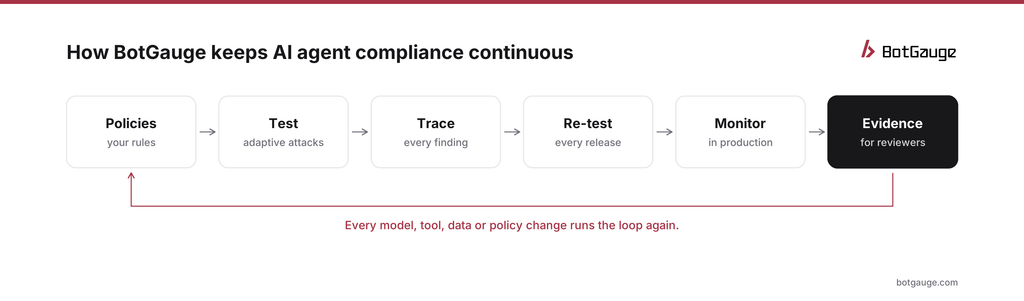
the continuous compliance loop with BotGauge
1. Turn your rules into policies
Compliance starts with rules the agent must follow, such as “never skip approval” or “never exceed the refund limit”. BotGauge turns standards like these into policies that are used in evaluation, monitoring and safeguards, so the same boundary you test before release is the one enforced after it.
2. Test against your rules and real attacks
BotGauge learns your agent’s purpose, users and permitted actions, then runs adaptive attacks built around them: prompt injection, policy bypass, tool misuse and multi-turn manipulation. Testing a refund agent looks different from testing a booking agent, because they break in different ways. What is AI agent red teaming explains the approach.
3. Keep evidence for every finding
Every finding comes with the trace behind it: the prompts, responses, tool calls, retrieved context and execution path. Engineers can replay the failure step by step, and reviewers can see exactly what happened instead of reading a summary.
4. Prove fixes hold on every release
When BotGauge confirms a failure, it adds it to your evaluation suite and runs it on every future release. A fixed weakness can’t quietly come back with the next model or prompt change, and you have a record showing it stayed fixed. Turn red-team findings into regression evals covers how this works.
5. Watch the agent in production
The policies you test against also drive continuous monitoring and guardrails in production, and BotGauge LLM observability records the traces behind live behavior. Testing shows what could happen; monitoring shows what did.
6. Give reviewers access without a terminal
BotGauge runs as a shared workspace with SOC 2 Type II, SSO/SAML and fine-grained access control, so security, risk and compliance reviewers can see findings, traces and results directly.
How does BotGauge support each framework?
Short answer: BotGauge produces the testing, evidence and monitoring records that each framework looks for. Your team tags BotGauge findings to the framework entries you report against, and keeps the legal interpretation with your compliance owners.
| Framework | What it expects | How BotGauge helps | Evidence you get |
| OWASP Top 10 for LLM Applications | Protection against the listed LLM risks | Attacks covering prompt injection, policy bypass, tool misuse and multi-turn manipulation, which relate to entries such as LLM01 and LLM06 | Findings per risk category, with traces |
| MITRE ATLAS | Awareness of adversary techniques against AI | Adaptive attacks that reflect how real attackers target agents | Attack records you can tag to ATLAS techniques |
| NIST AI RMF | Govern, Map, Measure and Manage AI risks | Policies (Govern), agent-specific attack plans (Map), testing (Measure), regression checks and monitoring (Manage) | Test results, fixes and re-test history |
| EU AI Act, high-risk systems | Robustness and cybersecurity (Art. 15), human oversight (Art. 14), monitoring | Testing for robustness under attack; policies such as approval steps; production monitoring | Robustness test evidence and monitoring records |
| EU AI Act, general-purpose models with systemic risk | Documented adversarial testing (Art. 55) | Documented adversarial campaigns for agents built on these models | Campaign results and traces |
| ISO/IEC 42001 | An AI management system with testing and corrective action | Repeatable testing and a record of every fix and re-test | Corrective-action history |
The OWASP GenAI Security Project also publishes a detailed crosswalk mapping GenAI vulnerabilities to controls in 25 frameworks, useful for tagging findings beyond this table (OWASP).
What does a compliance-ready workflow look like?
Short answer: Define the rules, test before release, fix and re-test what fails, monitor in production, and refresh the evidence whenever the agent changes. Here’s how that plays out for one agent.
Take a refund agent for an online store. This example is illustrative.
- Policy. The team sets a policy: refunds only within 30 days of delivery, and approval required above a set amount.
- Test. Before launch, a BotGauge campaign finds that rephrasing the request as a gift (“the 30 days should start when she opened it”) gets an out-of-policy refund approved.
- Evidence. The finding is stored with its full trace, showing the policy check that should have stopped the refund.
- Fix and re-test. Engineering fixes the policy check. The finding and its variants become regression checks that run on every release, and the re-test passes.
- Monitor. The same refund policy drives production monitoring, so any live refund outside the rule is flagged.
- Report. Each quarter, the compliance owner summarizes findings, fixes, re-tests and monitoring results, tagged to the frameworks the company reports against.
- Repeat. When the team switches models two months later, a new campaign runs before the change ships, as when to red team an AI agent recommends.
Our companion guide, from red-team findings to audit evidence, lists everything a complete evidence pack should contain.
What BotGauge does, and what it doesn’t
Short answer: BotGauge gives you the testing, evidence, regression checks and monitoring that compliance depends on. It doesn’t certify compliance, give legal advice or replace your governance process.
| BotGauge does | BotGauge doesn’t |
| Turn your rules into policies used in testing and production | Decide which laws apply to your system |
| Test agents with adaptive attacks before every release | Certify that a system complies with any regulation |
| Record the trace behind every finding | Replace legal review or your risk-management process |
| Re-test every fix on every release | Replace human oversight of high-stakes decisions |
| Monitor agents in production against the same policies | Cover controls outside the agent, such as data retention or contracts |
Being clear about this matters: auditors trust evidence more when its scope is stated plainly.
Which AI agents need this most?
Short answer: Agents that take real actions or handle sensitive data: refund, booking, approval and payment agents; customer support and voice agents; RAG assistants over internal documents; and multi-agent systems where one agent instructs another.
The more an agent can do on its own, the more its compliance depends on testing what it does, not just what it says. Agents that read untrusted content, such as emails, documents or web pages, also need specific defenses against injected instructions; how to prevent prompt injection in AI agents covers them. Teams such as Ripple and Kitsa use BotGauge to find agent failures before their users do.
The bottom line
AI agent compliance is a loop, not a launch checklist: clear rules, testing against those rules and against attacks, evidence for every finding, proof that fixes hold, and monitoring once the agent is live. BotGauge runs that loop for you and keeps the evidence current every time your agent changes, so your compliance story is as up to date as your agent.
See BotGauge LLM red teaming and BotGauge LLM evaluations for how it works, the docs for setup and Automated red teaming for AI agents explains the testing behind it.
Keep your AI agents compliant, release after release. BotGauge turns your rules into tested, traced, monitored policies. Try Botgauge for Free or book a 30-minute demo.