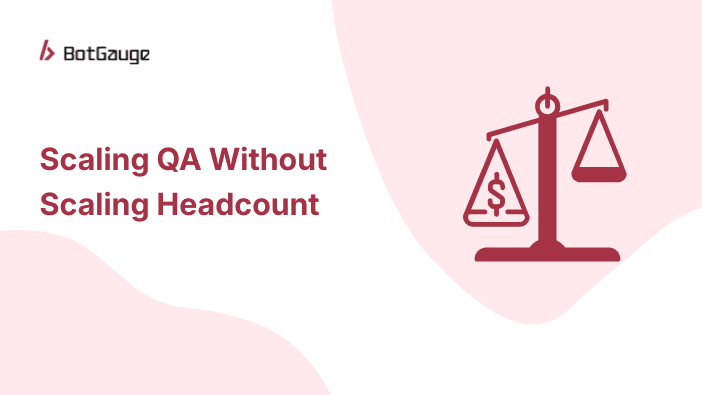
When a small QA team falls behind, the instinct is always the same: open a requisition. But the math of the hiring reflex rarely works. An SDET costs $120k to $150k+ per year before benefits and takes three to six months to hire, and by the time they are productive, the product has grown past the capacity they added. The team is bigger and the backlog is bigger too. That is not bad luck. It is linear math applied to a compounding problem.
This piece makes one argument: small QA teams do not fail to scale because they are small. They fail because testing work compounds while headcount only adds, and the way out is to change who owns the work, not how many people share it.
Why can’t small QA teams scale?
Small QA teams cannot scale because their workload grows super-linearly while their capacity grows linearly. Every new feature adds tests to write, and every UI or workflow change breaks tests that already exist, so the maintenance burden compounds with the size of the suite. A two-person team maintaining 300 tests spends most of its week keeping old tests alive rather than covering new features. Adding one more person adds fixed capacity to a compounding problem, which is why hiring alone never closes the gap.
The maintenance tax: why QA work compounds
The core of the scaling problem is a cost that never appears in any budget. Call it the maintenance tax: every automated test a small team writes is not just an asset, it is a liability the same team must service for as long as it exists. The suite you celebrated at 200 tests is a standing obligation by test 400.
Here is the arithmetic that makes it a tax rather than a chore. Suppose each test in your suite has even a 2% chance of breaking in any given sprint, because a selector changed, a flow moved, or a dependency shifted. At 100 tests, that is two repairs a sprint. At 500 tests, it is ten. The repair work grows with the size of the suite, while the team’s hours do not grow at all. Coverage and maintenance are the same curve; one just lags the other.
The industry numbers show how far behind teams already are. The 2025-26 World Quality Report puts average test automation coverage at just 33%, with only 8% of organizations reporting a fully established automation strategy. In other words, teams are paying the maintenance tax on a third of the coverage they actually need, and the tax compounds before the coverage does. Meanwhile the cost of what slips through is enormous: CISQ estimates poor software quality costs the US at least $2.41 trillion a year.
This is why the QA bottleneck feels permanent no matter what a small team does. Any hour spent writing a new test creates future maintenance hours, and any hour spent on maintenance is an hour of coverage not written. The team closest to the problem is structurally unable to get ahead of it.
The three ways teams try to scale QA, and why each fails
Faced with the maintenance tax, teams reach for one of three fixes. Each buys a different input; none changes who carries the compounding work.
1. Hire more QA engineers. Hiring buys labor. It is the most expensive input and it scales exactly linearly: double the coverage need, double the payroll. Worse, new hires inherit the existing maintenance tax before they add anything new. By the time a new SDET is productive, a meaningful share of their week already belongs to the suite that predates them.
2. Outsource to a QA services firm. Outsourcing buys someone else’s labor. The economics are the same linear trade with a markup: you pay for testers or project hours, onboarding takes months, and the workflow becomes ticket-driven. Manual verification keeps pace with neither daily deploys nor the regression load of a fast-changing product.
3. Buy an AI-only testing tool. AI tools buy generation speed, which is real, and then quietly hand the rest back. Nobody validated the generated tests, so your team triages false positives. The tool does not maintain what it created, so your team tunes prompts and fixes brittle output. The generation problem gets solved; the ownership problem does not move an inch.
Notice the pattern. All three purchases are denominated in effort: salaried, billed, or licensed. None of them is denominated in the thing you actually want, which is trustworthy coverage that stays alive as the product changes.
Comparing the four paths to QA scale
The difference between the options is not features; it is where the compounding work lands.
| Hire an SDET | QA services firm | AI-only tool | Outcome-owned autonomous QA | |
|---|---|---|---|---|
| What you buy | Labor | Someone else’s labor | Generation speed | Coverage as an outcome |
| Upfront cost | $120k-150k+ per SDET | Project hours or dedicated fees | $10k-50k+ per year in licenses | Typically a fraction of one QA salary |
| Time to value | 3-6 month hiring cycle | Months of onboarding | Weeks of configuration | Days to weeks |
| Who maintains tests | Your team, forever | Their testers, ticket by ticket | Your team, hidden in triage and prompt tuning | The provider, via self-healing plus expert review |
| Validation | The same overloaded team | Manual, ticket-driven | Often none; output ships unverified | Human sign-off on every test |
| Scales with product | Linearly with headcount | Linearly with billed hours | Poorly; maintenance grows with suite size | Coverage grows without team growth |
| Who owns the outcome | You | You | You | The provider |
The real lever: ownership, not labor
All three traditional fixes share one assumption: that QA scale is purchased in units of effort. The assumption is wrong. Coverage is the goal, and ownership is the lever. A small team scales the moment the compounding parts of the work, meaning generation, validation, and above all maintenance, stop being its responsibility, regardless of how many people it has.
That is the structural definition of the autonomous QA category that has emerged over the last two years, sometimes called Autonomous QA as a Solution (AQaaS): AI generates tests from product context, human experts validate them before they run, self-healing absorbs the routine breakage, and the provider is accountable for the coverage rather than the hours. The important part is not the acronym. It is the accounting change: maintenance moves off your team’s balance sheet entirely.
There is a useful test for whether any option, including this one, actually changes your scaling math. Ask one question of every spend: after this money is spent, who owns the compounding work? If the answer is still your team, you bought capacity, not scale.
A scaling playbook for a two-person QA team
Whatever model you choose, the sequence below stops the compounding first and buys capacity second.
- Measure the maintenance tax. For two weeks, log hours spent fixing existing tests versus writing new coverage. Most small teams find upkeep consumes more than half their capacity, and this number is the business case for everything that follows.
- Rank flows by cost of failure, not ease of testing. Login, checkout, payments, and the workflows unique to your product come first. Coverage breadth means nothing if the revenue path is thin.
- Stop hand-writing tests for stable flows. Human effort belongs on exploratory testing and genuinely novel paths; generation of routine coverage is now a solved problem.
- Make self-healing a requirement, not a feature. If the suite cannot survive a UI change without human hours, you are still paying the tax, whatever the tool’s brochure says.
- Buy outcomes, not inputs. Evaluate every option, hire, firm, tool, or managed model, on the ownership question above.
Where BotGauge fits
BotGauge is built on exactly this ownership model. AI agents read your PRDs, UX flows, and demo videos and generate context-aware tests for functional, UI, and API workflows. A dedicated domain FDE pod reviews and signs off every test before it runs. Self-healing updates tests automatically when the product changes, and everything runs in your CI/CD pipeline on every commit with unlimited parallelization. Pricing is tied to coverage outcomes delivered, not headcount or licenses, so the compounding work sits with BotGauge rather than your team.
The field results match the theory. Kitsa’s co-founder and CTO put it directly: instead of scaling QA headcount, they scaled automation with BotGauge, and got higher coverage, lower cost, and faster releases. Atlas went from kickoff to coverage in three weeks and reported 94% fewer production incidents. Critical flows are typically automated in 48 hours, with around 80% coverage in 14 days.
The takeaway
A small QA team is not a staffing problem waiting for budget. It is a structural problem: the work compounds and the team does not, so every unit of effort purchased, whether salaried, outsourced, or licensed, is eventually consumed by the maintenance tax. Scaling QA means moving generation, validation, and maintenance off the team entirely, and keeping human judgment where it earns its cost. The teams that scale are not the ones that hired fastest. They are the ones that stopped owning work a machine and a dedicated expert could own for them.
Frequently Asked Questions
How do I scale QA without hiring?
What is the maintenance tax in test automation?
How many QA engineers do I need per developer?
Is outsourcing QA better than hiring in-house?
What is Autonomous QA as a Solution (AQaaS)?

For related guidance on building your QA function, see choosing a QA partner and hiring QA engineers. Our full breakdown on QA outsourcing covers this in more depth, or explore BotGauge directly.
For related guidance on building your QA function, see choosing a QA partner and hiring QA engineers. Our full breakdown on QA outsourcing covers this in more depth, or explore BotGauge directly.